Jamnalal Bajaj (4 November 1889 – 11 February 1942) was an Indian businessman, freedom fighter and philanthropist, the founder of the Bajaj group. A wealthy merchant of Wardha, he asked Mahatma Gandhi to accept him as a son, served as treasurer of the Indian National Congress for two decades, and brought Gandhi to settle at Wardha. He regarded his fortune as a trust to be spent on the country.
Quick Facts
| Full name | Jamnalal Bajaj |
| Born | 4 November 1889, Kashi ka Bas, Sikar, Rajasthan |
| Died | 11 February 1942, Wardha, Maharashtra (aged 52) |
| Community | Marwari |
| Occupation | Businessman, freedom fighter, philanthropist |
| Founded | The Bajaj group (1926) |
| Offices | Treasurer of the Indian National Congress |
| Spouse | Jankidevi Bajaj |
| Children | 5 |
Early Life
He was born into a poor family in a village near Sikar in Rajputana. When he was about four, Seth Bachhraj, a rich Marwari banker and cotton merchant of Wardha in central India, and his wife saw the child and asked to adopt him as their grandson. He was taken to Wardha and brought up as the heir.
He had little formal schooling. He was married at twelve to Jankidevi. At seventeen, after a quarrel in which the old man taunted him about his dependence, he wrote out a renunciation of the inheritance and left the house. Bachhraj relented. Jamnalal inherited the business on his death in 1907, and in later life gave to charity a sum equal, with interest, to what he had received, considering that he had no right to it.
The Seeker
He went from one holy man and public figure to another, looking for a guide. In 1915 he met Mahatma Gandhi, newly returned from South Africa, and found that this was a man who lived as he spoke.
In 1920 he asked Gandhi to adopt him. Gandhi, who had four sons, agreed, and referred to him afterwards as his fifth. The family gave up foreign cloth and ornaments; Jankidevi put away her veil and her gold.
The Freedom Movement
The government had given him the title Rai Bahadur for his contribution to the war fund. He returned it in 1921. He was elected treasurer of the Congress in 1920 and held the post for most of the rest of his life.
- he led the flag satyagraha at Nagpur in 1923 and was jailed
- he was imprisoned again in the salt satyagraha of 1930, and in 1939 at Jaipur, where he led the campaign for civil rights in the princely state from which his family came
- he presided over or financed the national organisations for khadi, for the spread of Hindi, for cow protection and for village industries
Against Untouchability
In 1928 he threw open his family’s Lakshminarayan temple at Wardha to the so-called untouchables, one of the first major temples in the country to admit them, and opened his wells and fields as well. He dined with Dalits and employed them in his house, for which members of his community boycotted him.
Wardha
In 1921 he persuaded Gandhi to open a branch of his ashram at Wardha and to send Vinoba Bhave to run it. When Gandhi left Sabarmati, Bajaj invited him to make Wardha his home. In 1936 Gandhi moved to a village a few kilometres away on land Bajaj provided, and named it Sevagram. For the last decade of the freedom struggle Wardha was the working capital of the Congress, and the party’s leaders stayed at Bajaj’s guest house.
Business
He ran his cotton trading and ginning firms with strict honesty; he would not speculate or pay bribes. In 1926 he founded the firm from which the Bajaj group grew, and in 1931 a sugar mill in the United Provinces. He regarded himself, in the phrase Gandhi liked, as a trustee of his wealth for the people.
Death
He died suddenly of a brain haemorrhage at Wardha on 11 February 1942. Gandhi wrote that he had lost a son who never said no to him.
Family and Legacy
Jankidevi Bajaj worked with Vinoba Bhave in the land-gift movement and was awarded the Padma Vibhushan. His eldest son, Kamalnayan, expanded the group into scooters, three-wheelers and electrical goods, and his grandson Rahul Bajaj made Bajaj Auto one of the largest two-wheeler makers in the world.
A foundation gives the Jamnalal Bajaj Awards each year for constructive work on Gandhian lines, and a management institute in Mumbai carries his name.
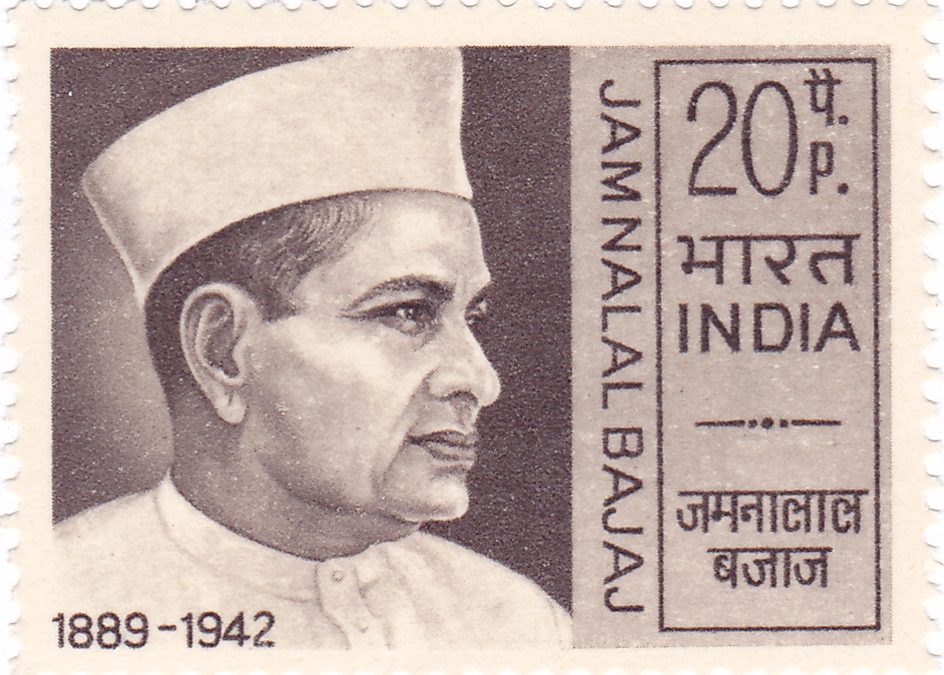
Featured image: Jamnalal Bajaj, from a 1970 postage stamp of India. Photo by India Post, Government of India, licensed under Government Open Data License – India, via Wikimedia Commons.