Ghanshyam Das Birla (10 April 1894 – 11 June 1983) was an Indian industrialist, the builder of the Birla group and one of the founders of modern Indian business. He broke the British monopoly of the jute trade, set up industries in textiles, cars, aluminium, cement and fibre, and was for more than thirty years the friend, host and chief financial supporter of Mahatma Gandhi. He founded the institute at Pilani that became BITS.
Quick Facts
| Full name | Ghanshyam Das Birla |
| Born | 10 April 1894, Pilani, Rajasthan |
| Died | 11 June 1983, London (aged 89) |
| Community | Marwari (Maheshwari) |
| Occupation | Industrialist, philanthropist |
| Founded | Birla Jute (1919), Hindustan Motors (1942), UCO Bank (1943), Grasim (1947), Hindalco (1958) |
| Institutions | Federation of Indian Chambers of Commerce and Industry (co-founder, 1927); Birla Institute of Technology and Science, Pilani |
| Awards | Padma Vibhushan (1957) |
Early Life
He was born at Pilani, a small town in the dry Shekhawati region of Rajputana, from which Marwari traders had spread across India. His grandfather had founded a trading house, and his father dealt in opium, silver and cotton in Bombay and Calcutta. He had only a few years of schooling under a village teacher, and taught himself English, economics and much else.
At sixteen he went to Calcutta and set up as a broker in jute.
Breaking the Monopoly
The jute industry of Bengal was owned and run by Scottish firms, who controlled the mills, the exchange and the shipping, and did not welcome Indians. Birla made money in the trade during the First World War and in 1919 founded Birla Jute, among the first jute mills owned by an Indian. The established firms tried to stop him from getting land, machinery and credit. He persisted, and the experience made him a nationalist in business.
A cotton mill at Gwalior followed in 1921, and then sugar, paper and insurance.
Gandhi
He met Mahatma Gandhi in 1916 and became his devoted follower, though never an uncritical one. He gave freely to Gandhi’s causes: the Congress, khadi, the campaign against untouchability, of whose organisation, the Harijan Sevak Sangh, he was the first president. Gandhi stayed at his houses in Delhi, Bombay and Calcutta. It was at Birla House in New Delhi that Gandhi spent his last months and was assassinated on 30 January 1948.
Birla also acted as an unofficial go-between with British ministers and viceroys, explaining Gandhi to them and them to Gandhi. Their correspondence fills volumes; he described the relationship in a memoir, In the Shadow of the Mahatma.
Spokesman of Indian Business
- a member of the Central Legislative Assembly from 1926
- a founder, in 1927, of the Federation of Indian Chambers of Commerce and Industry, the voice of Indian as distinct from British business
- a delegate to the second Round Table Conference in London in 1931
- owner of the Hindustan Times, which he took over in the 1920s to give the national movement a newspaper in Delhi
- one of the authors, with J. R. D. Tata, of the Bombay Plan of 1944 for the country’s economic development
Industry
- **Hindustan Motors (1942),** which later made the Ambassador car
- **United Commercial Bank (1943)**
- **Gwalior Rayon, later Grasim (1947),** makers of man-made fibre
- **Hindalco (1958),** aluminium, at Renukoot
- tea, chemicals, cement, shipping and engineering companies
By the 1970s the group was the largest in India with the Tatas’. The licensing system of those years, which the big houses were accused of using to pre-empt competition, made the family a target of political attack.
Philanthropy
The Birla Education Trust, which he set up in 1929, founded schools and colleges at Pilani that became, in 1964, the Birla Institute of Technology and Science. He and his family built temples in Delhi, Calcutta and other cities, open to all castes, and planetariums, hospitals and museums.
Personal Life
He was twice widowed young and did not marry a third time. He had three sons and daughters. He rose before dawn, walked several miles each day, and ran his companies through a traditional Marwari system of daily financial reports.
He died in London on 11 June 1983. The group was later divided among branches of the family; the largest part is led by his great-grandson, Kumar Mangalam Birla.
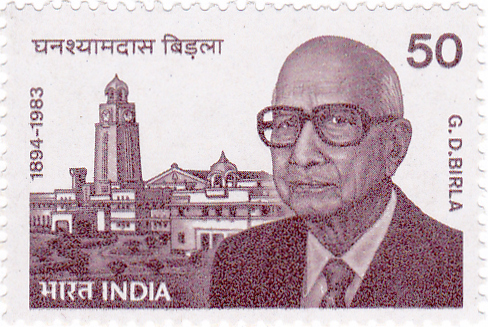
Featured image: G. D. Birla, from a 1984 postage stamp of India. Photo by India Post, Government of India, licensed under Government Open Data License – India, via Wikimedia Commons.