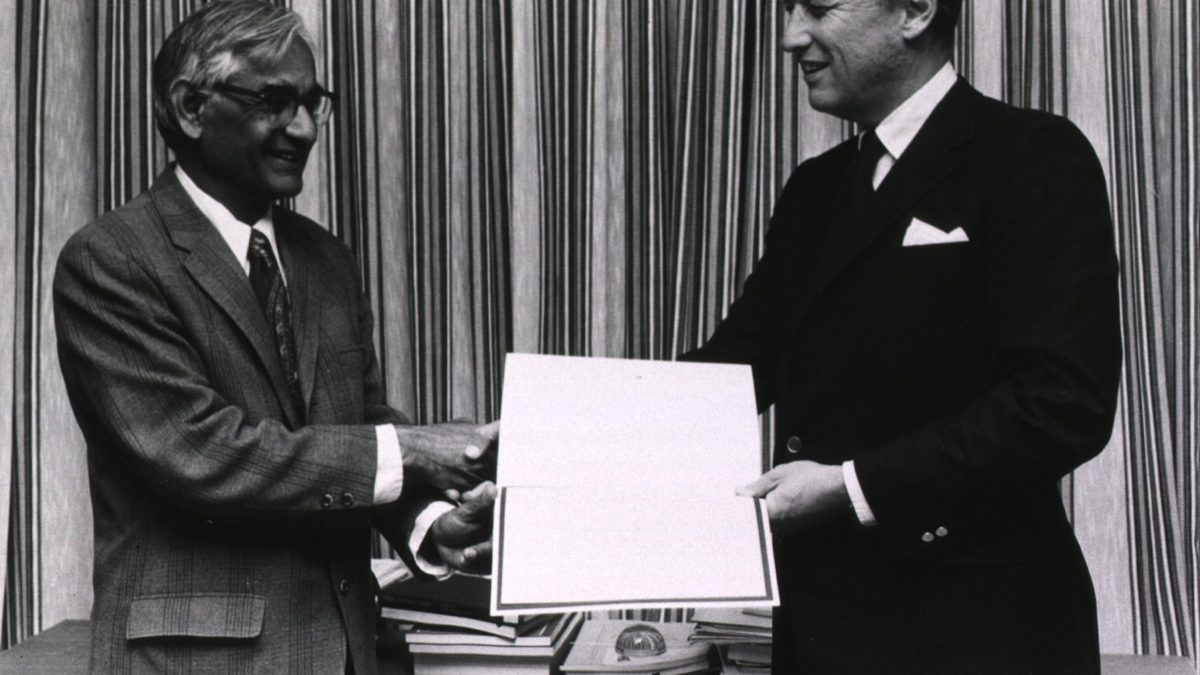
Har Gobind Khorana (9 January 1922 – 9 November 2011) was an Indian-born American biochemist who shared the Nobel Prize in Physiology or Medicine in 1968 for showing how the genetic code directs the making of proteins. He went on to build the first artificial gene. The son of a village tax clerk in Punjab, he became one of the founders of modern molecular biology.
Quick Facts
| Full name | Har Gobind Khorana |
| Born | 9 January 1922 (official date), Raipur, Punjab, British India (now in Pakistan) |
| Died | 9 November 2011, Concord, Massachusetts, United States (aged 89) |
| Field | Biochemistry, molecular biology |
| Education | Punjab University, Lahore (B.Sc., M.Sc.); University of Liverpool (Ph.D., 1948) |
| Known for | Deciphering the genetic code; first synthetic gene |
| Nobel Prize | Physiology or Medicine, 1968 (shared with Marshall Nirenberg and Robert Holley) |
| Other honours | Padma Vibhushan (1969), Lasker Award (1968), US National Medal of Science (1987) |
| Spouse | Esther Elizabeth Sibler (m. 1952) |
| Children | 3 |
Early Life
He was born in Raipur, a village of about a hundred people in the Multan district of undivided Punjab, the youngest of five children. His father, Ganpat Rai Khorana, was a patwari, a village revenue clerk, who insisted on educating his children; the family, Khorana later wrote, was practically the only literate one in the village. He had his first lessons under a tree. His exact date of birth is not known; 9 January 1922 is the date in his papers.
Education
He took his B.Sc. in 1943 and M.Sc. in 1945 from Punjab University in Lahore. A Government of India fellowship took him to the University of Liverpool, where he received his doctorate in organic chemistry in 1948. He spent a year in Zurich with Vladimir Prelog, whom he regarded as the greatest influence on his thinking. He came back to India in 1949 but could not find a suitable post, and returned to England to work at Cambridge under Alexander Todd, where his interest in proteins and nucleic acids began.
Career
Vancouver and Wisconsin
In 1952 he moved to the British Columbia Research Council in Vancouver, and in 1960 to the Institute for Enzyme Research at the University of Wisconsin. He became a citizen of the United States in 1966.
The genetic code
By the early 1960s it was known that DNA carried instructions for making proteins, written in an alphabet of four chemical letters. The question was how to read it. Khorana made short chains of nucleic acid with precisely known, repeating sequences and observed which amino acids they produced. His work, with that of Marshall Nirenberg, established that the code is read in groups of three letters, that each group specifies one amino acid, and that some groups act as full stops. The two men and Robert Holley shared the Nobel Prize in 1968.
The first artificial gene
In 1970 his laboratory completed the first chemical synthesis of a gene, that of a yeast transfer RNA. That year he moved to the Massachusetts Institute of Technology, where in 1976 his team made a synthetic gene that worked inside a living bacterium. The methods he developed for building pieces of DNA to order underlie gene sequencing, the polymerase chain reaction and the biotechnology industry. In later years he studied rhodopsin, the light-sensitive protein of the eye. He retired from MIT in 2007.
Personal Life
He married Esther Elizabeth Sibler, who was Swiss, in 1952; they had two daughters and a son. He was known as a modest man who avoided publicity and worked long hours into old age. He died in Concord, Massachusetts, in 2011.
Legacy
India awarded him the Padma Vibhushan in 1969. The Khorana Program, run by the Indian and American governments with the University of Wisconsin, sends Indian students to American laboratories.
Featured image: Har Gobind Khorana receiving a lecture award at the US National Institutes of Health in 1978. Photo by the US National Institutes of Health, in the public domain, via Wikimedia Commons.