Chintamani Nagesa Ramachandra Rao (born 30 June 1934), known as C. N. R. Rao, is an Indian chemist who has worked for more than six decades on the structure and properties of solid materials. He has published more than 1,700 research papers and some fifty books, built several of India’s leading research centres, and advised successive Prime Ministers on science. He was awarded the Bharat Ratna in 2014.
Quick Facts
| Full name | Chintamani Nagesa Ramachandra Rao |
| Born | 30 June 1934, Bangalore |
| Age | 92 |
| Field | Solid-state chemistry, materials chemistry |
| Education | Mysore University (B.Sc.); Banaras Hindu University (M.Sc.); Purdue University (Ph.D., 1958) |
| Positions | Director, Indian Institute of Science (1984–1994); founder, Jawaharlal Nehru Centre for Advanced Scientific Research; Chairman, Scientific Advisory Council to the Prime Minister |
| Honours | Bharat Ratna (2014), Padma Vibhushan (1985), Fellow of the Royal Society (1982) |
| Spouse | Indumati Rao (m. 1960) |
| Children | 2 |
Early Life
He was born in Bangalore, the only child of Hanumantha Nagesa Rao, an inspector of schools, and Nagamma. His mother taught him at home in his first years, and his father insisted that he speak English as well as Kannada. As a schoolboy he heard a lecture by C. V. Raman and was taken round Raman’s laboratory, which he has described as the moment he decided on science.
Education
He took his B.Sc. from Mysore University at seventeen and his M.Sc. from Banaras Hindu University. He went to Purdue University in the United States and completed his Ph.D. in 1958, in under three years, followed by a period at the University of California, Berkeley.
Career
Kanpur and Bangalore
He returned to India in 1959 as a lecturer at the Indian Institute of Science on a small salary and with almost no equipment. In 1963 he moved to the new Indian Institute of Technology at Kanpur, where he built the chemistry department. He came back to the Indian Institute of Science in 1976 to found its solid-state and structural chemistry unit, and was the institute’s director from 1984 to 1994.
JNCASR
In 1989, the centenary year of Jawaharlal Nehru‘s birth, he founded the Jawaharlal Nehru Centre for Advanced Scientific Research at Jakkur in Bangalore, and has worked there since.
Research
He chose solid-state chemistry when few chemists considered it a serious field. His work covers:
- **Metal oxides:** how their structure governs their electrical and magnetic behaviour
- **High-temperature superconductors:** he was among the first to make and study the oxide materials that lose electrical resistance at relatively high temperatures
- **Nanomaterials:** carbon nanotubes, graphene and similar materials, on which he has worked since the 1990s
- **Hydrogen and energy:** artificial photosynthesis and the storage of hydrogen
Adviser
He chaired the Scientific Advisory Council to the Prime Minister under Rajiv Gandhi and again under Manmohan Singh, and pressed for the creation of the Indian Institutes of Science Education and Research. He has been a blunt critic of low spending on science and of the bureaucracy that governs it.
Awards
- Bharat Ratna, 2014
- Padma Shri (1974) and Padma Vibhushan (1985)
- Fellow of the Royal Society (1982) and its Royal Medal (2009)
- Dan David Prize (2005)
- Eni Award for energy research (2020)
- Membership of the major national academies of science, including those of the United States, France and Japan
Personal Life
He married Indumati in 1960; she is an educationist who works on science teaching. They have a son, Sanjay, and a daughter, Suchitra. He is known for his love of Carnatic music and for still going to the laboratory every day in his nineties.
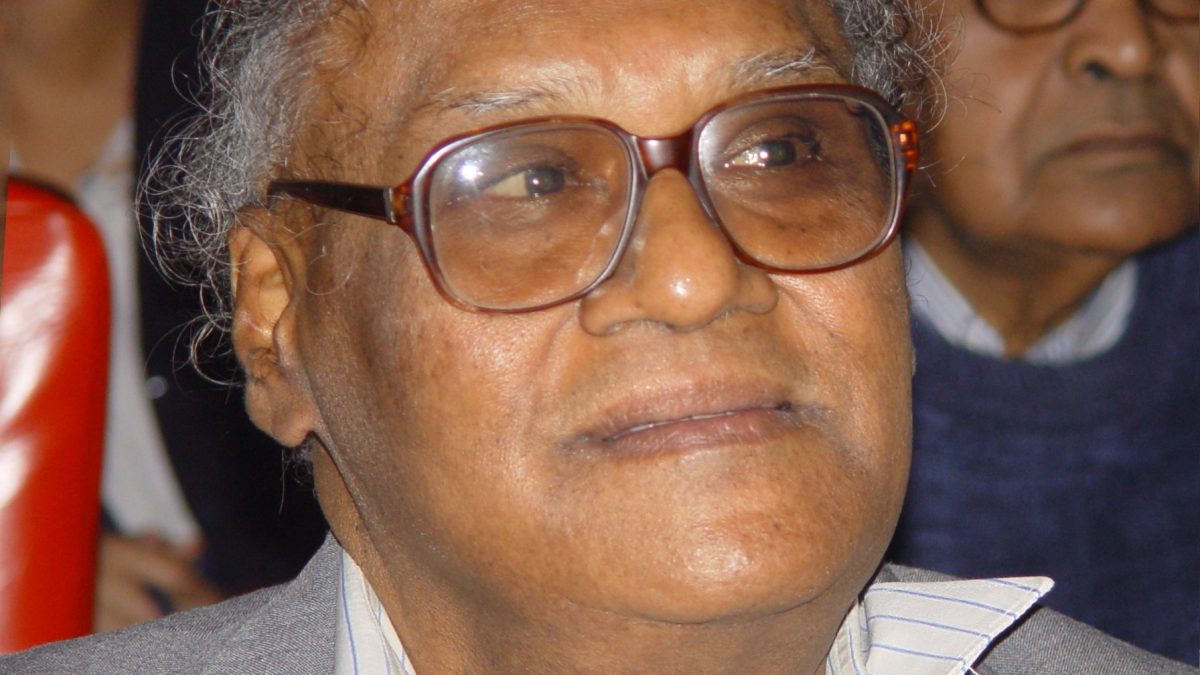
Featured image: C. N. R. Rao in December 2004. Photo by Biswarup Ganguly, licensed under CC BY-SA 3.0, via Wikimedia Commons.