
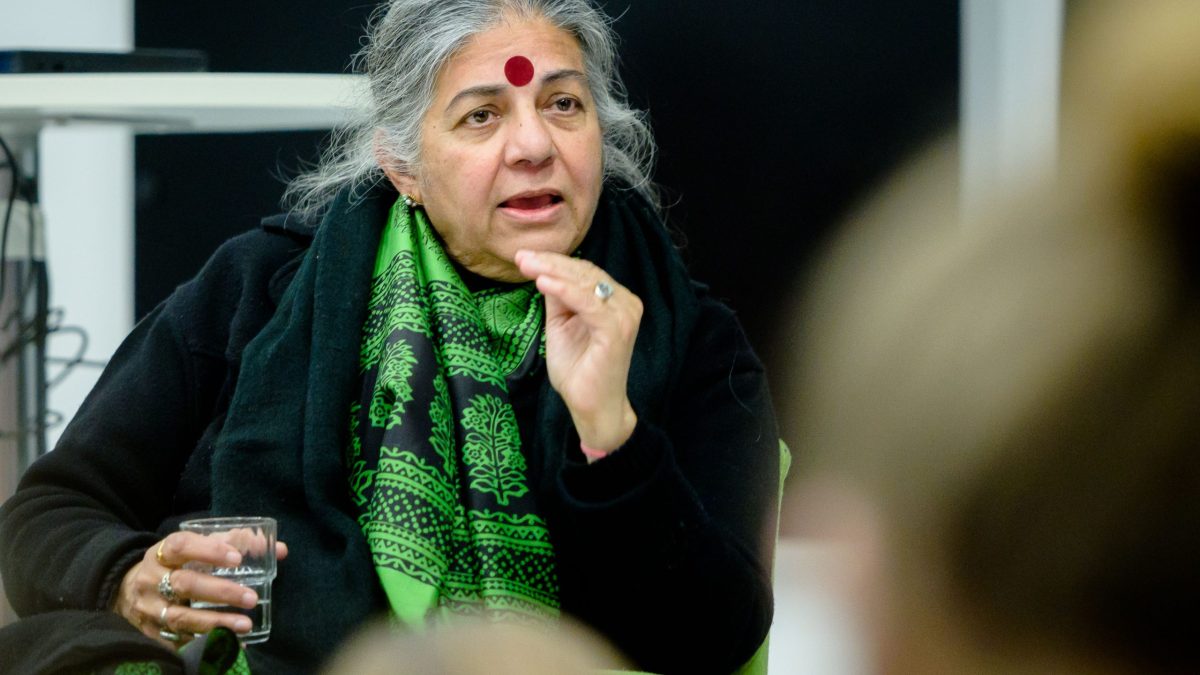
Vandana Shiva (born 5 November 1952) is an Indian environmental activist, author and campaigner for traditional farming. She founded Navdanya, a movement that sets up community seed banks and promotes organic agriculture, and she has led international campaigns against genetically modified crops and the patenting of seeds and plants. She has written more than twenty books and received the Right Livelihood Award in 1993. Her views are widely admired by environmental groups and strongly disputed by many agricultural scientists.
Quick Facts
| Full name | Vandana Shiva |
| Born | 5 November 1952, Dehradun, Uttar Pradesh (now Uttarakhand), India |
| Age | 73 |
| Occupation | Environmental activist, author |
| Education | Panjab University (B.Sc. Physics); University of Guelph (M.A.); University of Western Ontario (Ph.D. 1978) |
| Organisations | Research Foundation for Science, Technology and Ecology (1982); Navdanya (1991) |
| Known for | Seed sovereignty, opposition to GM crops, ecofeminism |
| Honour | Right Livelihood Award (1993) |
Early Life
Shiva was born in Dehradun in the Himalayan foothills. Her father was a forest conservator, and her mother, who had been a schools inspector, took up farming. She studied physics at Panjab University in Chandigarh and worked briefly at the Bhabha Atomic Research Centre. She then went to Canada, earning a master’s in the philosophy of science from the University of Guelph and a Ph.D. from the University of Western Ontario in 1978 with a thesis on the foundations of quantum theory.
Career
Back in India, Shiva did research on science and environmental policy in Bangalore. In the 1970s she volunteered with the Chipko movement, in which village women in the Himalayas hugged trees to stop them being felled. In 1982 she set up the Research Foundation for Science, Technology and Ecology in Dehradun.
Shiva founded Navdanya, meaning “nine seeds”, to save native varieties of crops and help farmers move away from chemical fertilisers and bought seed. It has set up more than a hundred community seed banks across India and runs an organic farm and learning centre, Bija Vidyapeeth, near Dehradun.
She argued that the Green Revolution had damaged soils and impoverished farmers, a case made in The Violence of the Green Revolution (1991). She took part in legal challenges to foreign patents on neem, basmati rice and an Indian wheat variety, which she called “biopiracy”; the European Patent Office revoked the neem patent in 2000. She has campaigned for years against genetically modified crops and the company Monsanto.
Criticism
Many scientists say Shiva exaggerates the risks of genetically modified crops and that some of her claims, particularly linking Bt cotton to farmer suicides in India, are not supported by evidence. Her supporters reply that she has drawn attention to corporate control over seeds and the costs of industrial farming.
Selected Books
Awards and Honours
Frequently Asked Questions
When and where was Vandana Shiva born?
Vandana Shiva was born on 5 November 1952 in Dehradun, Uttar Pradesh (now Uttarakhand), India and is 73 years old.
What is Vandana Shiva known for?
Known for: Seed sovereignty, opposition to GM crops, ecofeminism.
Featured image: Vandana Shiva at a Heinrich Böll Foundation event, January 2020. Photo by Stephan Röhl, Heinrich-Böll-Stiftung, licensed under CC BY-SA 2.0, via Wikimedia Commons.



