
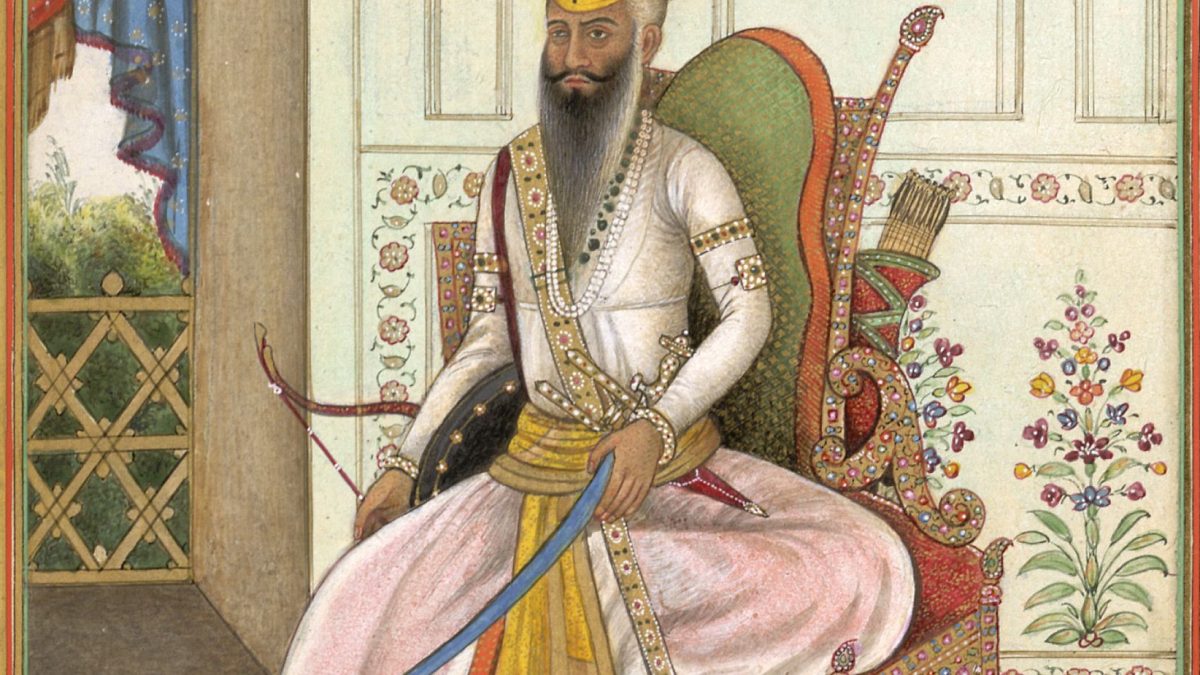
Maharaja Ranjit Singh (13 November 1780 – 27 June 1839), called Sher-e-Punjab, the Lion of Punjab, was the founder and ruler of the Sikh Empire. Blind in one eye and unable to read, he united the warring Sikh confederacies, took Lahore at nineteen, and built a kingdom that stretched from the Sutlej river to the Khyber Pass and from Kashmir to Multan. It was the last great Indian state to remain independent of the British.
Quick Facts
| Born | 13 November 1780, Gujranwala, Punjab (now in Pakistan) |
| Died | 27 June 1839, Lahore (aged 58) |
| Title | Maharaja of Punjab |
| Reign | 1801–1839 |
| Capital | Lahore |
| Dynasty | Sukerchakia |
| Known for | Founding the Sikh Empire; the modernised Khalsa army; gilding the Golden Temple |
| Successor | Kharak Singh |
Early Life
He was born at Gujranwala, the only son of Maha Singh, chief of the Sukerchakia misl, one of the twelve Sikh confederacies that had divided Punjab among themselves after the decline of Mughal and Afghan power. An attack of smallpox in infancy left his face scarred and took the sight of his left eye.
He had no schooling beyond the Sikh scriptures and never learnt to read or write. He was taught to ride and to fight, and is said to have been in his first battle at ten. His father died in 1792, and he became chief at twelve, under the guidance of his mother and later of his formidable mother-in-law, Sada Kaur.
Building the Kingdom
- **1799:** invited by its citizens, he took Lahore, the old capital of Punjab, on 7 July
- **1801:** on the day of Baisakhi he was proclaimed Maharaja
- **1802:** he took Amritsar, the holy city of the Sikhs
- **1809:** by the Treaty of Amritsar he agreed with the British that the Sutlej would be the boundary between them; he kept the agreement for thirty years and turned his ambitions north and west
- **1818:** Multan
- **1819:** Kashmir
- **1823–1834:** Peshawar and the trans-Indus frontier, taken from the Afghans
It was the first time in eight centuries that the invasion routes through the north-west had been closed by an Indian power. His general Hari Singh Nalwa held the frontier until his death at Jamrud in 1837.
The Army
He saw that the disciplined infantry and artillery of the East India Company could not be beaten by cavalry alone. He engaged officers who had served under Napoleon, among them the Frenchmen Allard and Court and the Italians Ventura and Avitabile, to train a regular army on European lines, the Fauj-i-Khas, and set up foundries to cast guns. By the 1830s it was the strongest army in Asia outside British control.
The Court
Though he ruled in the name of the Khalsa and struck coins in the names of the Sikh Gurus, never his own, his government was not sectarian. His foreign minister was a Muslim, Fakir Azizuddin; his prime minister a Dogra Hindu, Dhian Singh; his finance minister a Brahmin, Dina Nath. He gave grants to mosques and temples as well as gurdwaras, and by all accounts did not order an execution during his reign.
He covered the upper storeys of the Harmandir Sahib at Amritsar in gilded copper, giving it the name by which the world knows it, the Golden Temple, and gave gold for the spire of the Kashi Vishwanath temple at Varanasi.
The Koh-i-Noor
In 1813 he obtained the Koh-i-Noor diamond from the exiled Afghan king Shah Shuja, as the price of sheltering him. He wore it on his arm on state occasions. After the British annexed Punjab it was sent to Queen Victoria.
The Man
European visitors described a small, plain man of extraordinary energy and curiosity, fond of horses, strong drink and questions. He had many wives; his heirs were a disappointment.
Death and After
He died at Lahore on 27 June 1839 after a series of strokes. Within ten years, after palace murders and two wars with the British, his empire was gone, annexed in 1849. His youngest son, Duleep Singh, was taken to England as a boy.
In 2020 readers of a British history magazine voted him the greatest leader in world history.
Featured image: Maharaja Ranjit Singh, from an album made for Colonel James Skinner about 1830. Photo by an artist working for Colonel James Skinner, in the public domain, via Wikimedia Commons.



