
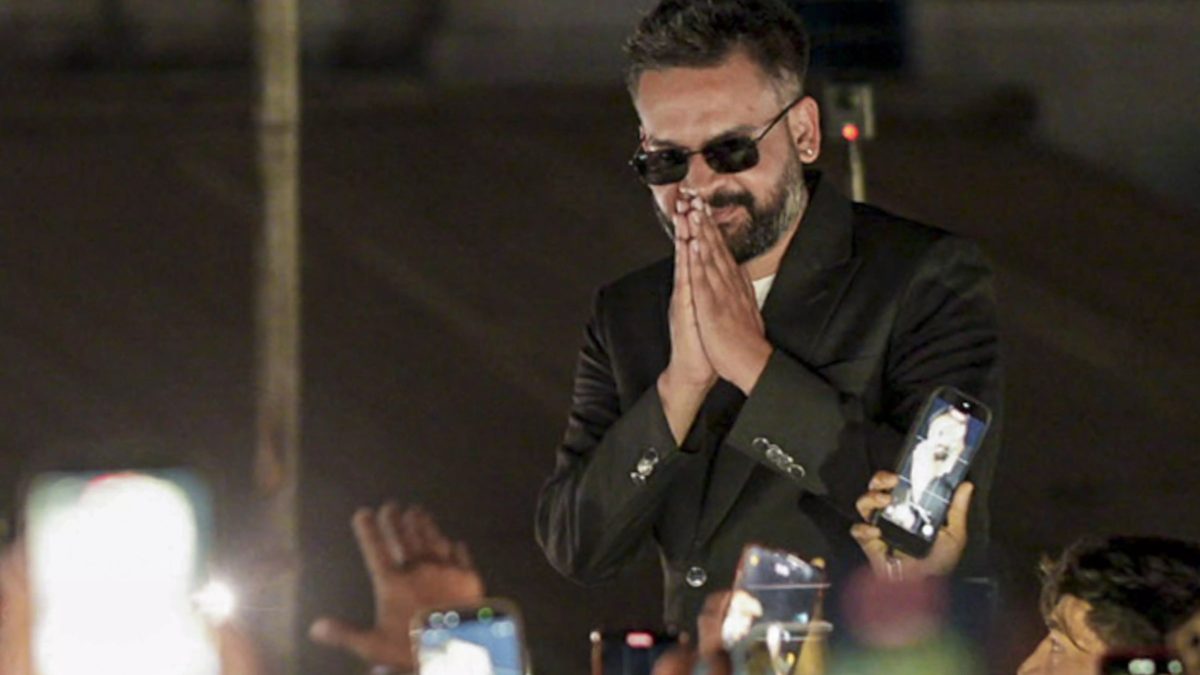
Nepal's Prime Minister, Balendra Shah, arrived in New Delhi on Sunday afternoon, 22 November 2026, for his first official visit to India, and on Monday he began a day of engagements that includes talks with Prime Minister Narendra Modi at Hyderabad House. Sources said the discussion between the two leaders would give "political direction" to bilateral relations for the coming years. The visit, which comes at a time when Nepal's new government is still setting out its foreign policy, is being closely watched in both capitals for signs of how the neighbours intend to manage a relationship that has seen both warmth and friction.
Mr. Shah is leading a 34-member delegation that includes his Chief Advisor Kumar Byanjankar, Finance Minister Swarnim Wagle and Foreign Minister Shisir Khanal. A separate business delegation is also travelling to India. The visit will feature a Nepal-India Business Forum aimed at attracting Indian investment to Nepal. Mr. Modi will host an official luncheon in honour of the Nepalese Prime Minister and his delegation. The size and composition of the delegation, which spans the finance and foreign ministries and the business community, suggests that economic cooperation is at the heart of Kathmandu's agenda.
The first concrete outcome came early on Monday. The Saryu-Kamala Express, a train that will run between Ayodhya and Janakpur in Nepal, was inaugurated at the Ayodhya Cantt Railway Station by Mr. Modi and Mr. Shah via video conferencing. Uttar Pradesh Chief Minister Yogi Adityanath said the start of a direct rail service between Ayodhya and Janakpur would open "a new chapter" in the centuries-old spiritual and cultural ties between the two regions, and would strengthen India-Nepal relations and facilitate pilgrimage for crores of devotees. Ayodhya and Janakpur are linked in Hindu tradition with the story of Lord Ram and Sita, which gives the train a symbolic weight beyond its transport value.
Before the talks, Mr. Shah paid homage to Mahatma Gandhi at Raj Ghat. In the visitors' book, he described truth as "a power unmatched by any force" and called compassion "the ultimate strength". Linking Gandhi's legacy with Nepal's heritage, he wrote: "On behalf of the people and Government of Nepal, I offer my deepest tribute. Coming from the birthplace of Lord Buddha, I behold in Gandhiji's legacy that very same immortal light: the profound truth that compassion is the ultimate strength, and that true leadership lies in selfless service to the humblest among us." The message was a gesture of cultural affinity that fits the tone of a first visit.
According to the sources cited by The Hindu, Mr. Shah will inaugurate several projects on Monday. Nepal and India are expected to inaugurate several completed projects in sectors such as connectivity and energy and lay foundation stones for upcoming initiatives, reflecting their efforts to expand cross-border cooperation. Discussions are expected to focus on strengthening economic cooperation, particularly in trade, transportation, investment and infrastructure development. The two sides are also expected to exchange memorandums of understanding covering education, health, agriculture, sports, disaster management and human resource development.
Energy is likely to be one of the most important topics. The Hindu has separately reported that Nepal got approval to import 350 MW of power from India during winter. Cross-border electricity trade has become a pillar of the relationship, as Nepal's hydropower potential and India's growing demand complement each other, and the arrangements for exports and imports across seasons are a regular subject of negotiation. Connectivity, including rail, roads and digital links, is the other major theme, and the new Ayodhya-Janakpur train shows how transport projects can carry political and cultural messages.
India's Ministry of External Affairs said in its description of the relationship that India and Nepal share "close and friendly relations, rooted in historical, cultural and civilisational links and strong people-to-people ties". It said bilateral cooperation has progressed across sectors, including trade and commerce, development partnership, energy and water resources, and physical and digital connectivity, with growing engagement in newer areas such as start-ups, technology and innovation, and sports. These are the standard terms in which New Delhi describes the relationship, but the emphasis on newer areas hints at a desire to broaden the partnership beyond traditional topics.
Not everyone in Nepal is satisfied with how the visit has been prepared. Former Prime Minister Jhala Nath Khanal said the two countries should maintain cordial relations and expand comprehensive cooperation, while expressing concern that Mr. Shah had not prepared a common national agenda ahead of the visit. "There are many expectations. And there are some irritants also in our relations which have to be eliminated," Mr. Khanal said, adding that relations should be developed "based on five principles of peaceful coexistence and neighbourliness." His remarks reflect a long-running debate in Nepal over how far to engage with India and how to present a united position on sensitive issues.
A commentary in The Hindu struck a similar note of caution. It said that while Nepal's new government may be granted some leeway for early misspeaking, Kathmandu and Delhi "must tread carefully in their words and steps." Any indication from Kathmandu that it is cavalier about India's position in the region, or from Delhi that it seeks to interfere with the new government's working, could set off "the same cycles of mistrust" that have dogged the relationship, particularly since the friction over Nepal's Constitution and the trade blockade from India in 2015. The 2015 episode remains a reference point for how quickly relations can deteriorate.
Mr. Shah has also brought a regional environmental message. In his maiden address to the 81st session of the UN General Assembly on 24 September 2026, he told world leaders that a warming climate is destabilising the fragile Himalayan ecology. He has proposed establishing a Himalayan Climate Resilience Mechanism led by Nepal, India and China, in the wake of recent devastating flash floods in the area. The proposal links directly to the themes of this visit, since the Himalayan region's rivers and glaciers affect millions of people in both countries, and it offers India a chance to engage with Nepal on a shared challenge that goes beyond the bilateral agenda.
Climate is not the only area where the two countries' interests overlap. Water resources, hydropower, trade routes and the movement of people across an open border all depend on stable relations. For Nepal, a landlocked country that relies heavily on India for access to the sea and for imports, a predictable partnership is essential. For India, a friendly and stable Nepal is important for security along its northern frontier and for its broader neighbourhood policy. The question is how both sides handle the issues that have caused friction in the past while building on areas of agreement.
The outcome of Monday's talks will be measured by what is announced and what is left unsaid. If the leaders agree on a package of energy, connectivity and investment measures and exchange the expected MoUs, the visit will be seen as a successful reset. If sensitive issues are raised in public or if the lack of a clear Nepali agenda becomes an issue, it could complicate the relationship. Either way, Mr. Shah's decision to make India his first official destination, and the symbolism of the Ayodhya-Janakpur train and the Raj Ghat tribute, signal that Kathmandu wants the partnership to have a cultural as well as a political dimension.
What happens next will depend on follow-through. Past visits between the two countries have produced long lists of agreements, and the test is whether projects are completed on schedule and whether the political understandings reached in Delhi survive the pressures of domestic politics in both countries. Over the coming months, the progress of the energy trade arrangements, the new train service and the business forum's investment pledges will show whether this visit marks the start of a new chapter, as leaders on both sides have suggested.

Leave a Reply