
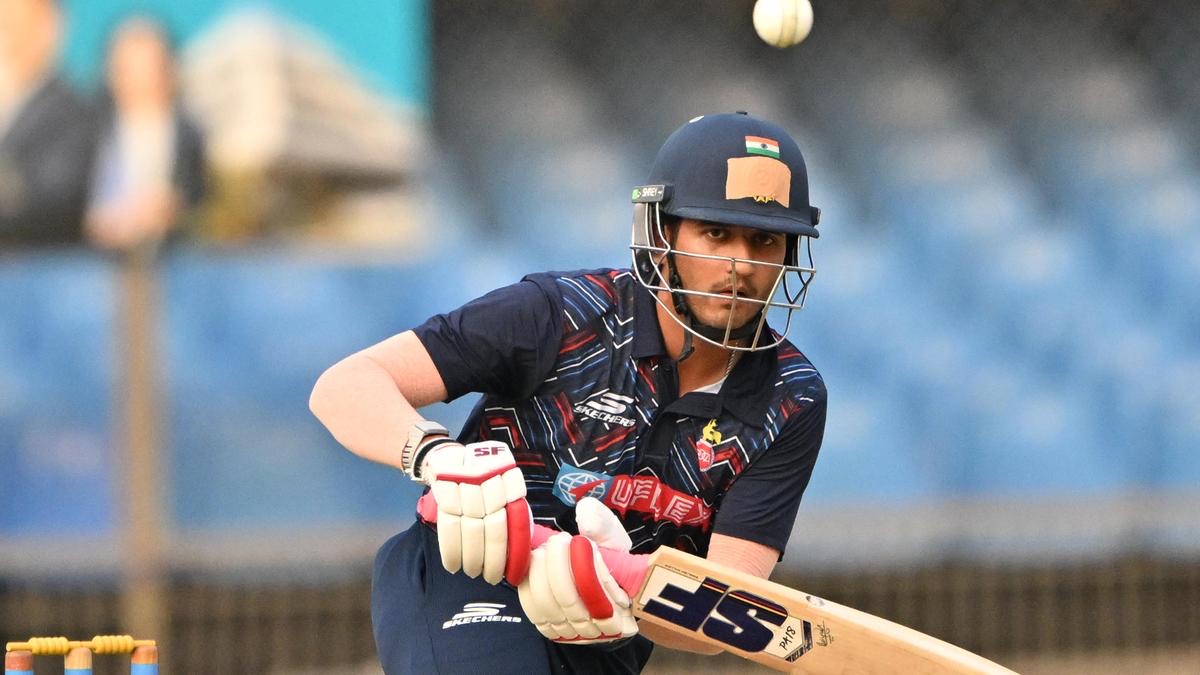
Delhi captain Priyansh Arya rewrote the Syed Mushtaq Ali Trophy (SMAT) record books on Tuesday, 24 November 2026, with a breathtaking 68-ball 181, including 7 fours and 19 sixes, against Tamil Nadu in a Group B match at the Daly College ground in Indore. The innings is the highest individual score and contains the most sixes in an innings in the tournament's history. It is also the highest T20 score by an Indian, according to The Hindu. Delhi finished on 275 for five in their 20 overs.
The records fell one after another. Arya went past Tilak Varma's previous best SMAT score of 151 with a six over long-on off left-arm spinner Sai Kishore, moving from 149 to 155. On the very next ball, he equalled Punit Bisht's record of 17 sixes in an innings with a hit over deep square leg. He later claimed the sixes record outright by sending his 18th six over deep cover off a full toss from Gurjapneet Singh, and he went on to add a 19th. The innings therefore broke both the individual score record and the sixes record in the same sequence of shots, a rare combination in a tournament that has seen many big hits.
The PowerPlay was where the innings took shape. Arya turned the first six overs into a personal exhibition of six-hitting. He took 22 runs off pacer R. Silambarasan and 22 runs off Sai Kishore in successive overs, the fourth and the fifth. Against Silambarasan he began by launching consecutive sixes over deep extra cover and deep midwicket, followed by a four over the infield to deep extra cover and an upper cut over deep backward point for another maximum. Sai Kishore fared no better: Arya first cleared the ropes straight down the ground and then brought up his half-century off just 18 balls with a slog sweep over deep backward square leg. A full toss was dispatched to deep backward square leg for four, and a six over long-on completed another 22-run over.
He continued the attack against Shahrukh Khan in the final over of the PowerPlay, slog-sweeping him over deep midwicket for six, cutting him through deep cover for four and finishing with another straight six. By then, Arya had raced to 78 off just 26 balls, as Delhi plundered 94 for one in the PowerPlay. He brought up his hundred off 36 balls with a straight six off Shahrukh. The pace of the innings shows how quickly the match was transformed. Delhi had the platform of 94 for one after six overs, and Arya had scored the bulk of it, with the highest individual score in the tournament still some distance away.
He was not without a moment of luck. Arya was dropped on 148 off Silambarasan by Amith Sathvik at long-off, a lapse that proved expensive for Tamil Nadu because it allowed him to go on to pass the 151 record and then to extend it. When he finished the innings at 181, he had accounted for a large share of Delhi's 275 for five, a total that put Tamil Nadu under heavy pressure from the start of their reply. The report published on Tuesday afternoon did not give the result of Tamil Nadu's chase.
Arya, the Delhi opener who plays for Punjab Kings in the Indian Premier League, has been in the public eye since 2025. He made his IPL debut for Punjab Kings in March 2025, and in April that year hit a century against Chennai Super Kings, which several outlets noted as one of the fastest in IPL history and the fastest by an uncapped player. Punjab Kings had bought him at the auction for ₹3.8 crore against a base price of ₹30 lakh. That background helps to explain why the 181 was treated by observers as the confirmation of a talent that had been recognised in the IPL and was now translating into record-breaking scores in domestic cricket.
What does the record mean in context? The previous SMAT best of 151 by Tilak Varma, who has played for India, shows how high the bar was. The tournament has been a showcase for power-hitting for years, and Punit Bisht's 17 sixes in an innings was considered a remarkable standard. For Arya to surpass both, in an innings that lasted 68 balls, is a statement about how the format has evolved and about how aggressive batting has become in domestic T20 cricket. It also shows how quickly the PowerPlay can become a platform: 94 for one after six overs, with Arya on 78, set a pace that the remaining overs could sustain.
The claim that it is the highest T20 score by an Indian carries extra weight. It refers to scores by Indian batters in T20 cricket, and it means that Arya's innings stands above the knocks of players who have made hundreds in the IPL and in international matches. That is a significant distinction at a time when selectors and franchises look closely at domestic performance. A player who scores at this rate against a bowling attack that includes Silambarasan, Sai Kishore, Gurjapneet Singh and Shahrukh Khan has shown he can handle both pace and spin.
There are limits to what one innings proves. T20 cricket is a high-variance format. The dropped catch at 148 is a reminder that even historic innings often depend on small moments. And the innings was played in a domestic tournament, where the standard of bowling varies from team to team. Selectors will weigh it alongside his consistency over a longer period.
Still, the immediate impact is clear. A score of 181 off 68 balls with 19 sixes will be remembered whatever the result. For Delhi, it was a statement of intent from a captain who led from the front; for Tamil Nadu, it was a day on which good bowlers were taken apart. For Indian cricket, it adds another name to the list of young batters whose strike-rates are redefining expectations in the shortest format.
The tournament continues, and the next questions are practical ones: how Delhi follows up, what happens in the group table, and whether other batters will try to chase the new records. But for now, the numbers are what they are: 68 balls, 181 runs, 19 sixes, and a place at the top of the SMAT record books.


Leave a Reply