
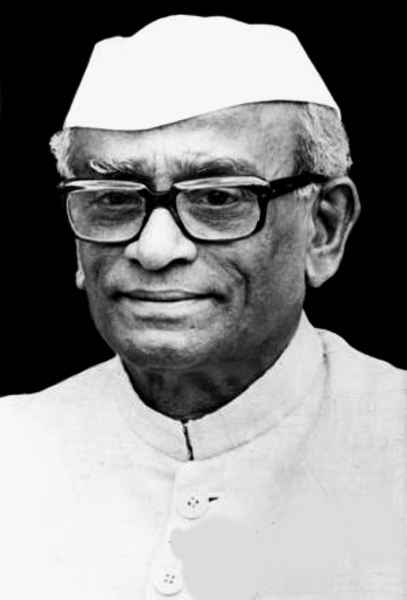
Neelam Sanjiva Reddy (19 May 1913 – 1 June 1996) was an Indian politician who was the sixth President of India, from 1977 to 1982. He was the first Chief Minister of Andhra Pradesh, president of the Indian National Congress and twice Speaker of the Lok Sabha. Defeated for the presidency in the famous contest of 1969, he retired to his farm, returned eight years later, and became the only person so far elected President without a contest.
Quick Facts
| Full name | Neelam Sanjiva Reddy |
| Born | 19 May 1913, Illur, Anantapur district, Andhra Pradesh |
| Died | 1 June 1996, Bangalore (aged 83) |
| Education | Theosophical High School, Adyar; Government Arts College, Anantapur (left 1931) |
| Parties | Indian National Congress; Janata Party |
| Offices | President of India (1977–1982); Speaker of the Lok Sabha (1967–1969; 1977); Chief Minister of Andhra Pradesh (1956–1960; 1962–1964); President of the Congress (1960–1962) |
| Spouse | Neelam Nagaratnamma |
| Children | 4 |
Early Life
He was born in the village of Illur in the dry Rayalaseema region, into a family of prosperous farmers. A visit by Mahatma Gandhi to Anantapur in 1929 changed the direction of his life. He left college in 1931 to join the freedom movement, gave up foreign cloth, and became secretary of the provincial Congress committee at twenty-five. He spent most of the years between 1940 and 1945 in prison.
Andhra
He was elected to the Madras legislature in 1946 and was a member of the Constituent Assembly. When the Telugu districts were separated as Andhra State in 1953 he became Deputy Chief Minister, and when the larger state of Andhra Pradesh was formed on 1 November 1956 he was its first Chief Minister.
His government began the great dams at Nagarjuna Sagar and Srisailam. He left in 1960 to be president of the Congress for two years, then returned as Chief Minister. In 1964 the Supreme Court made adverse remarks about his government’s conduct in a case concerning the nationalisation of bus routes, and he resigned.
Delhi
He was a Union minister under Lal Bahadur Shastri and Indira Gandhi, holding steel and mines and then transport and aviation. In 1967 he was elected Speaker of the Lok Sabha. He resigned from the Congress on taking the chair, holding that a Speaker should belong to no party, and was the first to do so.
1969
On the death of President Zakir Husain, the leaders of the Congress organisation nominated Reddy for the presidency. Indira Gandhi saw the choice as an attempt to control her. She encouraged the candidacy of V. V. Giri and asked her party’s legislators for a vote of conscience. Reddy lost narrowly. He went home to Anantapur and took up farming.
Return
He came back in 1975 to support Jayaprakash Narayan‘s movement. In the election of March 1977 he won Nandyal for the Janata Party, the only seat in Andhra Pradesh that the Congress lost. He was elected Speaker again.
When President Fakhruddin Ali Ahmed died, all parties, including Indira Gandhi’s, agreed on Reddy. The nominations of the other candidates were rejected, and on 21 July 1977 he was declared elected unopposed. At sixty-four he was the youngest President up to that time.
President
He took office on 25 July 1977. He moved into a small part of Rashtrapati Bhavan and took a reduced salary. In five years he worked with three Prime Ministers: Morarji Desai, Charan Singh and Indira Gandhi.
His most disputed decisions came in 1979. When the Desai government lost its majority he invited Charan Singh to form a government; and when Charan Singh resigned without facing Parliament, Reddy dissolved the Lok Sabha and called an election, declining to give Jagjivan Ram, the leader of the largest remaining group, a chance to form a government. Critics accused him of bias. The election returned Indira Gandhi to power, and he worked correctly with her, though in his farewell address he spoke bluntly of the failures of those in office.
Retirement and Death
He retired in 1982 to his farm at Anantapur and wrote a memoir, Without Fear or Favour. He died in Bangalore on 1 June 1996.
Legacy
The reservoir at Srisailam bears his name. His career is a study in the reversals of Indian politics: the man defeated in 1969 by a Prime Minister’s manoeuvre became President in the year of her fall.
Featured image: Neelam Sanjiva Reddy in 1977. Photo by Bhavanajagat , Neelam Sanjiva Reddy, licensed under CC BY-SA 4.0, via Wikimedia Commons.



