
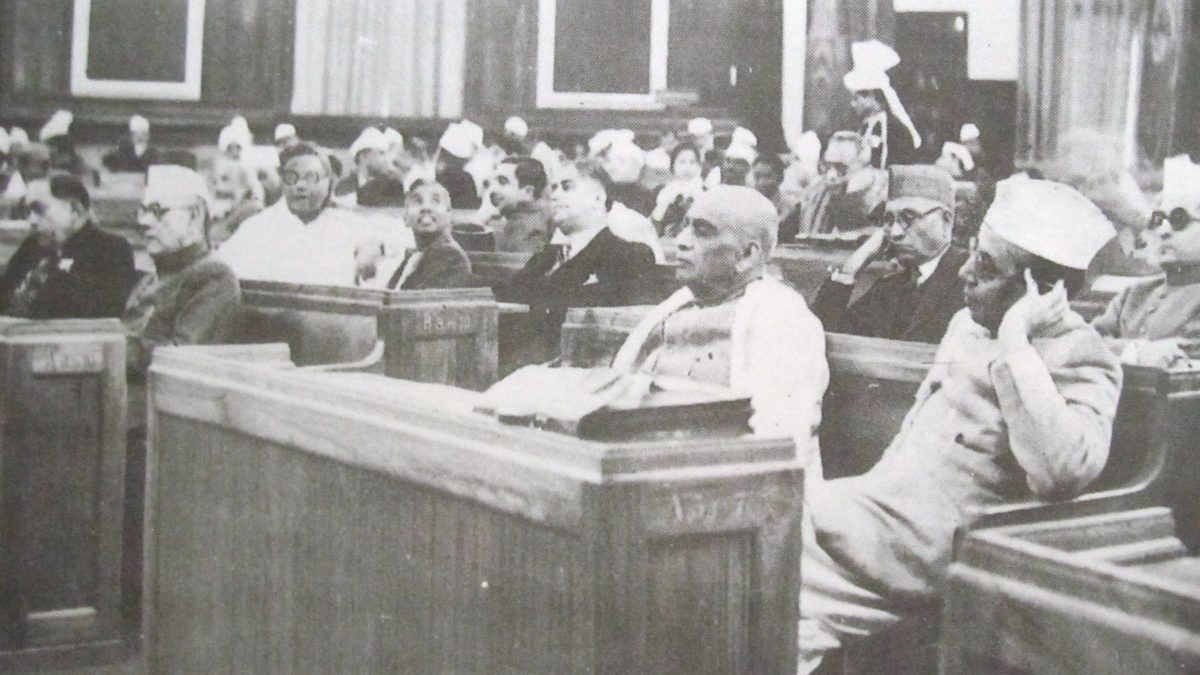
The Constitution of India came into force on 26 January 1950, making the country a republic. It had been written over nearly three years by an assembly of Indians, without foreign supervision, at a time of Partition, refugee movements and war in Kashmir.
The Constituent Assembly
- First meeting: 9 December 1946, in what is now the Central Hall of the old Parliament House
- Members: elected indirectly by the provincial legislatures, with representatives of the princely states. After Partition the Assembly had 299 members, 15 of them women.
- President: Dr Rajendra Prasad
- Constitutional Adviser: Sir B. N. Rau, who prepared the first draft
On 13 December 1946 Jawaharlal Nehru moved the Objectives Resolution, setting out the aims of the future Constitution. It later became the basis of the Preamble.
The Drafting Committee
On 29 August 1947 the Assembly appointed a seven-member Drafting Committee with Dr B. R. Ambedkar as chairman. Ambedkar steered the draft through the Assembly clause by clause, answering objections and explaining each provision. He is remembered as the chief architect of the Constitution.
Other committees were led by Nehru, Vallabhbhai Patel, who chaired the committee on fundamental rights and minorities, and Rajendra Prasad.
The timeline
- Time taken: 2 years, 11 months and 18 days
- Sessions: 11, with debates open to the press and public
- Adopted: 26 November 1949
- Signed: 24 January 1950, by 284 members
- In force: 26 January 1950
Why 26 January
The date was chosen to honour 26 January 1930, the day the Congress first observed as Purna Swaraj Day, pledging complete independence.
What it contained
The original Constitution had 395 articles in 22 parts and 8 schedules, making it the longest written constitution of any country. Its main features:
- Parliamentary democracy with a President as head of state
- Universal adult franchise: every adult could vote from the start, without tests of property, education or sex
- Fundamental rights enforceable by the courts
- Directive principles to guide government policy
- A federal system with a strong centre
- An independent judiciary
- Abolition of untouchability
The framers drew on the Government of India Act of 1935 and on the constitutions of Britain, the United States, Ireland, Canada and others.
The original copy
The Constitution was not printed but written by hand. Prem Behari Narain Raizada did the calligraphy in English, and artists from Santiniketan led by Nandalal Bose decorated the pages. The original copies are kept in the Parliament library.
Remembering it
26 January is Republic Day. Since 2015, 26 November has been observed as Constitution Day. The Constitution has been amended more than a hundred times, but its basic structure, the Supreme Court held in 1973, cannot be altered.
Image: Members of the Constituent Assembly of India at an early session, December 1946. Photo by an unknown photographer, in the public domain, via Wikimedia Commons.



