
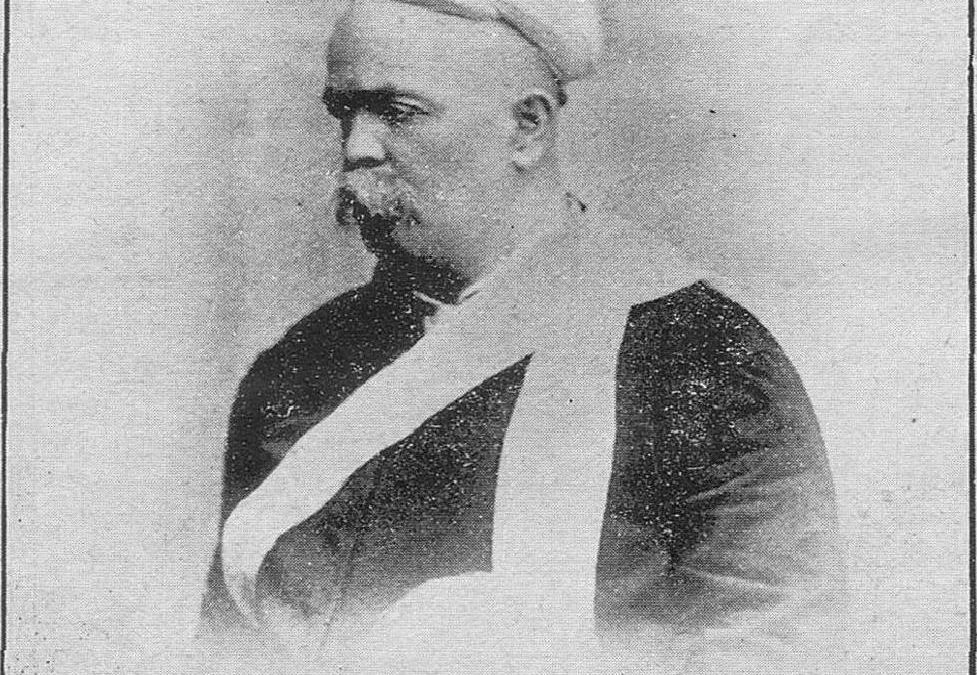
Mahadev Govind Ranade (18 January 1842 – 16 January 1901) was an Indian judge, social reformer, economist and historian, the leading figure of public life in western India in the late nineteenth century. He was a judge of the Bombay High Court, a founder of the Indian National Congress and of the Indian National Social Conference, and the teacher of a generation of moderate nationalists. He is called the father of Indian economics.
Quick Facts
| Full name | Mahadev Govind Ranade |
| Born | 18 January 1842, Niphad, Nashik district, Maharashtra |
| Died | 16 January 1901, Bombay (aged 58) |
| Education | Elphinstone College; University of Bombay (B.A. 1862, M.A., LL.B.) |
| Occupation | Judge, reformer, economist, historian |
| Offices | Judge of the Bombay High Court (1893–1901) |
| Associated with | Prarthana Samaj; Poona Sarvajanik Sabha; Indian National Congress; Indian National Social Conference |
| Notable works | Essays on Indian Economics; Rise of the Maratha Power |
| Spouse | Ramabai Ranade |
Early Life
He was born at Niphad into a Chitpavan Brahmin family and grew up at Kolhapur, where his father was an official of the state. He was a slow, silent child who became a formidable student. He was in the first group to graduate from the new University of Bombay, in 1862, took first-class honours, a master’s degree and a degree in law, and taught history and economics at Elphinstone College.
Judge
He entered the judicial service in 1871 and served for more than twenty years as a subordinate judge at Pune and elsewhere. The government distrusted his public activity and held back his promotion, transferring him for a time away from Pune. He was appointed to the bench of the Bombay High Court in 1893 and sat there until his death.
Reformer
He joined the Prarthana Samaj, the “prayer society” that sought to reform Hinduism from within, and became its guiding mind. He worked for the remarriage of widows, the education of women, a higher age of marriage and the removal of caste barriers, always by persuasion and by appeal to the older and better traditions of Hinduism itself.
In 1887 he founded the Indian National Social Conference, which met each year alongside the Congress to consider social questions. He held that political freedom and social reform could not be separated: a people could not be free in one sphere and enslaved in another.
His own conduct was attacked from both sides. When his first wife died in 1873, his father at once arranged his marriage to a girl of eleven, and Ranade, an advocate of widow marriage, gave way. Reformers never let him forget it. He educated the girl, Ramabai, against the opposition of the women of the family, and she became a notable reformer in her own right. In 1890 he did penance at the demand of the orthodox for having taken tea with Christian missionaries.
Public Life
The Poona Sarvajanik Sabha, founded in 1870, became under his direction the voice of public opinion in western India. It studied famine, land revenue and the condition of the peasants and sent reasoned petitions to the government. He was among the seventy-two men who founded the Indian National Congress at Bombay in 1885, though as a judge he could hold no office in it.
Economist
In lectures and articles, collected as Essays on Indian Economics, he argued that the doctrines of free trade taught in England did not fit a poor agricultural country. India’s poverty came from its dependence on farming alone, and the remedy was industry, which the state had a duty to foster through credit, technical education and protection. These ideas shaped Indian economic thinking up to and beyond independence. He was also a founder of the industrial conference and of several industrial and educational bodies.
Historian
His Rise of the Maratha Power (1900) presented the Maratha movement of the seventeenth century as a national awakening of a whole people, prepared by the saints of Maharashtra, and not the work of one man.
Disciple
Gopal Krishna Gokhale called himself Ranade’s pupil and learnt from him the habit of studying a subject thoroughly before speaking. Through Gokhale the influence passed to Gandhi. Bal Gangadhar Tilak, who opposed him on social reform, wrote on his death that he had breathed life into the cold body of Maharashtra.
Death
He died in Bombay on 16 January 1901. His widow founded the Seva Sadan in Pune for the training of women. The line of reformers continued with D. K. Karve.
Featured image: Mahadev Govind Ranade, from a portrait published in 1911. Photo by the editors of Andhra Patrika, in the public domain, via Wikimedia Commons.



