
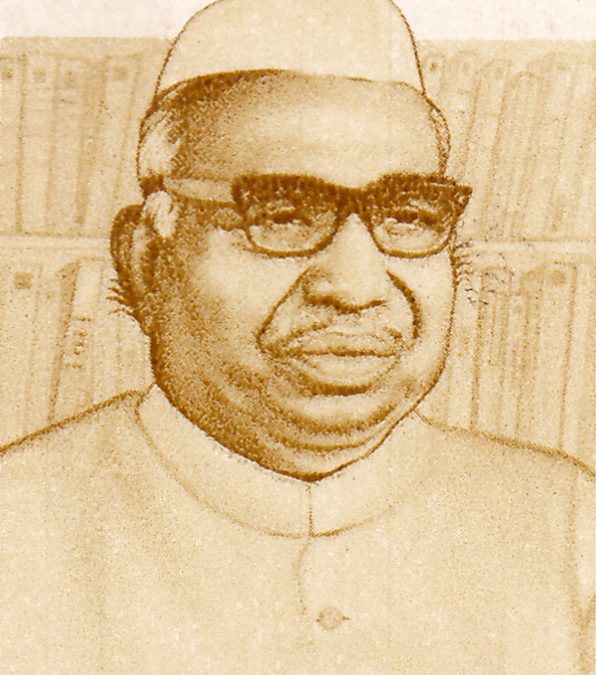
Jagjivan Ram (5 April 1908 – 6 July 1986), known as Babuji, was an Indian freedom fighter, the foremost Dalit leader within the Congress and one of the longest-serving ministers in the country’s history. He sat in legislatures without a break for fifty years, was Defence Minister during the war of 1971, Food Minister during the Green Revolution, and Deputy Prime Minister from 1977 to 1979.
Quick Facts
| Full name | Jagjivan Ram |
| Born | 5 April 1908, Chandwa, near Arrah, Bihar |
| Died | 6 July 1986, New Delhi (aged 78) |
| Education | Banaras Hindu University; University of Calcutta (B.Sc., 1931) |
| Parties | Indian National Congress; Congress for Democracy; Janata Party; Congress (J) |
| Offices | Deputy Prime Minister (1977–1979); Minister of Defence (1970–1974, 1977–1979); Minister of Food and Agriculture; Labour; Railways; Communications |
| Spouse | Indrani Devi |
| Children | Suresh Ram and Meira Kumar |
Early Life
He was born at Chandwa in the Shahabad district of Bihar into a family of the Chamar caste, treated as untouchable. His father had served in the British Indian Army and later became the head of a religious sect; he died when Jagjivan was a child, and his mother saw to his schooling.
At school in Arrah there were two water pots, one for Hindu boys and one for Muslims. When he drank from the Hindu pot a third was set aside for “untouchables”. He broke it, and the next, until the headmaster gave up. A brilliant student, he went to Banaras Hindu University, where he was refused meals in the hostel and haircuts by the barbers, and then to Calcutta, graduating in science in 1931.
The Freedom Movement
In Calcutta he organised a large rally of mill workers that brought him to the notice of Subhas Chandra Bose. He founded the All India Depressed Classes League in 1935 and argued that Dalits should seek their rights within Hinduism and the national movement, a position that set him apart from Dr B. R. Ambedkar. He was elected to the Bihar legislature in 1936 and was jailed in the individual satyagraha of 1940 and the Quit India movement of 1942.
Minister
In September 1946 Jawaharlal Nehru took him into the interim government as Labour Minister. At thirty-eight he was its youngest member. He stayed in the Cabinet, with one short break, for more than thirty years.
- **Labour (1946–1952):** the laws on minimum wages, industrial disputes and provident funds
- **Communications, Railways and Transport** in the 1950s and early 1960s
- **Food and Agriculture (1967–1970):** the years in which the Green Revolution ended the food shortage
- **Defence (1970–1974):** he was minister during the war of 1971
When the Congress split in 1969 he sided with Indira Gandhi and served as president of her party.
The Break
He moved the resolution in Parliament approving the Emergency in 1975. But in February 1977, days after elections were called, he resigned from the government and the Congress and formed the Congress for Democracy, denouncing authoritarian rule. His defection, which carried much of the Dalit vote, was a turning point of the campaign.
He joined the Janata Party government as Defence Minister and Deputy Prime Minister. He had hoped to be Prime Minister, in 1977 and again when the government fell in 1979, and many believed that his caste counted against him.
Personal Life
He married Indrani Devi, a freedom fighter and writer, in 1935. Their daughter, Meira Kumar, a former diplomat, was the first woman Speaker of the Lok Sabha, from 2009 to 2014. He died in 1986; his memorial in Delhi is called Samata Sthal, the place of equality, and his birthday is observed as Samata Diwas.
Featured image: Jagjivan Ram, from a 1991 postage stamp of India. Photo by India Post, Government of India, licensed under Government Open Data License – India, via Wikimedia Commons.



