
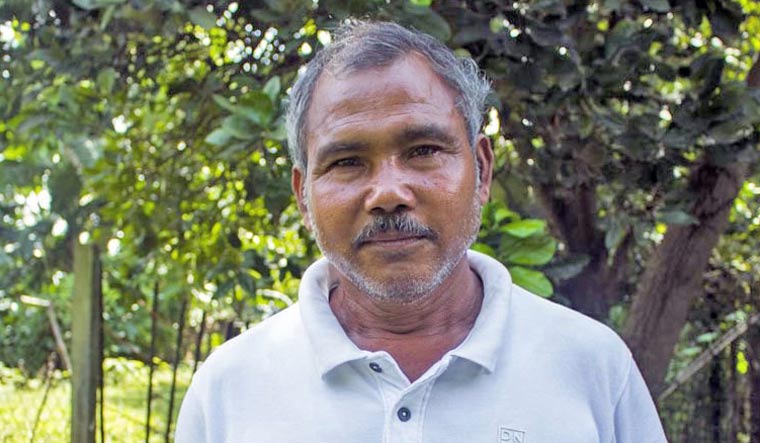
Jadav “Molai” Payeng (born 1959) is an Indian environmentalist from Assam. Working alone for more than forty years, he planted and tended trees on a barren sandbar of the Brahmaputra until it became a forest of about 550 hectares, now home to tigers, rhinoceroses, deer and visiting herds of elephants. It is called the Molai forest after him, and he is known as the Forest Man of India.
Quick Facts
| Full name | Jadav Payeng |
| Nickname | Molai |
| Born | 1959, Assam |
| State | Assam |
| Community | Mising |
| Occupation | Environmentalist, dairy farmer |
| Known for | Creating the Molai forest on a sandbar of the Brahmaputra near Jorhat |
| Awards | Padma Shri (2015) |
| Spouse | Binita Payeng |
| Children | 3 |
Early Life
He was born into a family of the Mising tribe, a community that lives along the rivers of upper Assam, and grew up near Kokilamukh in the Jorhat district, close to the river island of Majuli. His family kept cattle and buffalo and sold milk. He studied up to the tenth class.
How It Began
In 1979 a great flood on the Brahmaputra washed a large number of snakes on to a bare sandbar. When the water went down they died in the heat, having no shade. Payeng, then about sixteen, found them. He has said that he sat down and wept, and asked the elders what would happen if people one day died the same way.
He approached the forest department, which told him that nothing would grow there, and suggested he try bamboo. He planted about twenty bamboo seedlings. A government scheme to plant trees on part of the sandbar employed him as a labourer for a few years; when it ended and the others left, he stayed.
The Forest
Every day he crossed the river, carried seeds and saplings, and watered them. To improve the sand he brought red ants and termites from his village, which loosened the soil. He planted bamboo, then cotton trees, arjun, teak, gulmohar and many other species, and protected them from grazing and cutting. As the trees grew they seeded themselves.
The forest now covers about 550 hectares, more than the size of New York’s Central Park.
- **Wildlife:** Bengal tigers, one-horned rhinoceroses, deer, wild boar, apes, vultures and many other birds
- **Elephants:** a herd of about a hundred visits for several months each year and has calved there
He built a hut on the sandbar and lived there with his family, earning his living from the milk of his cows and buffalo. Tigers killed many of his animals; he said they did not know farming and had to eat.
Discovery
The outside world knew nothing of the forest for nearly thirty years. In 2008 forest officials followed a herd of elephants that had damaged a village and were astonished to find dense woodland where the maps showed sand. A wildlife photographer from Jorhat, Jitu Kalita, wrote about him in an Assamese newspaper in 2010, and the story spread.
In 2012 Jawaharlal Nehru University in Delhi honoured him and gave him the title Forest Man of India.
Recognition
- Padma Shri, 2015
- Honorary doctorates from Assam Agricultural University and Kaziranga University
- The documentary Forest Man (2013), by a Canadian film-maker, won awards at festivals abroad
- His story is told in school textbooks in India and has been taught in schools in the United States
Later Work
He has continued planting, on other sandbars of the Brahmaputra and on Majuli, which is being eaten away by erosion, and has advised projects in Rajasthan and abroad. He argues that every schoolchild should plant and look after two trees.
Personal Life
He and his wife, Binita, have two sons and a daughter. He still rises before dawn to cross the river. Poachers have threatened him for reporting them, and he has asked the government to give the forest formal protection.
The Molai forest lies in the same river system as Kaziranga National Park, further downstream.
Featured image: Jadav Payeng, the Forest Man of India. Photo by Jadav Payeng, licensed under CC BY-SA 3.0, via Wikimedia Commons.



