
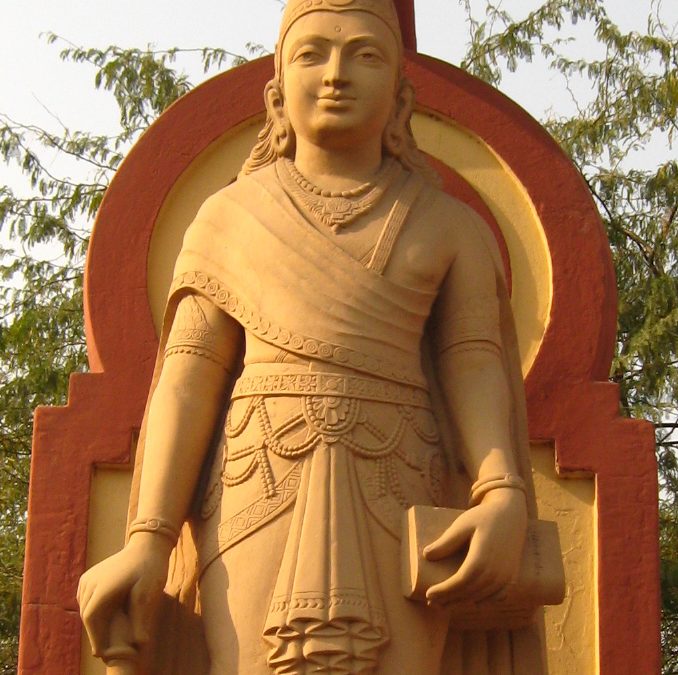
Chandragupta Maurya (reigned about 321–297 BCE) was the founder of the Maurya dynasty and the first ruler to bring most of the Indian subcontinent under one government. Rising from obscurity with the help of the Brahmin strategist Chanakya, he overthrew the Nanda kings of Magadha, took the north-west from the successors of Alexander the Great, and created an empire that his grandson Ashoka would bring to its height.
Quick Facts
| Born | about 350 BCE |
| Died | about 295 BCE, by tradition at Shravanabelagola, Karnataka |
| Dynasty | Maurya (founder) |
| Reign | about 321–297 BCE |
| Capital | Pataliputra (modern Patna) |
| Mentor | Chanakya (Kautilya) |
| Known for | Founding the Maurya empire; the treaty with Seleucus |
| Greek name | Sandrokottos |
| Successor | Bindusara |
Origins
Nothing certain is known of his birth. Buddhist texts make him a member of the Moriya clan of warriors; other traditions say he was of humble birth, the son or grandson of a woman named Mura. A Greek writer says he met Alexander as a young man. All agree that he began with no kingdom and no army.
Chanakya
The sources tell that Chanakya, a learned Brahmin of Taxila who had been insulted at the court of the Nanda king, found the boy, recognised his qualities and trained him. Together they raised a force, at first without success; a story relates that Chandragupta learnt his strategy from overhearing a mother scold her child for eating from the hot centre of a dish instead of the cooler edges. They began again from the frontiers.
The Nanda Overthrown
The Nandas ruled the rich Ganga plain from Pataliputra with a very large army, and were unpopular for their taxes. Around 321 BCE Chandragupta defeated them and took the throne.
The North-West
Alexander had died in 323 BCE, and his governors in the Indus region were soon fighting each other. Chandragupta drove out the Macedonian garrisons and annexed Punjab and Sindh.
About 305 BCE Seleucus Nicator, who had inherited the eastern part of Alexander’s empire, marched to recover the lost provinces. The outcome was a treaty much in Chandragupta’s favour. Seleucus gave up territory covering much of present-day Afghanistan and Baluchistan and received five hundred war elephants; there was also a marriage alliance between the two houses. The elephants later helped Seleucus win his decisive battle in the west.
The Empire
His dominions stretched from Afghanistan to Bengal and south into the Deccan. Seleucus sent an ambassador, Megasthenes, who lived at Pataliputra and wrote a book, the Indica, surviving in fragments.
- **The capital:** a city some fourteen kilometres long on the Ganga, surrounded by a wooden wall with 570 towers and 64 gates, and a palace more splendid than those of Persia
- **The army:** Greek writers speak of 600,000 infantry, 30,000 cavalry and 9,000 elephants, run by a war office of thirty members
- **Government:** officials supervised trade, irrigation, roads and the registration of births and deaths; a royal road ran from the north-west to the capital
- **The king:** hard-working and heavily guarded, changing his bedroom for fear of assassins
The Arthashastra, the treatise on government attributed to Chanakya, is thought to reflect in part the workings of this state.
Last Years
According to Jain tradition, he gave up the throne to his son Bindusara, became a Jain monk and travelled south with the teacher Bhadrabahu to Shravanabelagola in Karnataka, where he fasted to death in the manner of Jain ascetics. The hill there is called Chandragiri after him. The story appears in texts and inscriptions written centuries later.
Why He Matters
The identification of the Greek “Sandrokottos” with Chandragupta, made by the scholar Sir William Jones in 1793, gave historians the first firm date in ancient Indian history. The play Mudrarakshasa, written some seven centuries after his time, tells the story of his rise.
Featured image: A modern statue of the young Chandragupta Maurya at the Birla Mandir, New Delhi. Photo by आशीष भटनागर at Hindi Wikipedia, in the public domain, via Wikimedia Commons.



