
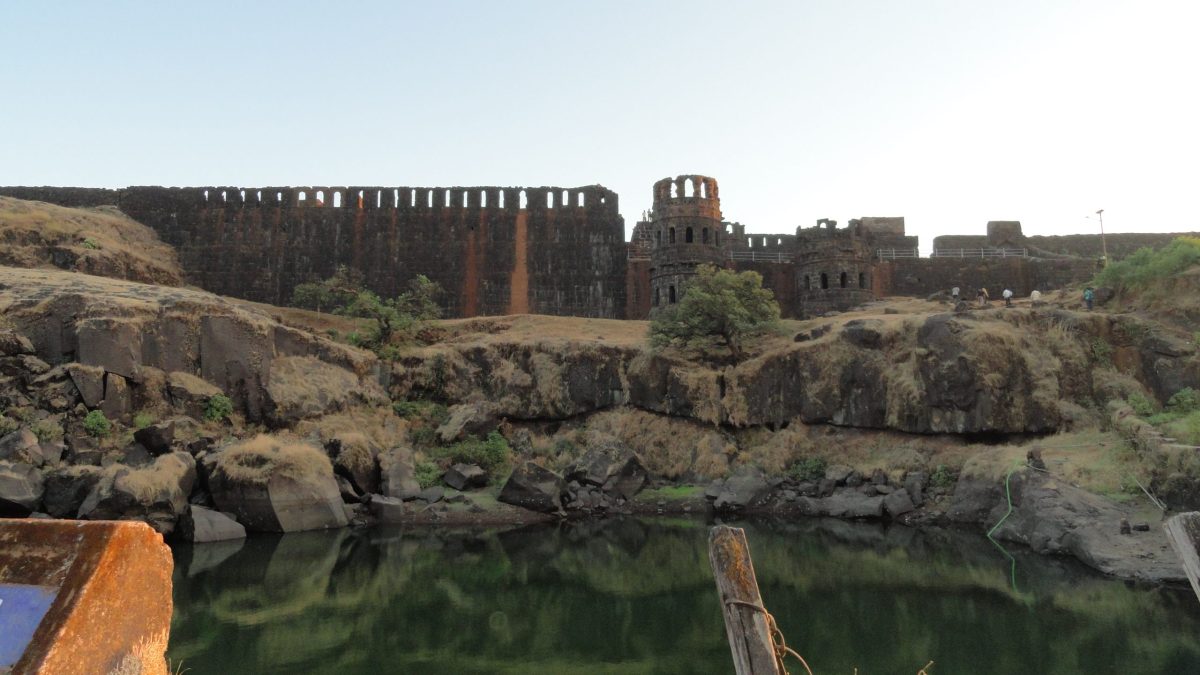
The Maratha kingdom founded by Shivaji in the seventeenth century was built on forts: on the peaks of the Sahyadri mountains, on the coast and on islands in the sea. Twelve of them were inscribed by UNESCO in July 2025 as the Maratha Military Landscapes of India, the country’s forty-fourth World Heritage Site.
At a glance
- Location: Maharashtra (eleven forts) and Tamil Nadu (one)
- Inscribed: 2025
- Type: Cultural
- Period: seventeenth to nineteenth centuries
- Number of forts: twelve
The twelve forts
Hill forts
- Shivneri: near Junnar, the birthplace of Shivaji in 1630
- Rajgad: his capital for about twenty-five years
- Raigad: where he was crowned Chhatrapati in 1674 and where he died in 1680
- Pratapgad: scene of his encounter with Afzal Khan in 1659
- Lohagad: near Lonavala, with a long fortified spur
- Salher: in Nashik district, one of the highest forts in the Sahyadris
- Panhala: near Kolhapur, a large plateau fort
Coastal and island forts
- Vijaydurg: a great sea fort on a creek, later the base of the admiral Kanhoji Angre
- Sindhudurg: built by Shivaji on a rocky island off Malvan
- Suvarnadurg: an island fort near Harnai
- Khanderi: an island off the coast near Mumbai, fortified to watch the English and the Siddis
In Tamil Nadu
- Gingee: a group of three fortified hills, taken by Shivaji in 1677, which later sheltered his son Rajaram during a long Mughal siege
Why forts mattered
The Marathas could not match the Mughal or Bijapur armies in the open plain. The broken country of the Western Ghats gave them hundreds of defensible hilltops, from which fast-moving troops could raid and to which they could withdraw. Shivaji captured, repaired or built more than three hundred forts, and created a navy with fortified harbours to protect the coast.
Features
- Use of terrain: walls follow the cliffs, and natural rock is cut into scarps
- Gates: hidden behind curved bastions so that they cannot be seen or rammed from outside
- Water: rock-cut cisterns to withstand long sieges
- Networks: forts placed within sight of one another to pass signals
Why they are a World Heritage Site
The forts illustrate a distinctive system of military planning adapted to mountains, coast and sea, which enabled the Marathas to become a major power.
Visiting
Raigad has a ropeway; Pratapgad and Panhala can be reached by road; most of the hill forts involve a climb, and the island forts a boat. The months after the monsoon, from October to February, are the best time.
Image: Raigad Fort in Maharashtra, the capital of Shivaji. Photo by Gbaadkar, licensed under CC BY-SA 3.0, via Wikimedia Commons.


Leave a Reply