
The old walled city of Ahmedabad, on the east bank of the Sabarmati river in Gujarat, has been continuously lived in for six centuries. In 2017 it became the first city in India to be inscribed by UNESCO as a World Heritage Site.
At a glance
- Location: Ahmedabad, Gujarat
- Inscribed: 2017
- Type: Cultural
- Founded: 1411
- Founded by: Sultan Ahmad Shah I of Gujarat
History
Ahmad Shah built his new capital beside an older town and gave it his name. It prospered under the Gujarat sultans, the Mughals and the Marathas as a centre of the textile trade, and its merchants, many of them Jains, were among the richest in India. In the twentieth century Mahatma Gandhi made his home at the Sabarmati Ashram across the river, from which he set out on the Dandi March.
The monuments
- Bhadra Fort: the citadel, with the triple gateway called Teen Darwaza leading to the old royal square
- Jama Masjid: completed in 1424, with a forest of 260 pillars
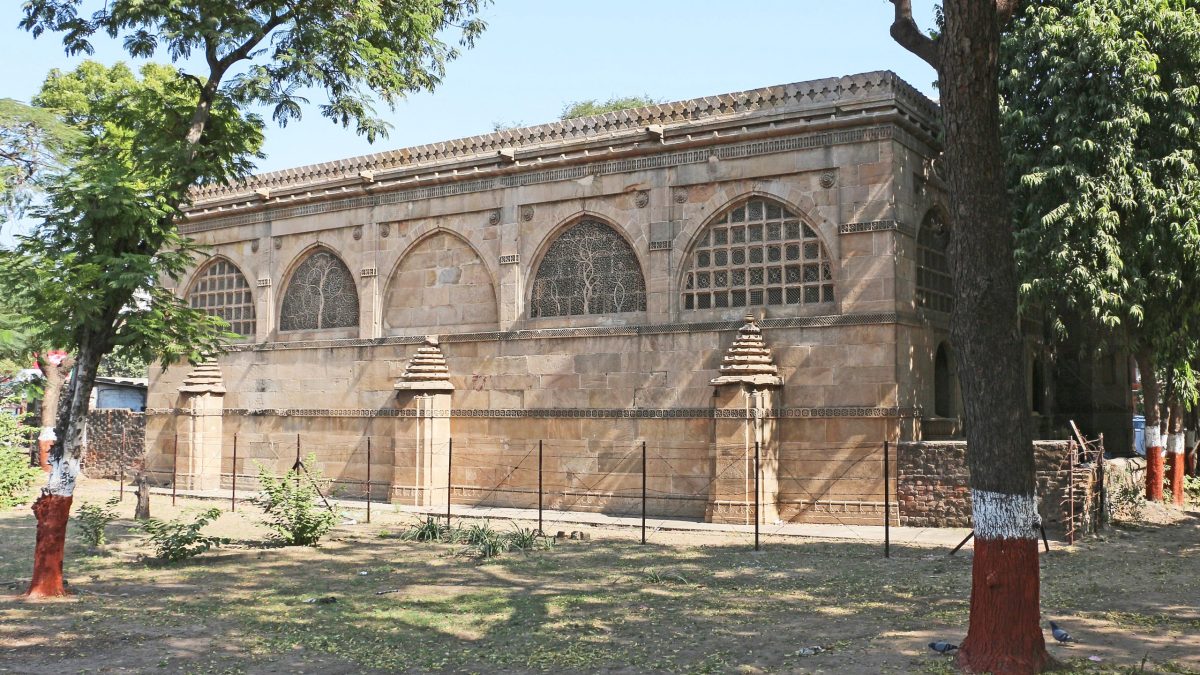
- Sidi Saiyyed Mosque: built in 1573, famous for a window screen of carved stone in the form of a tree with intertwining branches. The design has become the unofficial symbol of the city.
- Tombs of Ahmad Shah and his queens
- Hindu and Jain temples, including the Swaminarayan temple at Kalupur with its painted woodwork
The mosques of the sultanate period are known for combining Islamic forms with the stone carving of Gujarat’s temple tradition.
The pols
What makes the city distinctive is its housing. The old town is divided into several hundred pols: clusters of houses along a narrow lane, entered through a single gate, originally occupied by families of one community or trade.
- Houses: timber-framed, with carved wooden fronts, brackets and balconies, built round a small courtyard, with a tank beneath for storing rainwater
- Chabutaro: an ornamental tower for feeding birds, found in most pols
- Community life: each pol has its own shrine, well and notice board, and secret passages are said to link some of them
Why it is a World Heritage Site
UNESCO recognises the city as an exceptional example of a sultanate-period settlement in which communities of different faiths have lived closely together, and whose traditional neighbourhoods are still in use.
Visiting
The municipal corporation runs a morning heritage walk through the pols, starting at the Swaminarayan temple and ending at the Jama Masjid. The lanes are too narrow for cars and are best explored on foot.
Image: The Sidi Saiyyed Mosque in Ahmedabad, known for its carved stone screens. Photo by Bernard Gagnon, licensed under CC BY-SA 3.0, via Wikimedia Commons.




Leave a Reply