In the mid-1960s India depended on shiploads of foreign wheat to feed its people. Within a decade it was growing enough grain for itself. The change, known as the Green Revolution, was one of the most important events in the country’s economic history.
The crisis
India’s food output had not kept pace with its population. Two failed monsoons in a row, in 1965 and 1966, brought the threat of famine, especially in Bihar. The country imported about ten million tonnes of grain a year, mostly American wheat supplied under the PL-480 programme, and was said to be living “from ship to mouth”. The United States used the supplies to press India on policy. Prime Minister Lal Bahadur Shastri asked people to skip a meal a week and gave the slogan “Jai Jawan, Jai Kisan”.
The new seeds
The American scientist Norman Borlaug had bred dwarf varieties of wheat in Mexico that gave far higher yields when fed with fertiliser and water, and did not fall over under the weight of the grain. The Indian geneticist M. S. Swaminathan saw their promise, invited Borlaug to India in 1963 and tested the varieties in Indian fields.
The Food and Agriculture Minister, C. Subramaniam, backed the scientists against sceptics in the government. In 1966 India imported 18,000 tonnes of Mexican wheat seed, then the largest seed purchase in history.
What made it work
- Seeds: high-yielding wheat such as Lerma Rojo and Sonora 64, later improved by Indian breeders, and the rice variety IR8
- Inputs: chemical fertiliser, pesticides and assured irrigation from canals and tube wells
- Prices: a guaranteed minimum support price, with the Food Corporation of India, set up in 1965, buying the grain
- Farmers: in Punjab, Haryana and western Uttar Pradesh, who adopted the new methods quickly
The results
- Wheat: production rose from about 12 million tonnes in 1965 to about 17 million in 1968 and 20 million in 1970. Schools in Punjab were closed to store the 1968 harvest.
- Imports: India stopped depending on food aid in the early 1970s.
- Total foodgrain: output has grown from around 80 million tonnes in the mid-1960s to more than 300 million tonnes today.
Indira Gandhi released a postage stamp in 1968 titled “Wheat Revolution”.
The costs
- Water: Groundwater in Punjab and Haryana has fallen sharply.
- Soil and health: Heavy use of fertiliser and pesticide has damaged soils and raised health concerns.
- Narrow cropping: The wheat-rice cycle pushed out pulses, millets and oilseeds.
- Inequality: The gains went mainly to irrigated regions and larger farmers; rain-fed and eastern India were left behind.
Swaminathan himself warned of these dangers from the 1960s and later called for an “evergreen revolution”, raising output without ecological harm. He was awarded the Bharat Ratna in 2024.
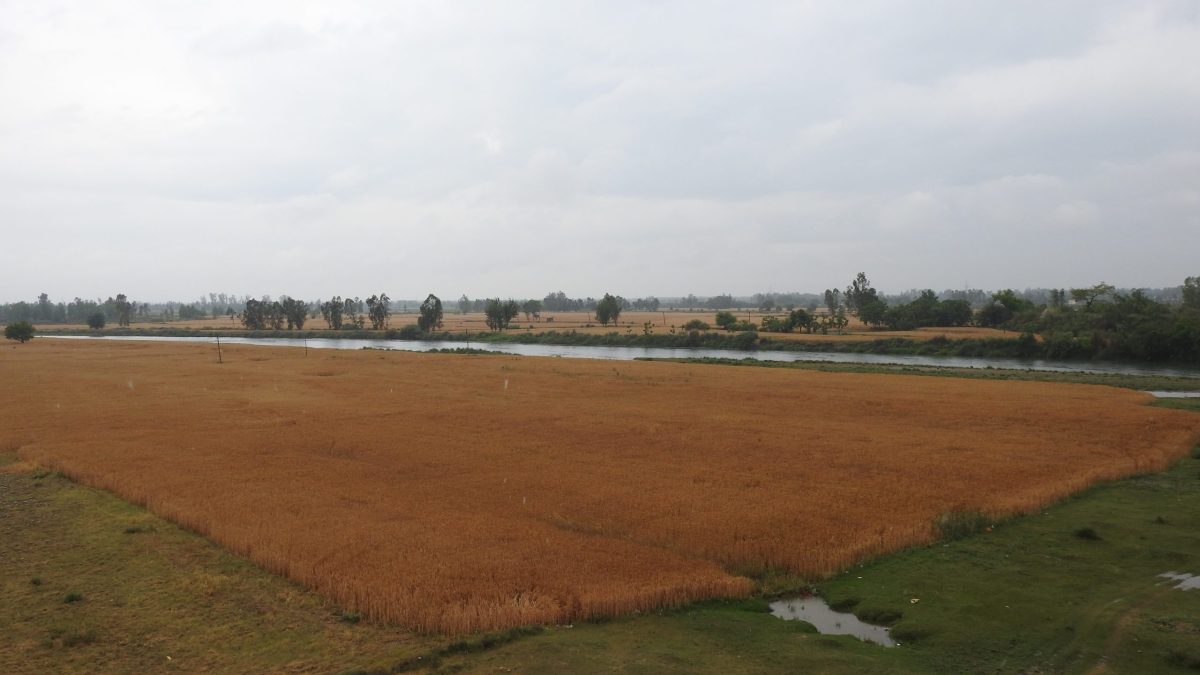
Image: A wheat crop in Punjab, the state at the centre of the Green Revolution. Photo by Harvinder Chandigarh, licensed under CC BY-SA 4.0, via Wikimedia Commons.