
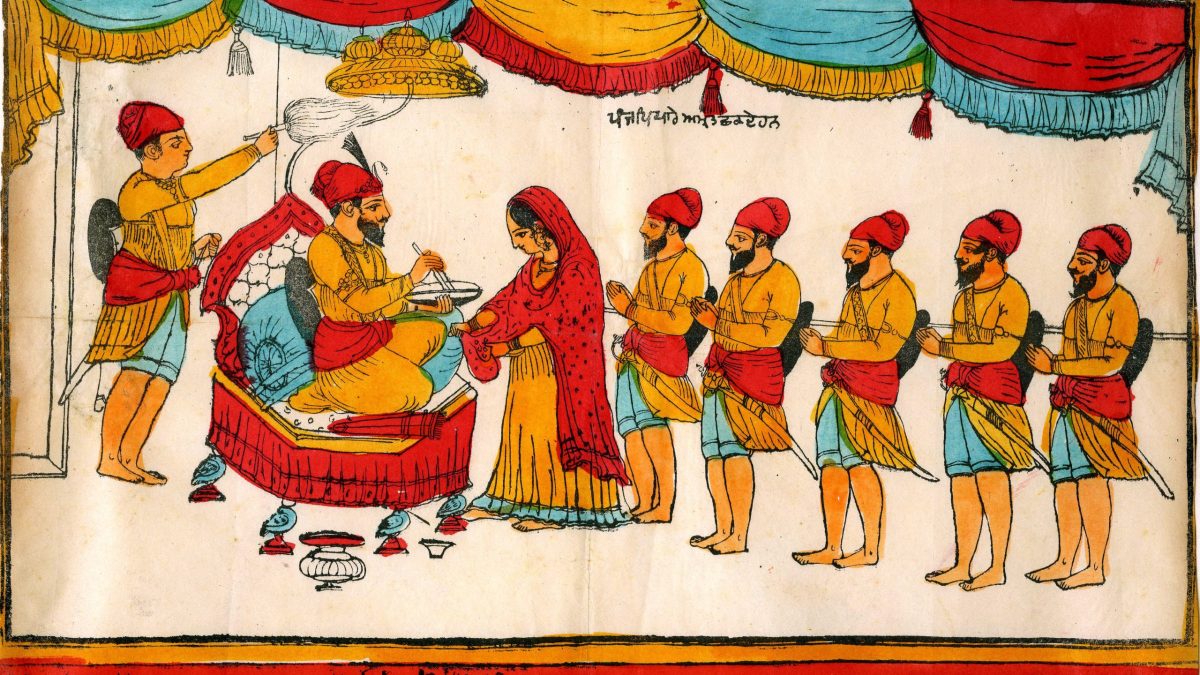
The Khalsa was founded in April 1699 by the tenth Sikh Guru, Guru Gobind Singh, at Anandpur Sahib in Punjab, and its creation is celebrated every year at the festival of Vaisakhi. It created a community of initiated Sikhs with a common code of conduct and a duty to protect the innocent, and it changed the course of Sikh history.
Quick Facts
| Date | Vaisakhi, April 1699 |
| Place | Anandpur Sahib, Punjab |
| Founder | Guru Gobind Singh, the tenth Guru |
| First initiated | The Panj Pyare (‘Five Beloved Ones’) |
| Core | Amrit initiation, the Rahit code, the five Ks, the name Singh |
| Later | Sikh misls, Dal Khalsa, the Sikh Empire |
Background
Guru Gobind Singh became Guru as a child after his father, Guru Tegh Bahadur, was beheaded in Delhi in 1675 on the orders of the Mughal emperor Aurangzeb, after he had taken up the cause of Kashmiri Brahmins seeking protection. The Sikh community was growing, and had its own armed followers, but had suffered from rival claimants and the corruption of the masand system of regional agents who collected offerings. The word khalsa, meaning pure, was already used earlier for Sikhs directly linked to the Guru.
The Gathering at Anandpur
On Vaisakhi in 1699 a large gathering assembled at Anandpur. According to tradition, the Guru stood before the crowd with a sword and called for a head. Five men came forward one after another, and after each the Guru went into the tent. The five were later brought out in new robes. They were named the Panj Pyare, the Five Beloved, and were initiated with amrit, a sweetened water stirred with a double-edged sword, the khanda. The Guru was then initiated by them in turn.
The Code of the Khalsa
- **Names:** men took the name Singh, ‘lion’, and women later the name Kaur
- **The five Ks:** kesh (uncut hair), kangha (comb), kara (steel bracelet), kachera (undergarment) and kirpan (sword)
- **The Rahit:** a code that forbids tobacco and other intoxicants and requires equality, with no distinction of caste within the order
- **Duty:** to defend the weak and the persecuted, and to fight injustice
The Khalsa also replaced the masands as the community’s organisation. Today most Sikhs honour the Khalsa as the highest ideal, though not all are formally initiated.
After the Guru
Guru Gobind Singh fought several battles with hill chiefs and Mughal forces and lost his four sons. He died in 1708 in Nanded after designating the Guru Granth Sahib as the Sikhs’ eternal Guru. Banda Singh Bahadur, whom he had sent to Punjab, led a Khalsa rebellion in 1709–10 that captured Sirhind, though he was captured in 1715 and executed the following year.
The Misls and the Empire
In the eighteenth century, Sikh fighting bands called misls arose across Punjab, and joined together in the Dal Khalsa in 1748 to resist Afghan invaders. Twelve main misls divided the country. At the end of the century Ranjit Singh united them and took Lahore in 1799, founding the Sikh Empire; see Ranjit Singh’s biography. The empire fell in the wars described in the Anglo-Sikh Wars.
Featured image: Guru Gobind Singh and the first Khalsa, in a Sikh painting. Photo by Attributed at Punjab, in the public domain, via Wikimedia Commons.




Leave a Reply