
The Sikh Empire built by Maharaja Ranjit Singh was the last major Indian state to fall to the East India Company. Within ten years of his death in 1839 it had been defeated in two wars and annexed. The Anglo-Sikh Wars of 1845–46 and 1848–49 brought the whole of the Indian subcontinent under British control, from the sea to the Khyber.
Quick Facts
| Wars | First (1845–46), Second (1848–49) |
| Sides | East India Company vs the Sikh Empire (Khalsa Army) |
| Key battles | Mudki, Ferozeshah, Aliwal, Sobraon; Chillianwala, Gujrat |
| Treaties | Lahore (March 1846); annexation proclaimed 1849 |
| Outcome | Punjab annexed; Maharaja Duleep Singh deposed |
Collapse of the Empire
Ranjit Singh kept a wary friendship with the British while building a modern army trained by European officers. After his death the kingdom fell into disorder. His son Kharak Singh was removed within months and died in prison, and his grandson Nau Nihal Singh died in suspicious circumstances after an accident at Lahore Fort. Sher Singh was crowned in 1841. The Khalsa Army grew from about 29,000 men in 1839 to more than 80,000 by 1845, and its regimental committees became a power of their own, outside the control of the court.
The First War (1845–46)
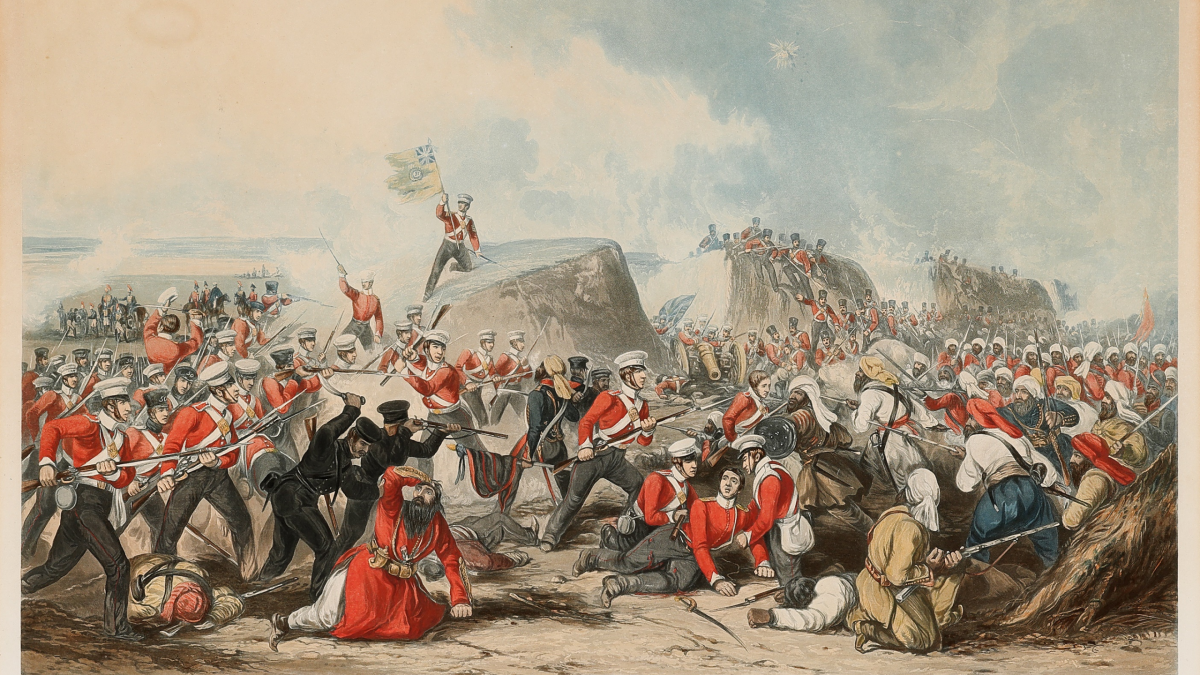
In December 1845 the Sikh army crossed the Sutlej. The Company’s army fought them at Mudki and Ferozeshah, in hard battles in which both sides suffered heavily, and at Aliwal in January 1846. The war ended at Sobraon on 10 February 1846, where the Sikhs were defeated on the banks of the river. Some accounts blame the treachery of Sikh commanders, including Lal Singh and Tej Singh, who are alleged to have been in touch with the British, though historians debate the extent of it.
- **Treaty of Lahore (9 March 1846):** the Sikh state gave up the Jalandhar Doab and paid an indemnity, and its army was reduced
- **Kashmir:** the region was sold to Gulab Singh of Jammu under the Treaty of Amritsar, creating a separate princely state under British suzerainty
- **A resident at Lahore:** the child maharaja, Duleep Singh, kept his throne under British supervision
The Second War (1848–49)
In April 1848 two British officers were killed at Multan, and the rebellion of the governor, Diwan Mulraj, spread. Lord Dalhousie, the Governor-General, took his time to prepare and then resolved to subdue the whole of Punjab.
- **Chillianwala (13 January 1849):** a costly and indecisive battle for the British commander, Hugh Gough
- **Multan:** the city fell on 22 January 1849
- **Gujrat (21 February 1849):** a decisive British victory, after which the Sikh army surrendered at Rawalpindi
Dalhousie annexed Punjab in 1849 and the East India Company received thanks from Parliament. Duleep Singh, then a boy, was sent away from Punjab, later taken to England in 1854. The Koh-i-Noor diamond was handed to the British Crown.
Why It Matters
Punjab’s fall removed the last independent power and gave the Company a loyal recruiting ground. Sikh soldiers later fought for the British in 1857 and in both world wars. The story of the empire’s rise is told in Ranjit Singh’s biography, and the larger context in the Revolt of 1857.
Featured image: The Battle of Sobraon, fought on 10 February 1846, in a painting by J. Harris. Photo by J. Harris after Henry Martens, in the public domain, via Wikimedia Commons.




Leave a Reply