Sir Vidiadhar Surajprasad Naipaul (17 August 1932 – 11 August 2018) was a Trinidad-born British writer of Indian descent. In novels and books of travel written over fifty years he examined the legacy of empire in the Caribbean, Africa, India and the Islamic world. He won the Booker Prize in 1971 and the Nobel Prize in Literature in 2001. He is regarded as one of the finest prose stylists in English and one of its most contentious figures.
Quick Facts
| Full name | Vidiadhar Surajprasad Naipaul |
| Born | 17 August 1932, Chaguanas, Trinidad |
| Died | 11 August 2018, London (aged 85) |
| Nationality | British (born Trinidadian) |
| Indian roots | Grandparents emigrated from eastern Uttar Pradesh as indentured labourers |
| Education | Queen’s Royal College, Port of Spain; University College, Oxford |
| Occupation | Novelist, travel writer, essayist |
| Notable works | A House for Mr Biswas, In a Free State, A Bend in the River, An Area of Darkness, India: A Million Mutinies Now |
| Awards | Booker Prize (1971), knighthood (1990), Nobel Prize in Literature (2001) |
| Spouse | Patricia Hale (m. 1955; died 1996); Nadira Alvi (m. 1996) |
Early Life
He was born at Chaguanas in Trinidad, then a British colony. His grandparents had come from the Gorakhpur region of northern India in the 1880s as indentured labourers for the sugar plantations. His mother’s family, the Capildeos, were prosperous and orthodox Brahmins. His father, Seepersad Naipaul, was a journalist on the Trinidad Guardian who wrote short stories and longed to be an author; the son inherited the ambition.
The family moved to Port of Spain, where he attended Queen’s Royal College and won a government scholarship.
Oxford and Early Struggle
He went to University College, Oxford, in 1950 to read English. He was lonely and depressed there, and his father died while he was away. After graduating he scraped a living in London, presenting a literary programme for the Caribbean on the BBC. In a BBC office in 1955 he typed the first sentence of what became Miguel Street.
Works
Trinidad
His early books are comedies of Trinidad life: The Mystic Masseur (1957), The Suffrage of Elvira and Miguel Street. A House for Mr Biswas (1961), based on his father’s life, follows a man’s lifelong struggle to own a house of his own and so to be someone. It is generally counted his masterpiece.
The wider world
- In a Free State (1971), linked narratives of displacement, which won the Booker Prize
- Guerrillas (1975) and A Bend in the River (1979), novels of disorder in the Caribbean and in post-colonial Africa
- The Enigma of Arrival (1987), an autobiographical novel of his life in the English countryside
- Among the Believers (1981) and Beyond Belief (1998), journeys through Iran, Pakistan, Malaysia and Indonesia
India
He wrote three books about the land of his ancestors, each different in mood.
- An Area of Darkness (1964): his first visit, a record of shock and disappointment; it was banned in India
- India: A Wounded Civilization (1977): written during the Emergency
- India: A Million Mutinies Now (1990): a more hopeful portrait of a country in which every group was finding its voice
Controversy
His harsh judgments of post-colonial societies and of Islam led critics, among them Edward Said and Derek Walcott, to accuse him of contempt for the people he came from. His remarks approving the rise of Hindu nationalism in India were also much criticised. An authorised biography by Patrick French, The World Is What It Is (2008), drew on his own papers to show his cruelty to his first wife.
Personal Life
He married Patricia Hale, an Englishwoman he had met at Oxford, in 1955; she was his first reader and editor until her death in 1996. For many years he also had a relationship with an Anglo-Argentine woman, Margaret Gooding. Two months after his wife’s death he married Nadira Alvi, a Pakistani journalist. He had no children of his own. His younger brother, Shiva Naipaul, was also a novelist.
He died in London in 2018, a few days before his eighty-sixth birthday.
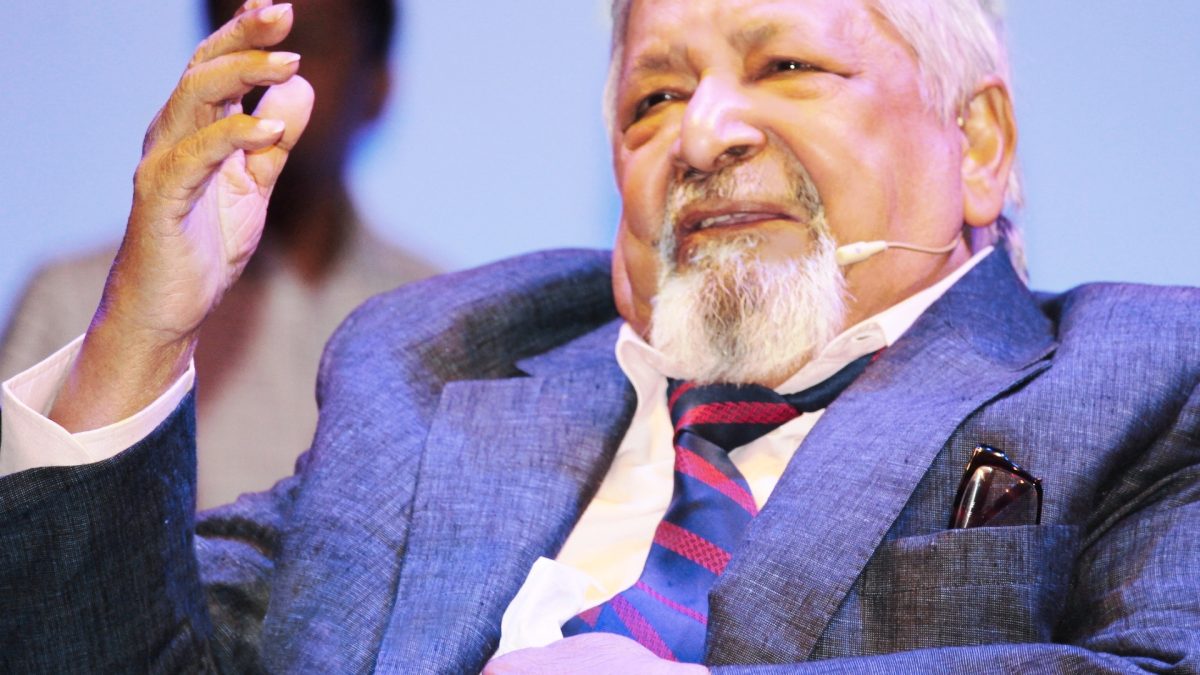
Featured image: V. S. Naipaul speaking at a literary festival in Dhaka, November 2016. Photo by Faizul Latif Chowdhury, licensed under CC BY-SA 4.0, via Wikimedia Commons.