Khushwant Singh (2 February 1915 – 20 March 2014) was an Indian novelist, historian and journalist. His novel Train to Pakistan is the best-known work of fiction about the Partition of India, and his two-volume A History of the Sikhs remains a standard work. As editor of The Illustrated Weekly of India he multiplied its readership several times over, and his weekly column, irreverent, bawdy and learned, ran in dozens of newspapers until he was in his nineties.
Quick Facts
| Full name | Khushwant Singh |
| Born | 2 February 1915, Hadali, Punjab (now in Pakistan) |
| Died | 20 March 2014, New Delhi (aged 99) |
| Education | Modern School, New Delhi; Government College, Lahore; King’s College London; Inner Temple |
| Occupation | Novelist, historian, journalist, lawyer, diplomat |
| Notable works | Train to Pakistan; A History of the Sikhs; I Shall Not Hear the Nightingale; Delhi; Truth, Love and a Little Malice |
| Offices | Member of the Rajya Sabha (1980–1986) |
| Awards | Padma Bhushan (1974, returned 1984), Padma Vibhushan (2007) |
| Spouse | Kaval Malik |
| Children | Rahul Singh and Mala Dayal |
Early Life
He was born at Hadali, a village on the edge of the Thar desert in western Punjab. His father, Sir Sobha Singh, was the chief building contractor of New Delhi; the family put up much of the new imperial capital, and owned a large part of it. He grew up in Delhi, and studied at Lahore and in London, where he was called to the bar.
By his own account he was an indifferent student and, in eight years of practice at the Lahore High Court, an unsuccessful lawyer.
Partition
In August 1947 he was driving from Lahore to his family’s summer home in the hills when he passed through a countryside emptied by killing. He never went back to live in Lahore. What he saw and heard that summer became, nine years later, a novel.
Diplomat
He joined the new Indian foreign service as a press officer and served in London and Ottawa. He then worked for All India Radio and for UNESCO in Paris, and left government for good in the mid-1950s to write.
Books
Train to Pakistan
Published in 1956, it is set in a village on the border in the summer of 1947, where Sikhs and Muslims have lived as neighbours for generations. A train arrives from Pakistan full of corpses. The novel shows, in a small compass and without taking sides, how ordinary people were drawn into murder, and how one disreputable man acts to stop it.
History
A History of the Sikhs, in two volumes (1963 and 1966), written with the help of a grant from the Rockefeller Foundation, was the first full scholarly account. He also wrote a life of Ranjit Singh and translated Sikh scripture, Urdu poetry and the fiction of other writers.
Other fiction
I Shall Not Hear the Nightingale (1959); Delhi (1990), a novel twenty years in the writing that tells the city’s history through a succession of narrators; The Company of Women; and many short stories.
Editor
He was the founding editor of the government’s planning journal, Yojana. In 1969 he took charge of The Illustrated Weekly of India, a staid magazine with a circulation of about sixty-five thousand. He filled it with controversy, investigative articles, series on India’s communities and a good deal of bare skin, and the circulation rose to some four hundred thousand. He was removed abruptly in 1978. He later edited the National Herald and, from 1980 to 1983, the Hindustan Times.
His column, “With Malice Towards One and All”, appeared for decades under a cartoon of him sitting inside a light bulb beside a pile of books and a bottle. It mixed politics, gossip, nature notes, obituaries, bad jokes and Urdu verse.
Politics
He was close to the family of Indira Gandhi and supported the Emergency of 1975, a position for which he was much criticised and which he later partly regretted. He was a nominated member of the Rajya Sabha from 1980 to 1986.
In June 1984, when the army entered the Golden Temple at Amritsar, he returned his Padma Bhushan in protest. He was equally outspoken against the Sikh militants, who put him on a hit list. During the massacre of Sikhs in Delhi that November he took refuge in a foreign embassy.
The Man
He called himself an agnostic and a dirty old man, and cultivated the reputation. In fact he rose at four, worked all day, and showed guests the door at eight in the evening. A sign outside his flat asked visitors not to ring the bell unless expected.
Death
His wife, Kaval, died in 2001. He published his last book at ninety-eight and died at his home in New Delhi on 20 March 2014, a few months short of a hundred. He was awarded the Padma Vibhushan in 2007. The epitaph he wrote for himself ends by thanking the Lord that he is dead, “this son of a gun”.
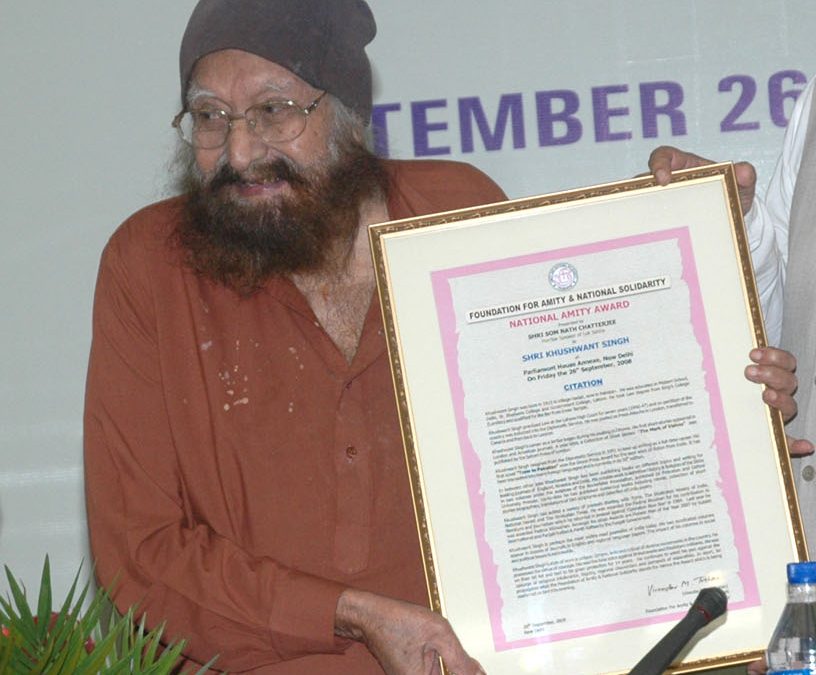
Featured image: Khushwant Singh receiving the National Amity Award in New Delhi, September 2008. Photo by the Ministry of Parliamentary Affairs, licensed under Government Open Data License – India, via Wikimedia Commons.