Sir Ahmed Salman Rushdie (born 19 June 1947) is an Indian-born British and American novelist. Midnight’s Children, his novel of India’s independence, won the Booker Prize in 1981 and was twice judged the best of all Booker winners. His novel The Satanic Verses brought a call for his death from the leader of Iran in 1989, and he became a symbol of the defence of free expression. In 2022 he was stabbed on a stage in the United States and lost the sight of one eye.
Quick Facts
| Full name | Ahmed Salman Rushdie |
| Born | 19 June 1947, Bombay (Mumbai), India |
| Age | 79 |
| Nationality | British and American (born Indian) |
| Education | Cathedral and John Connon School, Bombay; Rugby School; King’s College, Cambridge (history) |
| Occupation | Novelist, essayist |
| Notable works | Midnight’s Children, Shame, The Satanic Verses, The Moor’s Last Sigh, Joseph Anton, Knife |
| Awards | Booker Prize (1981), Best of the Booker (2008), knighthood (2007), Companion of Honour (2022) |
| Spouse | Rachel Eliza Griffiths (m. 2021); four earlier marriages |
| Children | 2 |
Early Life
He was born in Bombay two months before India’s independence, the only son of Anis Ahmed Rushdie, a Cambridge-educated businessman, and Negin, a teacher, in a Kashmiri Muslim family. He grew up in a house on Warden Road and was educated at the Cathedral School. At thirteen he was sent to Rugby School in England, and went on to read history at King’s College, Cambridge. His family moved to Pakistan in 1964.
Career
Beginnings
He worked in London as an advertising copywriter, coining slogans that are still remembered, and wrote in his spare time. His first novel, Grimus (1975), made little impression.
Midnight’s Children
Midnight’s Children (1981) tells the story of Saleem Sinai, born at the stroke of midnight on 15 August 1947 and telepathically linked to the thousand other children born in that hour. Exuberant, comic and crowded, written in an English full of the rhythms of Bombay, it changed the course of Indian writing in English. Shame (1983), about Pakistan, followed.
The Satanic Verses
The Satanic Verses (1988) includes dream sequences that many Muslims considered insulting to the Prophet. India banned its import within days of publication. There were book burnings in Britain and riots in Pakistan and India. On 14 February 1989 Ayatollah Khomeini of Iran issued a fatwa calling on Muslims to kill the author and his publishers.
Rushdie went into hiding under British police protection, using the name Joseph Anton, for most of a decade. His Japanese translator was murdered, and his Italian translator and Norwegian publisher were wounded. The Iranian government distanced itself from the threat in 1998, though the fatwa was never withdrawn.
Later work
He went on writing: Haroun and the Sea of Stories (1990), for his son; The Moor’s Last Sigh (1995); The Ground Beneath Her Feet; Shalimar the Clown; The Enchantress of Florence; and the memoir Joseph Anton (2012). He moved to New York in 2000.
The attack
On 12 August 2022, as he was about to speak at the Chautauqua Institution in New York State, a young man ran on to the stage and stabbed him repeatedly. He lost his right eye and the use of one hand. The attacker was convicted of attempted murder in 2025 and sentenced to twenty-five years in prison. Rushdie wrote about the attack and his recovery in Knife (2024). His novel Victory City (2023), set in the Vijayanagara empire, had been finished before it, and a collection of stories, The Eleventh Hour, followed in 2025.
Personal Life
He has been married five times: to Clarissa Luard, the mother of his son Zafar; to the American novelist Marianne Wiggins; to Elizabeth West, the mother of his son Milan; to the television presenter Padma Lakshmi; and, since 2021, to the poet Rachel Eliza Griffiths.
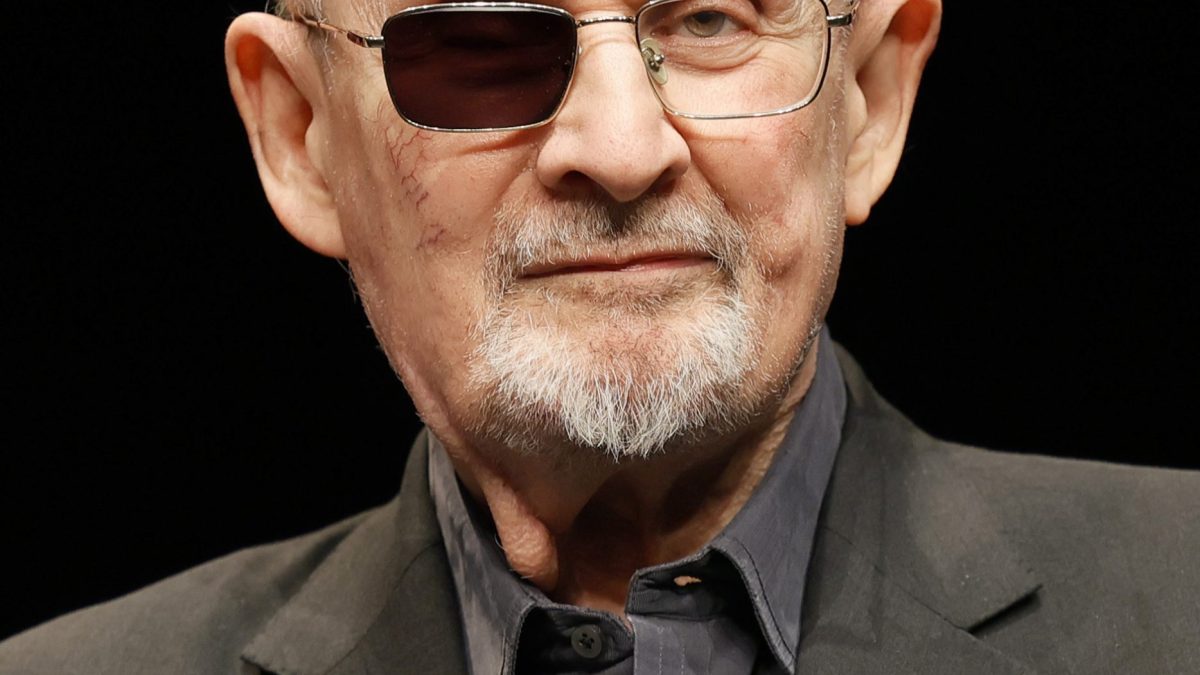
Featured image: Salman Rushdie at the launch of Knife in Berlin, May 2024. Photo by Elena Ternovaja, licensed under CC BY-SA 3.0, via Wikimedia Commons.