Kota Shivaram Karanth (10 October 1902 – 9 December 1997) was an Indian novelist, playwright, encyclopaedist and environmentalist who wrote in Kannada. He wrote forty-seven novels, revived the dance-drama Yakshagana, compiled encyclopaedias single-handed, and in his eighties fought a nuclear power plant. He received the Jnanpith Award in 1977. The historian Ramachandra Guha called him the Rabindranath Tagore of modern India.
Quick Facts
| Full name | Kota Shivaram Karanth |
| Born | 10 October 1902, Kota, near Udupi, Madras Presidency (now in Karnataka) |
| Died | 9 December 1997, Manipal, Karnataka (aged 95) |
| Language | Kannada |
| Occupation | Novelist, playwright, Yakshagana exponent, encyclopaedist, environmentalist |
| Notable works | Chomana Dudi, Marali Mannige, Bettada Jeeva, Mookajjiya Kanasugalu |
| Awards | Sahitya Akademi Award (1959), Jnanpith Award (1977), Padma Bhushan (1968; returned 1975) |
| Spouse | Leela Alva (m. 1936) |
| Children | 4 |
Early Life
He was born at Kota, a village on the coast near Udupi, the fifth child of a Brahmin family. He was studying at a college in Mangalore when Mahatma Gandhi called for non-cooperation with the British. He left without a degree in 1922 and spent some years spreading khadi and working for social reform. Experience cured him of several of his enthusiasms, he said later, but not of his curiosity.
Career
Novels
- Chomana Dudi (1933): an untouchable bonded labourer dreams of tilling his own land. It was one of the first Indian novels with a Dalit hero, and was filmed in 1975.
- Marali Mannige (1941): three generations of a coastal family; often named as his masterpiece
- Bettada Jeeva, Alida Mele, Kudiyara Kusu
- Mookajjiya Kanasugalu (1968): an old widow with strange powers of insight answers her grandson’s questions about gods, sex and history. It won the Jnanpith Award.
Yakshagana
He studied the traditional dance-drama of his coast, wrote the standard work on it, Yakshagana Bayalata, which won the Sahitya Akademi Award in 1959, and experimented with its costume, music and dance, taking a troupe abroad. He learnt dancing himself and performed into old age.
Everything else
He seemed able to do anything. He wrote a three-volume children’s encyclopaedia, Bala Prapancha, and a four-volume encyclopaedia of science, Vijnana Prapancha, largely by himself. He wrote on art, architecture and travel, compiled a dictionary, made films, ran a printing press and a school for children at Puttur, where he lived for some forty years, and painted.
Activism
He returned his Padma Bhushan in protest against the Emergency of 1975. In the 1980s he led protests against the felling of forests in the Western Ghats and against the nuclear power station at Kaiga, taking the case to court. In 1989, aged eighty-six, he stood for the Lok Sabha as an independent from the Kanara constituency on an environmental platform and lost.
Honours
- Jnanpith Award, 1977
- Sahitya Akademi Award, 1959, and its Fellowship
- Sangeet Natak Akademi Fellowship
- Pampa Award and several honorary doctorates
He is called Kadala Teerada Bhargava, the sage of the seashore.
Personal Life
In 1936 he married Leela Alva, a student from the Bunt community who had come to learn dance from him. The marriage across caste scandalised the district. They had four children; one son, Ullas Karanth, became a noted tiger biologist. His autobiography is titled Hucchu Manassina Hattu Mukhagalu, “Ten Faces of a Crazy Mind”. He died at Manipal in 1997, aged ninety-five.
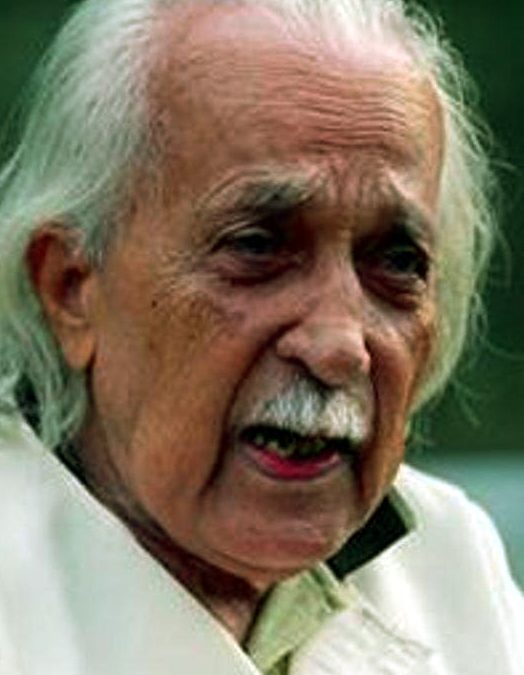
Featured image: Shivaram Karanth in his later years. Photo by Vishwanatha Badikana, licensed under CC BY-SA 4.0, via Wikimedia Commons.