Dattatreya Ramachandra Bendre (31 January 1896 – 26 October 1981), who wrote as Ambikatanayadatta, was an Indian poet in Kannada, considered by many the finest lyric poet the language has produced. Drawing on the speech and folk songs of the Dharwad region, he made a poetry that is musical, playful and mystical at once. He received the Jnanpith Award in 1973 and is known as Varakavi, the gifted poet.
Quick Facts
| Full name | Dattatreya Ramachandra Bendre |
| Pen name | Ambikatanayadatta (“Datta, son of Ambika”) |
| Born | 31 January 1896, Dharwad, Bombay Presidency (now in Karnataka) |
| Died | 26 October 1981, Bombay (aged 85) |
| Language | Kannada (also wrote in Marathi) |
| Occupation | Poet, teacher |
| Notable works | Gari, Nadaleele, Sakheegeeta, Arulu Marulu, Naku Tanti |
| Awards | Sahitya Akademi Award (1958), Padma Shri (1968), Jnanpith Award (1973) |
| Spouse | Lakshmibai (m. 1919) |
Early Life
He was born in Dharwad into a Chitpavan Brahmin family that had come from Maharashtra; Marathi was the language of the home, and Kannada the language of the street, which he made his own. His grandfather was a Sanskrit scholar. His father died when he was twelve, and he was brought up in poverty by his mother, Ambika, whose name he carried in his pen name.
Education
He matriculated in Dharwad in 1913 and took his B.A. in Sanskrit and English from Fergusson College in Poona in 1918. He returned to Dharwad to teach at the Victoria High School, and took an M.A. in 1935.
Career
The Friends’ Circle
In the 1920s he gathered around him a group of young writers in Dharwad, the Geleyara Gumpu or Friends’ Circle, which did much to create modern Kannada literature in the north of the state. His first long poem, Krishnakumari, appeared in 1922, and his first major collection, Gari (“Feather”), in 1932.
Prison
A patriotic poem, “Narabali” (“Human Sacrifice”), led the British to charge him with sedition in 1932. He was jailed for some months and then confined to a village, and for several years no school would employ him. The novelist Masti Venkatesha Iyengar supported him by making him editor of the journal Jeevana.
Solapur and after
From 1944 to 1956 he was professor of Kannada at a college in Solapur in Maharashtra. On retiring he returned to Dharwad, where he was an adviser to the All India Radio station and wrote plays and talks for it.
The poetry
His subjects were love, nature, family life, grief and the search for the divine, and his language was the spoken Kannada of Dharwad, full of rhyme and wordplay.
- Nadaleele (1938) and Sakheegeeta (1937), the latter a long poem on his married life
- Arulu Marulu, which won the Sahitya Akademi Award in 1958
- Naku Tanti (“Four Strings”, 1964), a late, dense, mystical collection for which he received the Jnanpith Award in 1973
- Songs such as “Ilidu Baa Taayi”, calling the Ganga down to earth, and “Kurudu Kanchana”, on blind money, which are sung across Karnataka
In later years he became absorbed in numbers and their symbolism. He was a follower of Sri Aurobindo.
Personal Life
He married Lakshmibai in 1919. Of their nine children, six died young, and the grief of those losses is in poems such as “Neeh Hinga Nodabyada Nanna”. Two sons, Panduranga and Vamana, and a daughter survived; Vamana Bendre became a scholar and edited his father’s works.
He died in Bombay in 1981. His house in Dharwad, Shrimata, at Sadhankeri, stands beside a memorial, Bendre Bhavana, and the lake at Sadhankeri that he made famous in a poem.
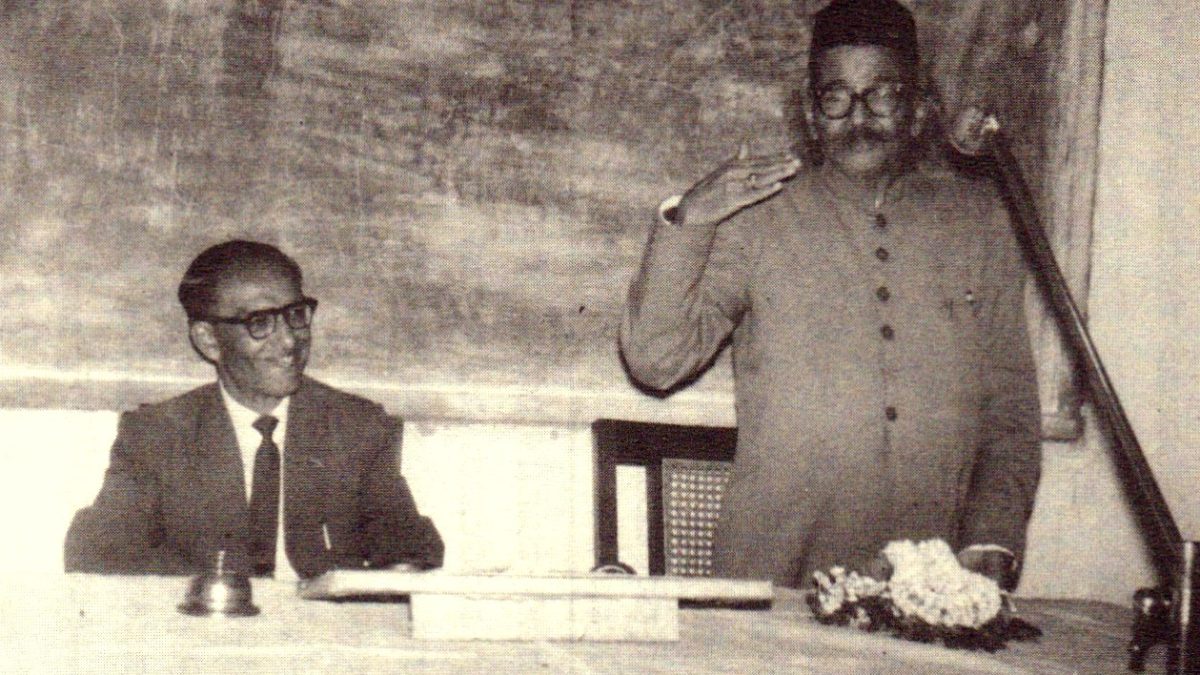
Featured image: D. R. Bendre with the writer H. S. Krishnaswamy Iyengar at a Kannada Sahitya Parishat function, January 1955. Photo by Bugs2beatles, licensed under CC BY-SA 4.0, via Wikimedia Commons.