
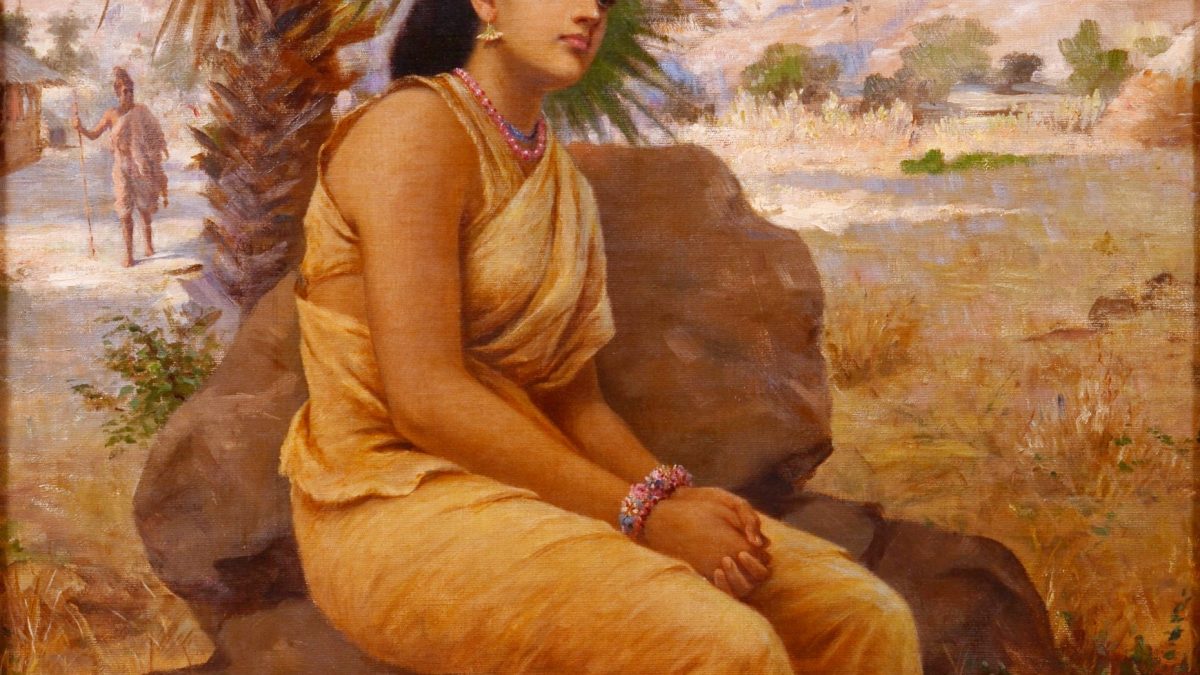
Raja Ravi Varma (29 April 1848 – 2 October 1906) was an Indian painter from the princely state of Travancore. He was the first Indian artist to master European oil painting and to apply it to Indian subjects: the heroines of Sanskrit literature, the stories of the epics and the gods. The cheap colour prints made from his pictures entered millions of homes and fixed the popular image of the Hindu deities.
Quick Facts
| Full name | Ravi Varma Koil Thampuran |
| Born | 29 April 1848, Kilimanoor, Travancore (now in Kerala) |
| Died | 2 October 1906, Kilimanoor (aged 58) |
| Occupation | Painter, printmaker |
| Notable works | Shakuntala, Damayanti and the Swan, Galaxy of Musicians, There Comes Papa, Jatayu Vadham, Lady in the Moonlight |
| Honours | Medals at Vienna (1873) and Chicago (1893); Kaisar-i-Hind Gold Medal (1904) |
| Spouse | Bhageerathi Bayi of the Mavelikkara royal family |
Early Life
He was born at Kilimanoor Palace, north of Thiruvananthapuram, into an aristocratic family related by marriage to the rulers of Travancore. His mother, Uma Ambabayi, was a poet, and his uncle, Raja Raja Varma, an amateur painter who noticed the child drawing on the palace walls and gave him his first lessons.
Training
At fourteen he was taken to the court of the Maharaja Ayilyam Thirunal at Thiruvananthapuram. The court painter taught him water-colour but guarded the secrets of oil. He learnt the technique largely by watching a visiting Dutch portrait painter, Theodor Jensen, at work, and by trial and error.
Career
Recognition
A portrait won him the Governor’s gold medal at the Madras exhibition of 1873, and the same year a painting sent to Vienna received an award. Commissions followed from princes across India. In 1893 ten of his paintings shown at the World’s Columbian Exposition in Chicago won two medals.
Baroda
His most important patron was Maharaja Sayajirao Gaekwad III of Baroda, who in 1888 commissioned fourteen large paintings of scenes from the Ramayana and the Mahabharata for his new palace. To prepare, Ravi Varma and his brother travelled across India studying costume and faces. He chose the sari as the dress of his heroines, helping to make it the national costume.
Paintings
- Shakuntala, pretending to remove a thorn from her foot so as to look back at her lover
- Damayanti and the Swan
- Galaxy of Musicians, women of different regions of India playing together
- There Comes Papa, a portrait of his daughter and grandson
- Jatayu Vadham, Ravana cutting the wing of the great bird
- portraits of rulers, British officials and their families
His brother, C. Raja Raja Varma, a fine landscape painter, was his constant companion and assistant.
The press
On the advice of the Dewan of Travancore, he set up a lithographic press in Bombay in 1894, later moved to Malavli near Lonavala, to print colour reproductions of his religious pictures. The oleographs of Lakshmi, Saraswati and Krishna sold in enormous numbers at prices the poor could afford. People who were barred from temples could now keep an image of a god at home. The press lost money; he sold it to its German technician in 1903. A young man who worked there, Dadasaheb Phalke, went on to make the first Indian feature film.
Personal Life
He married Bhageerathi Bayi of Mavelikkara; they had two sons and three daughters. Two of his granddaughters were adopted into the Travancore royal family, and one of them, Sethu Lakshmi Bayi, later ruled the state as regent.
Reputation
Critics of the next generation, led by the Bengal school, dismissed his work as sentimental and un-Indian. Later opinion has been kinder, recognising both his skill and his immense influence on calendar art, cinema and the visual imagination of India.
He died at Kilimanoor in 1906. Kerala’s highest award for artists, the Raja Ravi Varma Puraskaram, is named after him.
Featured image: Shakuntala lost in thought, painted by Raja Ravi Varma in 1901. Photo by Raja Ravi Varma, in the public domain, via Wikimedia Commons.



