Nandalal Bose (3 December 1882 – 16 April 1966) was an Indian painter and teacher, one of the founders of modern Indian art. The chief pupil of Abanindranath Tagore, he headed the art school at Rabindranath Tagore’s Santiniketan for nearly thirty years and trained two generations of artists. He made the posters for the Congress session at Haripura at Gandhi’s request, and with his students decorated the original manuscript of the Constitution of India.
Quick Facts
| Full name | Nandalal Bose |
| Born | 3 December 1882, Kharagpur, Munger district, Bihar |
| Died | 16 April 1966, Santiniketan, West Bengal (aged 83) |
| Education | Government School of Art, Calcutta |
| Occupation | Painter, teacher |
| Offices | Principal, Kala Bhavana, Santiniketan (1922–1951) |
| Notable works | Sati; Shiva Drinking Poison; the Dandi March linocut; the Haripura posters; illustrations for the Constitution of India |
| Awards | Padma Vibhushan (1954) |
| Spouse | Sudhira Devi |
Early Life
He was born at Kharagpur in the Munger district of Bihar, where his father managed an estate of the Maharaja of Darbhanga. His mother was skilled in the household arts of making dolls and decorating with rice paste, and he liked to watch the potters and image-makers of the town.
He was sent to Calcutta at fifteen. He failed at college, more than once, because he spent his time drawing, and at last persuaded his family to let him study art.
Abanindranath
In 1905 he showed his drawings to Abanindranath Tagore, then teaching at the Government School of Art, who accepted him at once. He studied there for five years and became the most gifted of the group of young painters who, with their teacher, turned away from European academic realism to the traditions of India and Asia. The movement is called the Bengal School.
His early paintings, such as Sati and Shiva Drinking the World’s Poison, were shown in Europe and Japan.
Ajanta
In 1909 he was one of the artists who helped the Englishwoman Lady Herringham to copy the ancient Buddhist wall paintings in the caves at Ajanta, and in 1921 he copied the murals in the Bagh caves. The strong, flowing line of those paintings became the basis of his own drawing. He also learnt from Japanese and Chinese artists, and travelled in China and Japan with Tagore in 1924.
Santiniketan
Rabindranath Tagore invited him to take charge of the art school, Kala Bhavana, at his new university. He was its principal from 1922 to 1951.
He taught that art should come from observing nature and life, not from copying, and should serve the community. Students drew trees, animals and the Santal villagers around them, painted murals on the buildings, designed sets and costumes for Tagore’s plays and decorations for the seasonal festivals, and learnt crafts alongside painting. He illustrated Tagore’s Bengali primer, Sahaj Path, with woodcuts known to every Bengali child.
Among his students were Benode Behari Mukherjee, Ramkinkar Baij and K. G. Subramanyan, and for a time Satyajit Ray.
Gandhi
He revered Mahatma Gandhi. In 1930, when Gandhi was arrested after the salt march, he made a black-and-white linocut of him striding forward with his staff, which became the best-known image of the march.
Gandhi asked him to decorate the grounds of the annual Congress sessions, so that villagers attending could see art. For the session at Haripura in Gujarat in 1938 he and his students painted some four hundred posters, about eighty of them by his own hand, on handmade paper in earth colours: a drummer, a potter, a woman husking rice, a cobbler, a wrestler. They are among the most loved works of Indian art.
The Constitution
When the Constitution of India was written out by hand in 1949–50, he was asked to decorate it. He and a team from Santiniketan illuminated each part with borders and with scenes from the history of India, from the Indus seals to the freedom movement. He also made the designs for the emblems of the national honours, the Bharat Ratna and the Padma awards.
Honours
- Padma Vibhushan (1954)
- Fellow of the Lalit Kala Akademi (1956)
- Honorary doctorates from several universities
In 1976 the Government of India declared his works national art treasures, which may not be exported.
Death
He retired in 1951 and lived on at Santiniketan, drawing every day on small cards. He died on 16 April 1966.
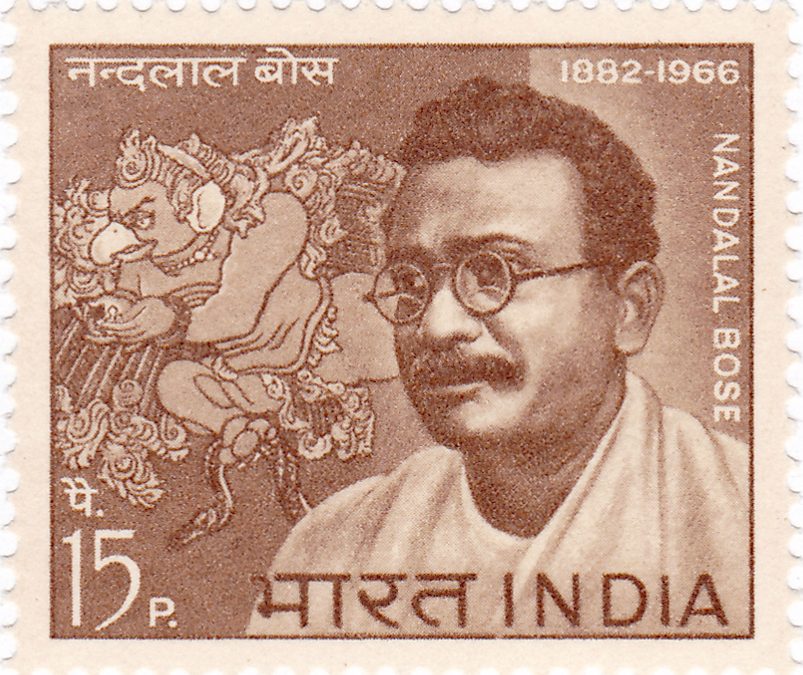
Featured image: Nandalal Bose, from a 1967 postage stamp of India. Photo by India Post, Government of India, licensed under Government Open Data License – India, via Wikimedia Commons.