Dhundiraj Govind Phalke (30 April 1870 – 16 February 1944), known as Dadasaheb Phalke, was an Indian film-maker who produced and directed Raja Harishchandra (1913), the first full-length Indian feature film. In a career of about twenty-five years he made some ninety-five features and many short films. He is called the father of Indian cinema, and the country’s highest film honour bears his name.
Quick Facts
| Full name | Dhundiraj Govind Phalke |
| Born | 30 April 1870, Trimbak, near Nashik, Maharashtra |
| Died | 16 February 1944, Nashik (aged 73) |
| Occupation | Film producer, director, screenwriter, editor |
| Education | Sir J. J. School of Art, Bombay; Kala Bhavan, Baroda |
| Notable films | Raja Harishchandra, Mohini Bhasmasur, Satyavan Savitri, Lanka Dahan, Shri Krishna Janma, Kaliya Mardan |
| Spouse | Saraswatibai Phalke |
Early Life
He was born at Trimbak, a pilgrim town near Nashik, the son of a Sanskrit scholar who later taught in Bombay. He studied at the Sir J. J. School of Art and then at the Kala Bhavan at Baroda, where he learnt painting, sculpture, architecture, photography and the making of printing blocks.
Before Films
He tried many trades: a photographic studio at Godhra, which failed when plague carried off his first wife and child; work as a draughtsman for the Archaeological Survey; scene painting for the theatre; and a period assisting a German conjuror, from whom he learnt stage magic. He became a skilled printer and worked for a time with the press that reproduced the paintings of Raja Ravi Varma. He started a printing business with partners, and left after a quarrel.
The Idea
Around Christmas 1910 he saw a film on the life of Christ in a Bombay picture house. As the images passed, he wrote later, he saw in his mind Rama and Krishna and wondered whether Indians would ever see Indian images on the screen. He watched every film he could, strained his eyes until he nearly lost his sight, and experimented with a toy camera, filming a pea plant growing in a pot.
In 1912, pledging his life insurance, he sailed to London, where he bought a camera, a printing machine and raw film and spent a short time learning the craft at a studio.
Raja Harishchandra
Back in Bombay he set up a studio in a bungalow at Dadar. His wife, Saraswatibai, loaded and developed the film, held white sheets as reflectors and cooked for the entire unit. No woman would agree to act, not even from the red-light quarter, and the part of Queen Taramati was played by a young man who worked as a cook in a restaurant.
The film, about the legendary king who gave up his kingdom and family rather than break his word, was about forty minutes long. It was shown to invited guests in April 1913 and opened to the public at the Coronation Cinematograph on 3 May 1913. It was a success.
Later Work
He moved to Nashik and made Mohini Bhasmasur, in which women appeared on the Indian screen for the first time, and Satyavan Savitri. In 1917 came Lanka Dahan, an enormous hit: the takings were carried from the cinema in bullock carts, and audiences took off their shoes when Rama appeared.
With financiers he founded the Hindustan Film Company in 1918 and made Shri Krishna Janma and Kaliya Mardan, in which his small daughter Mandakini played the child Krishna. He was a master of trick photography, and gods flew, vanished and multiplied in his films. He wrote, directed, designed, shot, developed and edited.
Decline
He had no head for business and disliked taking orders from partners. He walked out of the company, returned and left again. His subjects came from the epics and Puranas, and as audiences turned to other kinds of story, and then to the talkies, he was left behind. His only sound film, Gangavataran (1937), was his last.
Death
He spent his final years at Nashik in poor health and near poverty, largely forgotten by the industry he had started. He died on 16 February 1944.
Legacy
In 1969, on the eve of his centenary, the Government of India instituted the Dadasaheb Phalke Award for lifetime contribution to Indian cinema, presented each year with the National Film Awards. Among those who have received it is Satyajit Ray. The film city in Mumbai is named after him.
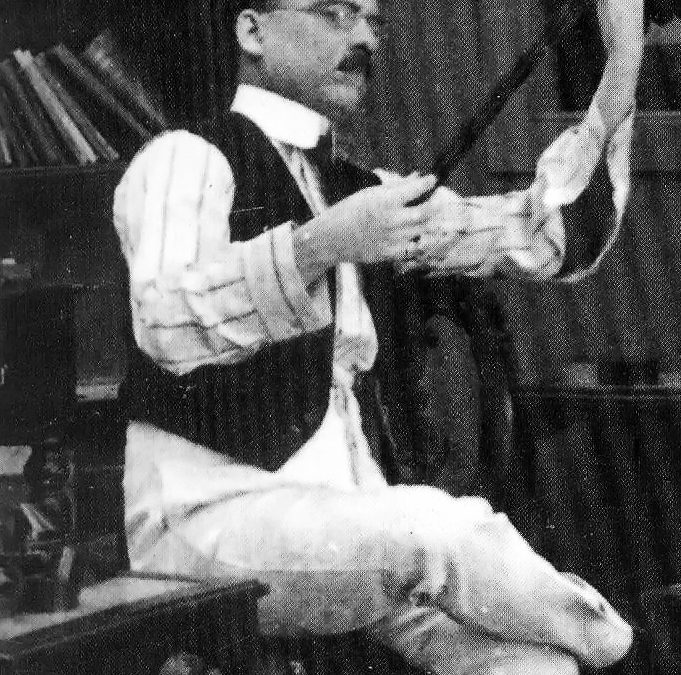
Featured image: Dadasaheb Phalke in the 1930s. Photo by an unknown photographer, in the public domain, via Wikimedia Commons.