Bimal Roy (12 July 1909 – 8 January 1966) was an Indian film director and producer, one of the masters of Hindi cinema. Trained as a cameraman in the studios of Calcutta, he brought to Bombay a quiet realism and a concern for the poor and the wronged. Do Bigha Zamin, Devdas, Madhumati, Sujata and Bandini are among the most admired films made in India. He won the Filmfare Award for Best Director seven times.
Quick Facts
| Full name | Bimal Roy |
| Born | 12 July 1909, Suapur, Dhaka district, Bengal (now Bangladesh) |
| Died | 8 January 1966, Bombay (aged 56) |
| Occupation | Film director, producer, cinematographer |
| Years active | 1932–1966 |
| Notable films | Udayer Pathey, Do Bigha Zamin, Parineeta, Devdas, Madhumati, Sujata, Bandini |
| Awards | Eleven Filmfare Awards, including seven for Best Director; International Prize, Cannes (1954) |
| Spouse | Manobina Roy |
Early Life
He was born into a family of landowners at Suapur in the Dhaka district of East Bengal. After his father’s death the estate manager cheated the family out of the property, and he came to Calcutta with his mother and brothers to look for work. The experience of dispossession stayed with him.
New Theatres
He joined the New Theatres studio as an assistant to the cameraman Nitin Bose and became a cinematographer himself. He photographed P. C. Barua’s Devdas (1935) and Mukti and was noted for his lighting.
His first film as director, Udayer Pathey (1944), about a young writer who takes the side of striking workers against the family of the rich woman who loves him, was shot with natural lighting and ordinary speech. It ran for a year in Calcutta and was remade in Hindi as Hamrahi.
Bombay
The Calcutta studios declined after Partition. In 1950 he moved to Bombay with a group of colleagues who were to become famous: the editor Hrishikesh Mukherjee, the writer Nabendu Ghosh, the composer Salil Chowdhury and others.
Do Bigha Zamin
At a film festival in Bombay in 1952 he saw the Italian film Bicycle Thieves. He founded his own company and made Do Bigha Zamin (“Two Acres of Land”, 1953), from a story by Salil Chowdhury: a peasant about to lose his plot to a landlord goes to Calcutta and pulls a rickshaw to earn the money to save it. Balraj Sahni played him. Much of it was shot in the streets.
It won the International Prize at Cannes in 1954 and the first Filmfare Awards for Best Film and Best Director, and is regarded as the beginning of the realist tradition in Hindi cinema.
The Major Films
- Parineeta (1953), from Sarat Chandra Chatterjee, with Meena Kumari
- Devdas (1955), also from Sarat Chandra, with Dilip Kumar, Suchitra Sen and Vyjayanthimala; many consider it the definitive version of the story. See Sarat Chandra Chattopadhyay.
- Madhumati (1958), a romance of reincarnation written by Ritwik Ghatak, with music by Salil Chowdhury. His greatest commercial success, it won nine Filmfare Awards, a record that stood for nearly forty years.
- Sujata (1959), about a girl of an “untouchable” caste brought up in a Brahmin household
- Parakh (1960), a satire on greed in a village
- Bandini (1963), in which Nutan plays a woman imprisoned for murder; his last feature and perhaps his finest
His company also produced Kabuliwala and Usne Kaha Tha, directed by others.
Style
He worked without rhetoric. His films are measured in pace and exact in detail, with songs placed so that they grow out of the story, and with women at their centre drawn with unusual understanding. He was a silent man on the set, who chain-smoked and seldom raised his voice.
A School of Film-Makers
Hrishikesh Mukherjee, Gulzar, who wrote his first film song for Bandini, and Basu Bhattacharya all began under him and carried his manner into the following decades. The cameramen and writers he trained shaped what came to be called the middle cinema.
Honours
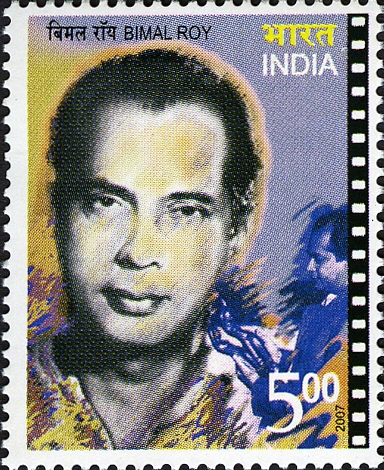
He won eleven Filmfare Awards: Best Film four times and Best Director seven, including three years in a row twice over. Several of his films received national awards. He served on the jury of the Moscow film festival. India issued a postage stamp in his honour in 2007.
Personal Life
He married Manobina, a photographer; they had three daughters and a son. His daughter Rinki Bhattacharya has written about his work, and his son Joy made a documentary on him.
Death
He was planning a film about the Kumbh fair when he was found to have cancer. He died in Bombay on 8 January 1966, aged fifty-six.
In Bengali cinema the same years saw the work of Satyajit Ray and Mrinal Sen.
Featured image: Bimal Roy, from a 2007 postage stamp of India. Photo by India Post, Government of India, licensed under Government Open Data License – India, via Wikimedia Commons.