
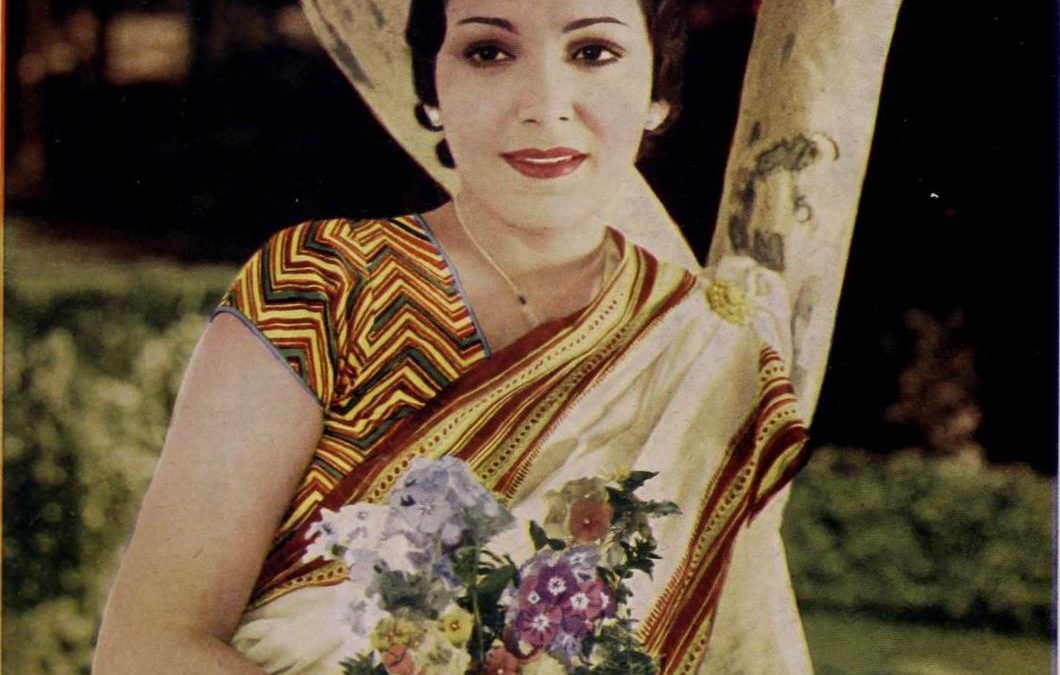
Devika Rani Chaudhuri (30 March 1908 – 9 March 1994), known as Devika Rani, was an Indian actress and film producer, the first great female star of Indian talking pictures and one of the founders of Bombay Talkies, the most modern studio of its day. Educated in England and trained in Germany, she brought professional standards and social respectability to an industry that had neither. After her husband’s death she ran the studio herself. In 1970 she became the first recipient of the Dadasaheb Phalke Award.
Quick Facts
| Full name | Devika Rani Chaudhuri |
| Born | 30 March 1908, Waltair (Visakhapatnam), Andhra Pradesh |
| Died | 9 March 1994, Bangalore (aged 85) |
| Occupation | Actress, film producer, studio head |
| Years active | 1928–1945 |
| Studio | Bombay Talkies (co-founder, 1934) |
| Notable films | Karma, Jawani Ki Hawa, Achhut Kanya, Jeevan Prabhat, Nirmala, Vachan, Durga |
| Awards | Padma Shri (1958), Dadasaheb Phalke Award (1969), Soviet Land Nehru Award (1990) |
| Spouse | Himanshu Rai (m. 1929; d. 1940); Svetoslav Roerich (m. 1945) |
Early Life
She was born at Waltair into a wealthy, anglicised Bengali family. Her father, Colonel M. N. Chaudhuri, was the first Indian Surgeon-General of the Madras Presidency. Through both parents she was related to Rabindranath Tagore.
At nine she was sent to boarding school in England. She later studied acting and music at the Royal Academy of Dramatic Art and the Royal Academy of Music in London, and took courses in architecture and textile design, working for a time as a designer.
Himanshu Rai
In 1928 she met Himanshu Rai, a Bengali lawyer turned film-maker who was producing silent films in collaboration with German studios. She worked on the costumes and sets of one of them, and they married in 1929. He was sixteen years older.
They went to Berlin, where she trained at the great UFA studios, watching the leading directors and actresses at work, and performed with him on the stage.
Karma
Rai’s first sound film, Karma (1933), made in English and Hindi, had its première in London. She played the lead, and the British press was ecstatic about her beauty and her diction. The film contained a kissing scene of several minutes, the longest in Indian cinema, which has been talked of ever since. It failed in India.
Bombay Talkies
In 1934 the couple founded Bombay Talkies at Malad, then outside the city, with German technicians, the best equipment available and a staff recruited largely from educated families. It ran like a modern company, with a canteen where all castes ate together, and trained a generation of film-makers.
She was its star. In 1936, during the making of a film, she left with her leading man, Najmul Hasan. She was persuaded to come back; he was dismissed, and a laboratory assistant was put in his place. The assistant was Ashok Kumar.
Achhut Kanya (1936), in which she played a Dalit girl in love with a Brahmin boy, was a great success and is the film by which she is remembered. She and Ashok Kumar made a series of films together, Janmabhoomi, Izzat, Nirmala, Vachan.
Head of the Studio
Himanshu Rai died in 1940 after a breakdown. Devika Rani took over as controller of production. Under her the studio made Basant and Kismet (1943), the biggest hit of the decade, and she introduced new talent, most famously a young man from Peshawar named Yusuf Khan, whom she hired in 1942 and renamed Dilip Kumar.
But the studio was divided into factions, and a group of its leading men broke away to found a rival. She tired of the struggle and in 1945 sold her shares and left films for good, at thirty-seven.
Roerich
The same year she married the Russian painter Svetoslav Roerich, son of the artist and mystic Nicholas Roerich. They lived first in the Kullu valley in the Himalaya and then on a large estate outside Bangalore, where they grew aromatic plants and lived in seclusion. She served on the boards of national academies of art, music and dance.
Honours
- Padma Shri (1958)
- Dadasaheb Phalke Award for 1969, the first ever given
- Soviet Land Nehru Award (1990)
Death
Roerich died in January 1993, and she on 9 March 1994, in Bangalore. They had no children. The disposal of the estate and its paintings was the subject of years of litigation; the Government of Karnataka eventually took it over.
Legacy
She is called the First Lady of Indian Cinema. The studio she helped to build gave Hindi film Madhubala, Raj Kapoor as a young assistant, and many of the directors and technicians of the next thirty years.
Featured image: Devika Rani in the film Nirmala, 1938. Photo by an unknown photographer, in the public domain, via Wikimedia Commons.



