
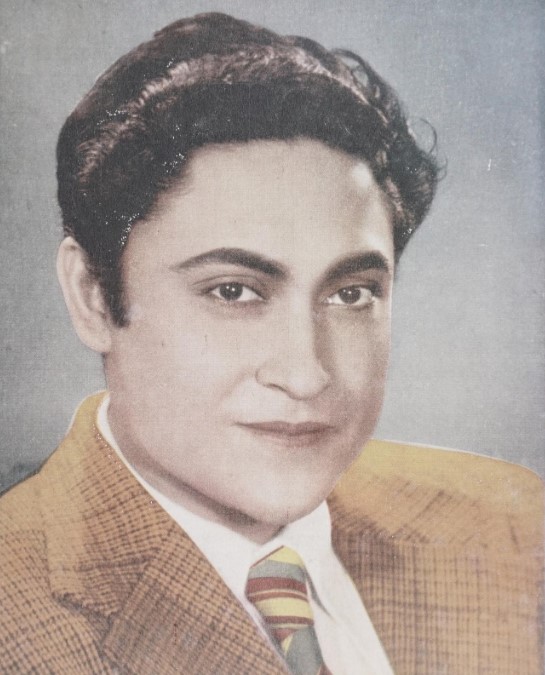
Ashok Kumar (13 October 1911 – 10 December 2001), born Kumudlal Ganguly and known affectionately as Dadamoni, was an Indian film actor whose career ran from 1936 to the late 1990s. A reluctant actor pushed in front of the camera by accident, he became the first great star of Hindi talking pictures and introduced a natural, conversational style of acting. Kismet (1943), in which he played a likeable thief, was the biggest hit Indian cinema had known. He received the Dadasaheb Phalke Award in 1988.
Quick Facts
| Birth name | Kumudlal Ganguly |
| Born | 13 October 1911, Bhagalpur, Bihar |
| Died | 10 December 2001, Mumbai (aged 90) |
| Occupation | Actor, producer, singer, painter |
| Years active | 1936–1997 |
| Notable films | Achhut Kanya, Kismet, Mahal, Parineeta, Chalti Ka Naam Gaadi, Kanoon, Bandini, Jewel Thief, Aashirwad, Pakeezah, Khatta Meetha |
| Awards | Padma Shri (1962), National Film Award for Best Actor (1969), Dadasaheb Phalke Award (1988), Padma Bhushan (1999) |
| Spouse | Shobha Devi |
| Children | 4 |
Early Life
He was born at Bhagalpur, at his mother’s family home, and grew up at Khandwa in the Central Provinces, where his father was a lawyer. He was the eldest of four children; his brothers Anoop and Kishore Kumar followed him into films. He was sent to Calcutta to study law, and failed the examination.
His sister had married Sashadhar Mukherjee, who worked at the new Bombay Talkies studio. Kumudlal went to Bombay in the mid-1930s hoping to become a director, and was given a job in the laboratory.
An Accidental Star
In 1936 the leading man of the film Jeevan Naiya left the studio in disgrace. The studio’s head, Himanshu Rai, ordered the laboratory assistant to take his place opposite Devika Rani. He protested that he could not act, and that his family would be ashamed. He was renamed Ashok Kumar.
The same year he and Devika Rani starred in Achhut Kanya, about a Brahmin boy and an “untouchable” girl, and it was a great success. A series of hits with the actress Leela Chitnis followed, Kangan, Bandhan and Jhoola.
Kismet
In Kismet (1943) he played a pickpocket and confidence trickster, cigarette in hand, who is nonetheless the hero. It was the first Hindi film with an anti-hero, and it ran at one cinema in Calcutta for more than three years, a record that stood for three decades.
Style
The actors of the 1930s declaimed, in the manner of the stage. He spoke his lines as people speak, and let his face do the rest. Later generations of actors, from Dilip Kumar onwards, acknowledged that he had shown them how.
Producer
With partners he took over the management of Bombay Talkies in the 1940s. Among the films made under him were Ziddi, which gave Dev Anand his first success, and Mahal (1949), a ghost story in which he starred, and which made stars of Madhubala and of the singer Lata Mangeshkar.
A Long Career
- **1950s:** Parineeta, Howrah Bridge, and the comedy Chalti Ka Naam Gaadi (1958), with his two brothers
- **1960s:** the judge in Kanoon, the freedom fighter in Bandini, the surprise villain of Jewel Thief, and Aashirwad (1968), which won him the National Film Award and in which he sang a rapid-fire children’s song about a railway train
- **1970s and after:** Pakeezah, Victoria No. 203, Chhoti Si Baat, Khatta Meetha, Khoobsurat and Shaukeen, as the wise or mischievous elder
He appeared in about two hundred and seventy-five films. On television he was the narrator who summed up each episode of the first Indian soap opera, Hum Log, in 1984–85, and played the last Mughal emperor in a serial.
Other Gifts
He was a qualified homoeopath, to whom patients came from far away, a painter, a chess player and a singer who recorded his own songs in his early films.
Honours
- Sangeet Natak Akademi Award (1959)
- Padma Shri (1962) and Padma Bhushan (1999)
- National Film Award for Best Actor (1969)
- Dadasaheb Phalke Award (1988)
Personal Life
He married Shobha in 1936, in a match arranged by his family, and they were together until her death in 1987. They had a son and three daughters, one of whom, Preeti Ganguly, was a comic actress. His brother Kishore died on Ashok Kumar’s birthday in 1987, and he never celebrated the day again.
Death
He died of heart failure at his home in Mumbai on 10 December 2001, aged ninety.
Featured image: Ashok Kumar in 1942. Photo by FilmIndia magazine, in the public domain, via Wikimedia Commons.



