
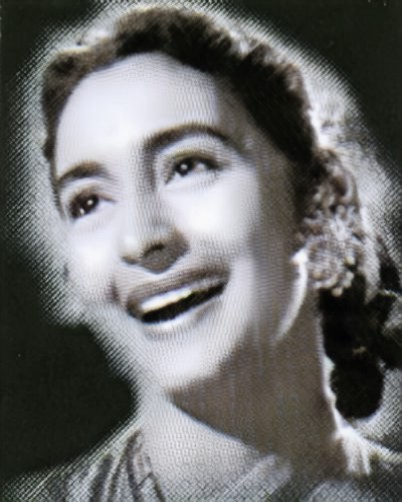
Nutan Samarth Bahl (4 June 1936 – 21 February 1991), known as Nutan, was an Indian film actress, regarded by many critics and fellow actors as the finest Hindi cinema has had. In a career of forty years she appeared in more than seventy films, and gave in Seema, Sujata and Bandini performances of a restraint and truth rare in the popular cinema of the time. She won the Filmfare Award for Best Actress five times, a record that stood alone for more than thirty years.
Quick Facts
| Full name | Nutan Samarth Bahl |
| Born | 4 June 1936, Bombay |
| Died | 21 February 1991, Bombay (aged 54) |
| Occupation | Actress |
| Years active | 1950–1991 |
| Notable films | Seema, Paying Guest, Anari, Sujata, Chhalia, Bandini, Milan, Saraswatichandra, Saudagar, Main Tulsi Tere Aangan Ki |
| Awards | Five Filmfare Awards for Best Actress; Padma Shri (1974) |
| Spouse | Rajnish Bahl (m. 1959) |
| Children | Mohnish Bahl |
Early Life
She was born in Bombay into a Marathi family of the film world. Her mother, Shobhna Samarth, was a leading actress of the 1940s, famous for playing Sita; her father, Kumarsen Samarth, was a director and poet. The parents separated when she was a child. She was the eldest of four; her sister Tanuja also became an actress.
She was a thin, awkward girl who was told she was plain. Her mother launched her at fourteen in Hamari Beti (1950), which she directed herself. In 1952 Nutan won a Miss India title. After a few films she was sent for a year to a finishing school in Switzerland, which she remembered as the happiest time of her youth.
Stardom
She returned in 1954, and the next year played an orphan sent to a reformatory in Seema. It won her the first of her Filmfare Awards, at nineteen.
She could be light as well as grave. In Paying Guest and Tere Ghar Ke Samne with Dev Anand, Anari and Chhalia with Raj Kapoor, and Dilli Ka Thug with Kishore Kumar, in which she appeared in a swimsuit, she was a modern, spirited heroine.
Bimal Roy
Her two films for Bimal Roy are the heart of her work.
- Sujata (1959): a girl of an “untouchable” caste brought up, but never quite accepted, in a Brahmin household. She plays it almost without raising her voice.
- Bandini (1963): Kalyani, a prisoner serving a sentence for murder, whose story is told in flashback. She had retired after her marriage and the birth of her son, and was persuaded to return for it. It is commonly named as the greatest performance by an actress in Hindi film.
Later Career
Unlike most heroines of her time she went on playing leading parts after marriage and motherhood.
- Milan (1967) and Saraswatichandra (1968)
- Saudagar (1973), as a village woman used and discarded by a trader in palm sugar, with Amitabh Bachchan
- Main Tulsi Tere Aangan Ki (1978), for which she won her fifth Filmfare Award at forty-two
In the 1980s she played mothers, in Meri Jung, Naam and Karma, and won a sixth Filmfare Award, for a supporting role.
The Actress
She worked from within. Directors spoke of the expressiveness of her face and voice and of her habit of doing less than was asked. She could sing, and recorded her own songs in a film produced by her mother. She was also trained in classical dance and wrote devotional songs.
Family Quarrel
In the 1960s she went to court against her mother over the management of her earnings as a minor. The two did not speak for about twenty years and were reconciled in the early 1980s.
Personal Life
In 1959 she married Rajnish Bahl, an officer of the Navy. Their son, Mohnish Bahl, became an actor. The actress Kajol, daughter of her sister Tanuja, equalled her record of five Best Actress awards in 2011.
Death
She was treated for breast cancer in 1990. It returned, and she died in Bombay on 21 February 1991, aged fifty-four, with two films unfinished.
Legacy
India issued a postage stamp in her honour in 2011. Actresses of later generations have continued to name her as the one they studied.
Featured image: Nutan. Photo by India Post, licensed under Government Open Data License – India, via Wikimedia Commons.



