
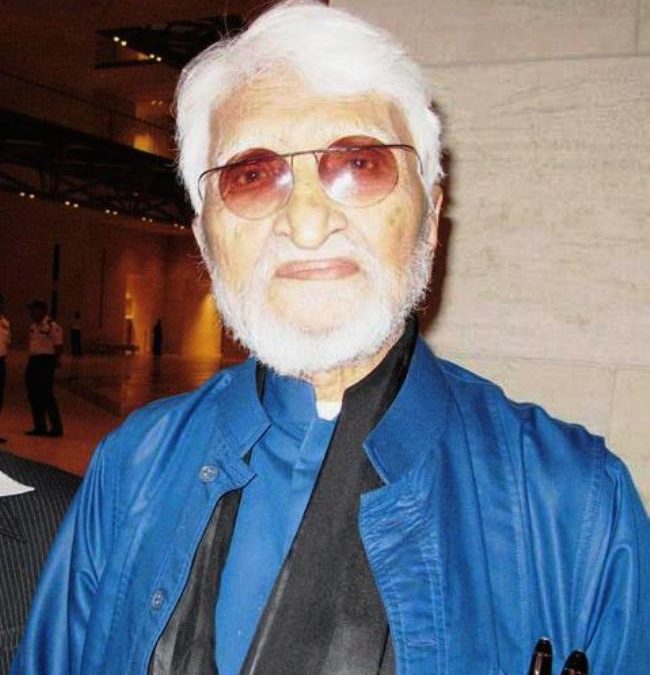
Maqbool Fida Husain (17 September 1915 – 9 June 2011) was an Indian painter, the best-known Indian artist of the twentieth century. Tall, white-bearded and usually barefoot, he painted horses, the epics, cinema and the life of the street in a bold, fast style, and made modern art known to a public that had never entered a gallery. Protests and court cases over some of his pictures drove him to leave India in old age, and he died abroad.
Quick Facts
| Full name | Maqbool Fida Husain |
| Born | 17 September 1915, Pandharpur, Bombay Presidency (now Maharashtra) |
| Died | 9 June 2011, London (aged 95) |
| Nationality | Indian; citizen of Qatar from 2010 |
| Occupation | Painter, film-maker |
| Notable works | Zameen, Between the Spider and the Lamp, the Horses, Mahabharata and Ramayana series, Mother Teresa series |
| Awards | Padma Shri (1966), Padma Bhushan (1973), Padma Vibhushan (1991) |
| Other | Nominated member of the Rajya Sabha (1986–1992) |
| Spouse | Fazila Bibi (m. 1941) |
| Children | 6 |
Early Life
He was born in the temple town of Pandharpur into a Sulaimani Bohra family. His mother died when he was about a year and a half old. His father remarried and moved to Indore, where the boy went to school and learnt calligraphy. He taught himself to paint by going out into the countryside on a bicycle with his colours.
Bombay
He came to Bombay in the 1930s with almost no money and studied briefly at the Sir J. J. School of Art. To live, he painted cinema hoardings, working on scaffolding with huge brushes for a few annas a square foot, and later designed nursery furniture and toys. The scale and speed of hoarding painting stayed in his work.
Career
The Progressive Artists
In 1947, the year of independence, the painter F. N. Souza invited him to join the Progressive Artists’ Group, with S. H. Raza, K. H. Ara and others. They wanted an art that was modern and Indian, free of both the British academic style and the revivalism of the Bengal school.
Major work
- Zameen (1955), a long frieze of village life, and Between the Spider and the Lamp (1956)
- **Horses:** powerful, rearing animals drawn from the Muharram processions of his childhood, Chinese pottery and Greek sculpture, which became his signature
- **Series:** on the Ramayana and the Mahabharata, on Mother Teresa, on the British Raj and on the cities of India
- In 1971 he was invited to show at the São Paulo Biennale alongside Pablo Picasso
He painted in public, to music, on enormous canvases, and was the first Indian artist whose pictures sold for very large sums.
Films
His short film Through the Eyes of a Painter (1967) won a Golden Bear at the Berlin festival. He later made the feature films Gaja Gamini (2000), a tribute to the actress Madhuri Dixit, and Meenaxi: A Tale of Three Cities (2004).
Controversy
In 1996 a Hindi magazine published an article attacking drawings he had made in the 1970s that showed Hindu goddesses unclothed. Hindu organisations accused him of insulting their faith. His exhibitions were vandalised, his house in Mumbai was attacked, and hundreds of criminal complaints were filed against him across the country. A further painting, showing India as a nude female figure, brought more.
In 2006 he left India and lived in Dubai and London. The Delhi High Court quashed several cases in 2008, observing that nudity in art was an old Indian tradition, but threats continued. In 2010 he accepted the citizenship of Qatar.
Death
He died in London on 9 June 2011 and was buried there. He had said repeatedly that he longed to return.
Personal Life
He married Fazila Bibi in 1941; they had six children, among them the painter Shamshad Husain and the film-maker Owais Husain. He gave up wearing shoes in the 1960s, he said in memory of the Hindi poet Muktibodh.
Featured image: M. F. Husain in his later years. Photo by Ayaz360, in the public domain, via Wikimedia Commons.



