
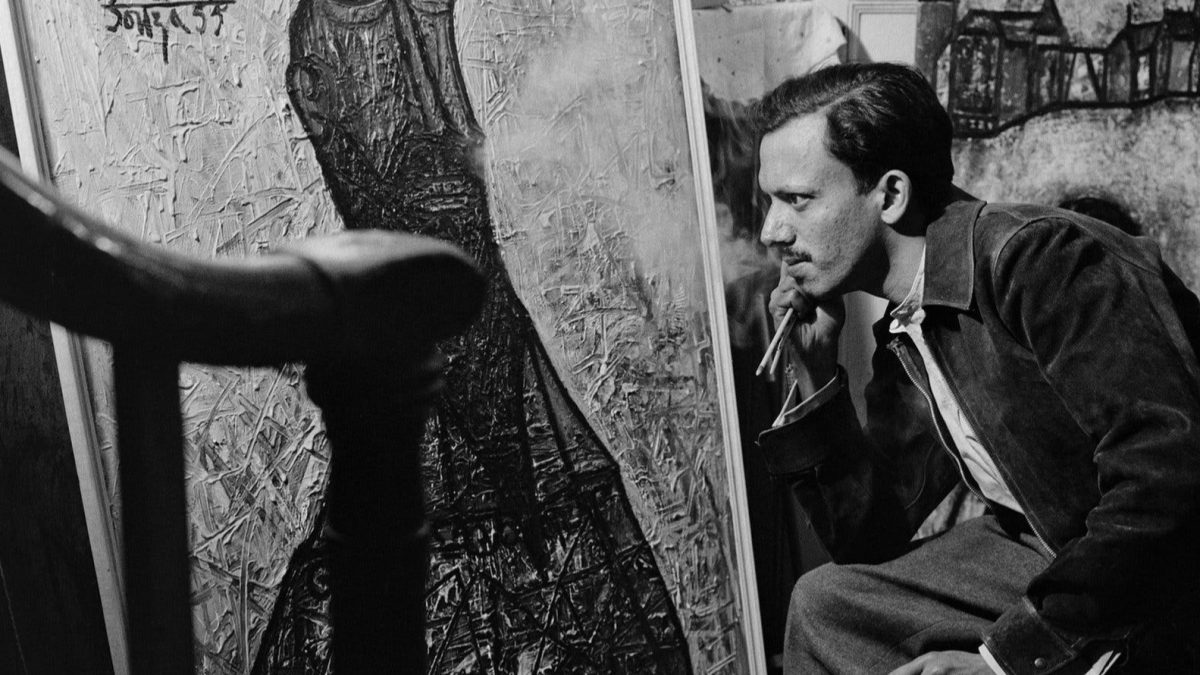
Francis Newton Souza (12 April 1924 – 28 March 2002) was an Indian painter, a founder of the Progressive Artists’ Group of Bombay and the first artist of independent India to make a reputation in Europe. His work is fierce and unsparing: tortured Christs, grimacing heads, heavy nudes, churches and still lifes drawn with a thick black line. A rebel expelled from two schools, he spent most of his life in London and New York. His paintings now fetch the highest prices of any Indian artist of his generation.
Quick Facts
| Full name | Francis Newton Souza |
| Born | 12 April 1924, Saligao, Goa |
| Died | 28 March 2002, Mumbai (aged 77) |
| Education | St Xavier’s High School, Bombay; Sir J. J. School of Art, Bombay (expelled 1945) |
| Occupation | Painter, writer |
| Known for | Co-founding the Progressive Artists’ Group (1947) |
| Notable works | Birth (1955); Crucifixion (1959); Words and Lines (book, 1959) |
| Lived in | Bombay; London (1949–1967); New York (from 1967) |
Early Life
He was born in the village of Saligao in Goa, then a Portuguese colony, into a Roman Catholic family. His father died three months later and a sister soon after. He himself nearly died of smallpox, which scarred his face; his mother vowed that if he lived he would be a priest, and added the name of the saint Francis Xavier to his own.
She took him to Bombay, where she worked as a dressmaker. The ritual, the images of suffering saints and the authority of the Church marked his imagination for life, as did his revolt against them.
Expelled
He was expelled from his Jesuit school at fifteen for drawing obscene pictures on the lavatory walls; he maintained that he had only been correcting bad ones. He entered the Sir J. J. School of Art and was expelled in 1945 for his part in the Quit India agitation. He joined the Communist Party for a time, and painted the poor of Bombay and Goa.
The Progressives
In December 1947, a few months after independence, he brought together a group of young painters and sculptors: M. F. Husain, S. H. Raza, K. H. Ara, H. A. Gade and S. K. Bakre. They called themselves the Progressive Artists’ Group. Souza wrote its manifesto. They rejected both the academic realism of the art schools and the nostalgia of the Bengal School, and claimed the freedom to paint in a modern language of their own. The group lasted only a few years, but almost every major Indian painter of the following decades came out of it or its circle.
In 1949 the police raided an exhibition of his in Bombay and removed paintings, including a nude self-portrait, as obscene. He left for London that year.
London
The first years were hard; his wife supported him by working. The turn came in 1955. The poet Stephen Spender published his autobiographical essay “Nirvana of a Maggot” in a leading magazine, and an exhibition at a London gallery sold out. The critic John Berger wrote about him at length.
Through the late 1950s and early 1960s he was one of the most talked-of painters in Britain. His book Words and Lines appeared in 1959.
The Work
- **Christ and the saints:** crucifixions in which the figure is black, spiked and agonised, a deliberate assault on the sweet images of his childhood; one of 1959 is in the Tate in London
- **Heads:** faces with teeth bared, eyes high in the forehead, features hatched and distorted, often of men in suits and clerical collars
- **Nudes:** women drawn with a frank, aggressive sensuality that owed something to the temple sculpture of India
- **Landscapes and still lifes:** towns and churches leaning under dark skies, and tables set with the vessels of the Mass
His sources were Goan church art, the bronzes of south India, Romanesque painting, Rouault and Picasso. The line was his own: fast, thick and sure.
New York
In 1967 he moved to New York, where he lived for the rest of his life. His reputation in the West faded, and he sold little. He experimented with what he called chemical alterations, drawing over printed magazine pages with solvents. He returned often to India, where a new generation of collectors was beginning to seek him out.
Personal Life
He had several marriages and relationships and a number of children. His relations with women, dealers and fellow artists were stormy, and he fell out with nearly everyone who had helped him.
Death
He died of a heart attack in Mumbai on 28 March 2002 and is buried there.
Legacy
Within a few years of his death his paintings were setting records at auction; Birth, of 1955, sold for more than two million dollars in 2008 and for about four million in 2015. He is now recognised as the most forceful draughtsman among the Indian modernists, a generation after Nandalal Bose and the Bengal School against which he rebelled.
Featured image: F. N. Souza with one of his paintings in London, 1955. Photo by Thurston Hopkins, in the public domain, via Wikimedia Commons.



