
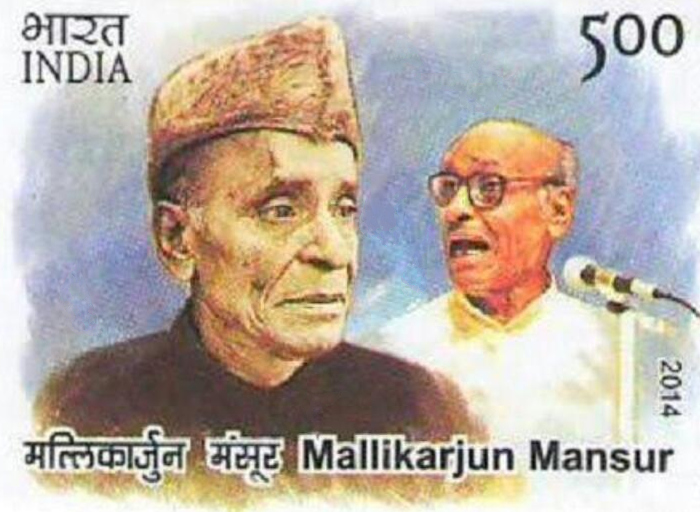
Pandit Mallikarjun Mansur (31 December 1910 – 12 September 1992) was an Indian singer of Hindustani classical music, the greatest representative in his time of the Jaipur-Atrauli gharana, the most intricate of the schools of khayal. He commanded a vast number of rare and compound ragas that few others dared to sing. For most of his life he was known chiefly in his own region; recognition across the country came when he was past sixty, and he sang with undiminished power into his eighties.
Quick Facts
| Full name | Mallikarjun Bheemarayappa Mansur |
| Born | 31 December 1910, Mansur, Dharwad district, Karnataka |
| Died | 12 September 1992, Dharwad (aged 81) |
| Genre | Hindustani classical vocal (khayal) |
| Tradition | Jaipur-Atrauli gharana |
| Teachers | Nilkanth Bua Alurmath; Manji Khan; Bhurji Khan |
| Awards | Padma Shri (1970), Padma Bhushan (1976), Kalidas Samman (1981), Padma Vibhushan (1992) |
| Children | Rajshekhar Mansur and others |
Early Life
He was born in the village of Mansur, a few kilometres from Dharwad, into a farming family of the Lingayat community. His father was the village headman and loved the theatre. The boy left school after a few years and, with his elder brother, joined a travelling drama company, where he played child parts and sang.
Training
A singer of the Gwalior school, Nilkanth Bua Alurmath, heard him in the company and took him as a pupil. He learnt from him for about six years and began to give concerts and make records.
In the mid-1930s, in Bombay, he met Manji Khan, the gifted son of Alladiya Khan, the founder of the Jaipur-Atrauli style. He was accepted as a disciple, and after Manji Khan’s early death continued with his brother Bhurji Khan for many years. The second training transformed him, and he became the chief inheritor of that school.
The Music
The Jaipur-Atrauli style is built on unusual ragas, many of them combinations of two or three, and on long, looping patterns of notes sung in one breath that land exactly on the first beat of the rhythmic cycle. Mansur sang ragas such as Shukla Bilawal, Bahaduri Todi, Sampoorna Malkauns and Khat with complete ease, and brought to this severe, intellectual music an exultant energy that was his own. He rarely announced what he was about to sing; listeners who knew the tradition recognised it, and the rest were carried along.
He also set to music and sang the vachanas, the devotional prose-poems of the Kannada saints of the twelfth century, and helped to make them part of the concert repertoire of Karnataka.
Career
For decades he lived at Dharwad, travelling to sing at conferences and for patrons, and for a time worked for a gramophone company in Bombay as a music director, recording other artists. He served as a music adviser to the Dharwad station of All India Radio.
His reputation among musicians was always high. The wider public discovered him in the 1970s, when he was invited to the major festivals in Delhi, Bombay and Calcutta, and the recordings of his later years show him at his height. He gave his last concert a few months before his death.
The Man
He lived simply in a modest house at Dharwad, smoked bidis incessantly, and treated music as a form of worship. He would sing for a handful of listeners in a small room with the same absorption as for a large audience. Asked late in life what he wished for, he said that he wanted another lifetime to learn music.
Honours
- Padma Shri (1970), Padma Bhushan (1976) and Padma Vibhushan (1992)
- Sangeet Natak Akademi Award (1971) and Fellowship
- Kalidas Samman of the Government of Madhya Pradesh (1981)
His autobiography in Kannada, whose title means “My Journey in Music”, has been translated into English by his son.
Death
He died at Dharwad on 12 September 1992. His house there is now a memorial, and a national music festival is held in his name.
Legacy
His son, Rajshekhar Mansur, a professor of English, carried on his music. With Gangubai Hangal and Bhimsen Joshi he is one of the reasons the small town of Dharwad holds a place of its own in the history of Indian music.
Featured image: Mallikarjun Mansur, from a 2014 postage stamp of India. Photo by India Post, Government of India, licensed under Government Open Data License – India, via Wikimedia Commons.



