
Kishori Amonkar, who lived from 10 April 1932 to 3 April 2017, was an Indian classical vocalist of the Jaipur gharana and is considered one of the foremost classical singers in India. She performed the classical genre khyal and the light classical forms thumri and bhajan. She was trained by her mother, the classical singer Mogubai Kurdikar, also of the Jaipur gharana, but experimented with a variety of vocal styles in her career.
She was born in Bombay on 10 April 1932. Her father died when she was seven, leaving her and two younger siblings to be raised mainly by her mother. In her early career she travelled with her mother to performances and accompanied her on the tanpura. She has said her mother was an exacting teacher, who taught by singing phrases and making her repeat them. In the early 1940s she began taking lessons from Anjanibai Malpekar of the Bhendibazaar gharana, whom she credited with teaching her the technique of meend, the gliding between notes, and later trained with teachers from several gharanas, including Anwar Hussain Khan of the Agra gharana, Sharadchandra Arolkar of the Gwalior gharana and Balkrishnabuwa Parwatkar.
Her work in light music reshaped her classical singing, and she changed her Jaipur gharana style by adding features from other gharanas. She was praised and criticised for pushing the boundaries of the Jaipur tradition. She described herself as a romantic whose approach put emotional expression ahead of tradition, and she often departed from the rhythmic, melodic and structural conventions of the gharana. She criticised the idea that gharanas decide or limit a singer’s technique, and said that the Jaipur methods were the base of her style, on which she performed many variations, including an adoption of alapchari, which relaxes the link between rhythm and note.
She called music “a dialogue with the divine” and the sadhana, the medium, to reach the sadhya, the destination. She emphasised enabling students to move beyond repetitive technique and to learn the tools to improvise on their own, which she credited her mother with. “You have to walk and run on your own,” she said. “The guru gives you strength to be able to do that. If you don’t, then you remain ordinary. My mother made sure I wasn’t ordinary.” In 2010 she published a book in Marathi, Swaraartha Ramani, setting out her views on musical theory and practice.
Her career as a classical vocalist grew in the 1960s and 1970s. Before that she stopped performing for a time because of an illness that affected her ability to sing, and she has said that she used the break to consider and develop her own style, which went beyond the schools of music. She created compositions in many ragas and was a popular speaker who travelled across India, best known for lectures on the role of rasa, feelings or emotions, in music.
She sang playback for the 1964 film Geet Gaya Patharon Ne and for the 1990 film Drishti, but decided to stay away from film music because she felt it put lyrics ahead of the swaras. Her mother also disapproved: Kurdikar reportedly told her she would be forbidden to touch her mother’s tanpura if she continued to work in films.
She spoke about how women performers are treated, saying that her mother’s example shaped her insistence on professionalism and on fair payment for musicians. On one occasion she refused to perform because the audience was badly behaved. She was married to Ravindra Amonkar, a school teacher, and they had two sons, Bibhas and Nihar. She said, “I never play to the gallery. The audience cannot disturb the loneliness of an artiste.” She lived in the Prabhadevi area of Mumbai.
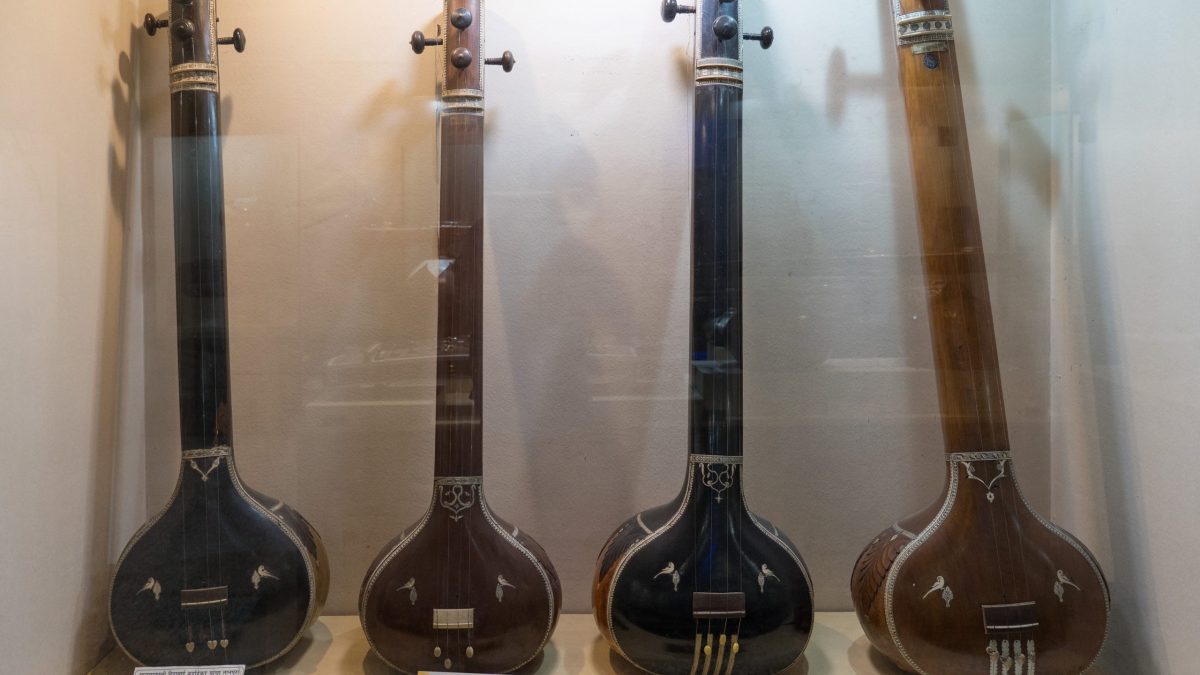
Featured image: Tanpuras on display at the Raja Dinkar Kelkar Museum, Pune (file photo, 2024; Kishori Amonkar accompanied her mother on the tanpura, and this is not a photo of her). Photo by Alexkom000, licensed under CC BY 4.0, via Wikimedia Commons.



