
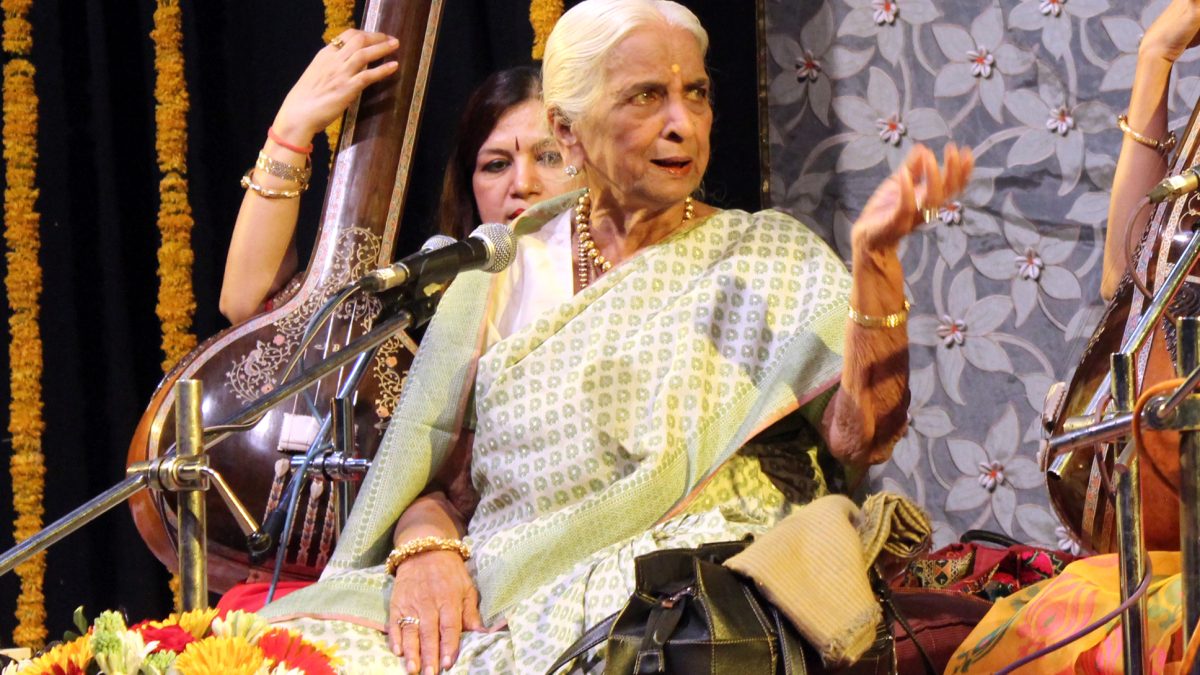
Girija Devi (8 May 1929 – 24 October 2017) was an Indian classical singer of the Banaras gharana, known as the “Queen of Thumri”. She was equally at home in khayal and in the semi-classical and seasonal song forms of eastern Uttar Pradesh, the thumri, dadra, tappa, kajri, chaiti and hori, and she is credited with raising their standing on the concert stage. She received the Padma Vibhushan in 2016.
Quick Facts
| Full name | Girija Devi |
| Born | 8 May 1929, Varanasi, Uttar Pradesh, India |
| Died | 24 October 2017 (aged 88), Kolkata, West Bengal |
| Occupation | Hindustani classical vocalist, teacher |
| Tradition | Banaras gharana |
| Known as | Queen of Thumri; “Appaji” to her students |
| Awards | Padma Shri (1972); Sangeet Natak Akademi Award (1977); Padma Bhushan (1989); Padma Vibhushan (2016) |
Early Life
She was born in Varanasi into a landowning family. Her father, Ramdeo Rai, played the harmonium and loved music, and against the custom of the time he arranged for his daughter to be taught. From the age of five she studied with the singer and sarangi player Sarju Prasad Misra, learning khayal and tappa, and later with Shrichand Misra. Her father also had her taught riding and swimming. As a child she acted in a film.
She was married in her teens to a businessman who supported her singing on condition that she did not perform in private salons. Her mother and grandmother objected strongly to a woman of the family singing in public.
Career
She gave her first broadcast on All India Radio, Allahabad, in 1949 and her first public concert at a music conference in Bihar in 1951, where she is said to have stood in for an established artist at short notice and held the audience. Within a few years she was a regular at the major conferences in Calcutta, Bombay and Delhi.
Her training in khayal gave her light-classical singing an unusual depth. In thumri, a form that elaborates a line or two of romantic or devotional poetry, she followed the slow, emotional style of Banaras, drawing many shades of meaning from a single phrase. She had a large repertoire of the songs sung in the villages around Varanasi for the monsoon, for spring and for Holi, and she presented them with their dialect and earthiness intact while giving them classical polish. She composed many pieces herself.
After her husband’s death in 1975 she devoted much of her time to teaching. In the 1980s she joined the faculty of the ITC Sangeet Research Academy in Kolkata, and in the 1990s she taught at Banaras Hindu University. She trained many singers in the old manner, with students living in her house.
Honours
She received the Padma Shri in 1972, the Padma Bhushan in 1989 and the Padma Vibhushan in 2016, the Sangeet Natak Akademi Award in 1977 and its fellowship in 2010, and the Tansen Samman.
Personal Life and Death
She had one daughter. She kept the speech and manners of Varanasi wherever she lived, and was known for her love of paan, her humour and her strictness as a teacher. She continued to perform into her late eighties. She died in Kolkata on 24 October 2017 after a cardiac arrest, and her body was taken to Varanasi for cremation on the bank of the Ganga.
Legacy
With Siddheshwari Devi and Rasoolan Bai before her, she is counted among the great women singers of Banaras, and she was the last of that line. Her recordings remain the standard for the Banaras style of thumri.
Frequently Asked Questions
When and where was Girija Devi born?
Girija Devi was born on 8 May 1929 in Varanasi, Uttar Pradesh, India.
When did Girija Devi die?
Died: 24 October 2017 (aged 88), Kolkata, West Bengal.
What is Girija Devi’s occupation?
Occupation: Hindustani classical vocalist, teacher.
What honours has Girija Devi received?
Padma Shri (1972); Sangeet Natak Akademi Award (1977); Padma Bhushan (1989); Padma Vibhushan (2016).
Featured image: Girija Devi performing at Bharat Bhavan, Bhopal, July 2015. Photo by Suyash Dwivedi, licensed under CC BY-SA 4.0, via Wikimedia Commons.



