Gangubai Hangal (5 March 1913 – 21 July 2009) was an Indian singer of Hindustani classical music, one of the foremost exponents of the khayal in the style of the Kirana gharana. Born into a community of hereditary women singers that respectable society looked down on, she endured insult and poverty in her early years and became one of the most revered musicians in the country. Her deep, powerful voice was unmistakable. She sang in public until she was past ninety.
Quick Facts
| Full name | Gangubai Hangal |
| Born | 5 March 1913, Dharwad, Karnataka |
| Died | 21 July 2009, Hubli, Karnataka (aged 96) |
| Genre | Hindustani classical vocal (khayal) |
| Tradition | Kirana gharana |
| Teacher | Sawai Gandharva |
| Awards | Padma Bhushan (1971), Sangeet Natak Akademi Award (1973), Padma Vibhushan (2002) |
| Children | Krishna Hangal and two sons |
Early Life
She was born at Dharwad, in the north of what is now Karnataka, a region that has produced many of the great Hindustani singers. Her family belonged to a community of boatmen in which women were by custom dedicated to music; her mother, Ambabai, and her grandmother were respected singers of the southern, Carnatic style.
When the child showed a taste for the Hindustani music she heard on a neighbour’s gramophone, her mother stopped singing altogether, so that the two styles would not be confused in her daughter’s ear. The family moved to Hubli in 1928 so that she could learn.
In 1924, at eleven, she sang the welcome song at the session of the Indian National Congress at Belgaum, presided over by Mahatma Gandhi. She recalled being afraid that, as a girl of a low caste, she would be made to eat apart from the others.
Training
After lessons from local teachers she became, in the late 1930s, a disciple of Sawai Gandharva, the great pupil of the founder of the Kirana school. He lived at Kundgol, a small town some distance away, and she travelled there by train to learn and came home by the night train. Her fellow student was the young Bhimsen Joshi, who would see her to the station with a lantern; she called him her brother to the end of her life.
Prejudice
As a girl walking to her lessons she was jeered at in the street as a “singing woman”. Even after she became known, hosts would sometimes seat her on the veranda to eat. She married, at sixteen, Gururao Kaulgi, a Brahmin lawyer; the marriage, across such a gulf of caste, was never fully accepted by his family, and she kept her mother’s name. He was unsuccessful in his affairs, and she supported the household by her singing.
Career
She made her first records in the early 1930s and sang on the radio from Bombay. She became a regular at the major music conferences from the 1940s.
In the mid-1950s an operation on her throat changed her voice, which became deep, broad and almost masculine. She made of it an instrument of great force.
Her music was austere. She sang few ragas, chiefly the large, serious ones, and unfolded each slowly, note by note, in the Kirana manner, without ornament for its own sake. She would not sing light songs or film music. She was accompanied for decades by her daughter, Krishna, whose death in 2004 was a heavy blow.
She gave what was announced as her last concert in 2006, at ninety-three, celebrating seventy-five years as a performer. In all she is said to have sung in more than two hundred cities and received some fifty awards and several honorary doctorates.
Honours
- Padma Bhushan (1971) and Padma Vibhushan (2002)
- Sangeet Natak Akademi Award (1973) and Fellowship (1996)
- Nominated member of the Karnataka Legislative Council
- A music university at Mysore and a residential music school at Hubli bear her name
Her memoir was published in Kannada under a title meaning “The Song of My Life”.
Death
She died at Hubli on 21 July 2009, aged ninety-six, and was given a state funeral. She had donated her eyes.
Legacy
She is remembered with Mallikarjun Mansur, Bhimsen Joshi and Kumar Gandharva as one of the great voices that came out of a small corner of north Karnataka, and as a woman who made her way by the quality of her art alone.
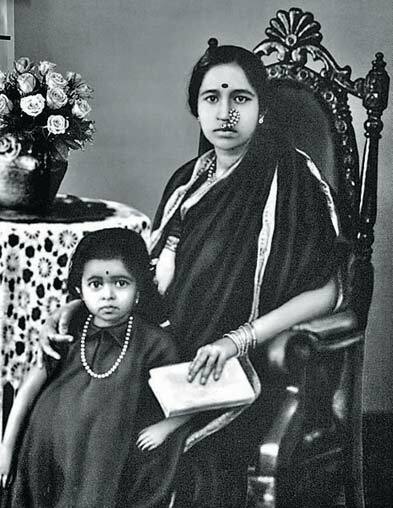
Featured image: Gangubai Hangal with her daughter Krishna, 1930s. Photo by an unknown photographer, in the public domain, via Wikimedia Commons.