Lakshminath Bezbaroa (14 October 1864 – 26 March 1938) was an Indian poet, short-story writer, essayist, playwright and satirist who wrote in Assamese. He was the central figure of the Jonaki era, the romantic age of Assamese literature, and did more than anyone to give the language a modern prose. He wrote Assam’s state song, and is known as Sahityarathi, the charioteer of literature.
Quick Facts
| Full name | Lakshminath Bezbaroa |
| Born | 14 October 1864, Ahatguri, near Nagaon, Assam |
| Died | 26 March 1938, Dibrugarh, Assam (aged 73) |
| Language | Assamese |
| Occupation | Poet, short-story writer, essayist, playwright, satirist, businessman |
| Notable works | Burhi Aair Sadhu, Kripabor Barbaruar Kakatar Topola, Surabhi, Jonbiri, Kadamkali, Padum Kunwari, Mor Jiban Sowaran |
| Titles | Sahityarathi, Rasaraj |
| Spouse | Pragyasundari Devi (m. 1891) |
Early Life
He was born on the night of Lakshmi Purnima on a boat moored on a sandbank of the Brahmaputra at Ahatguri, while his father, Dinanath Bezbaroa, a senior official under the British, was being transferred from Nagaon to Barpeta. He was named after the goddess.
The family were hereditary physicians to the Ahom kings and devout followers of the Vaishnava saint Sankardev. He spent his childhood in the towns to which his father was posted, Barpeta, Tezpur, North Lakhimpur and finally Sivasagar, and the devotional songs and stories of the household stayed with him.
Calcutta and Jonaki
He went to Calcutta for college and took his B.A. from the General Assembly’s Institution. Assamese had only recently been restored as the language of schools and courts in Assam after decades in which Bengali had been used, and the Assamese students in Calcutta felt the need to prove their language. In 1888 they formed a society for its improvement, and in 1889 they started a magazine, Jonaki (“Firefly”). Bezbaroa, with Chandra Kumar Agarwala and Hemchandra Goswami, was its moving spirit. The magazine brought romantic poetry, the short story and the modern essay into Assamese.
Marriage and Business
In 1891 he married Pragyasundari Devi, a granddaughter of Debendranath Tagore and niece of Rabindranath Tagore. He is said to have refused the dowry offered. When members of the Tagore circle suggested that Assamese was a form of Bengali, he argued the point with them firmly.
He did not take up government service. He went into the timber trade in Calcutta with the Assamese businessman Bholanath Barooah, and later worked for Bird and Company at Sambalpur in Odisha, where he lived for some twenty years. Nearly all his writing was done outside Assam.
Works
- Burhi Aair Sadhu (“Grandmother’s Tales”, 1911), with Kakadeuta aru Natilora and Junuka: the folk tales of Assam, collected and retold. Stories such as “Tejimola” are known to every Assamese child.
- Kripabor Barbaruar Kakatar Topola and its sequels: comic and satirical essays written in the voice of an invented character, which earned him the name Rasaraj, king of humour
- Surabhi, Sadhukathar Kuki, Jonbiri: short stories; he is regarded as the father of the Assamese short story
- Kadamkali: poems and songs
- Padum Kunwari: a historical novel
- Chakradhwaj Singha, Joymati Kunwari, Belimar: historical plays, and four farces
- Studies of Sankardev and Madhavdev, and an autobiography, Mor Jiban Sowaran
He also edited the magazine Banhi from 1909.
The State Song
His song “O Mur Apunar Desh” (“O my dearest country”), first published in Banhi in 1909, was adopted as the state song of Assam in 1927 at a student conference at Tezpur and is sung at public functions in the state.
Later Life
He presided over the Asam Sahitya Sabha at Guwahati in 1924. He died at Dibrugarh on 26 March 1938, at the house of his daughter. They had four daughters, one of whom died in infancy.
Legacy
The Asam Sahitya Sabha observes 26 March as Sahitya Divas, Literature Day. His house at Sambalpur has been preserved, and the 150th anniversary of his birth was celebrated across Assam in 2014.
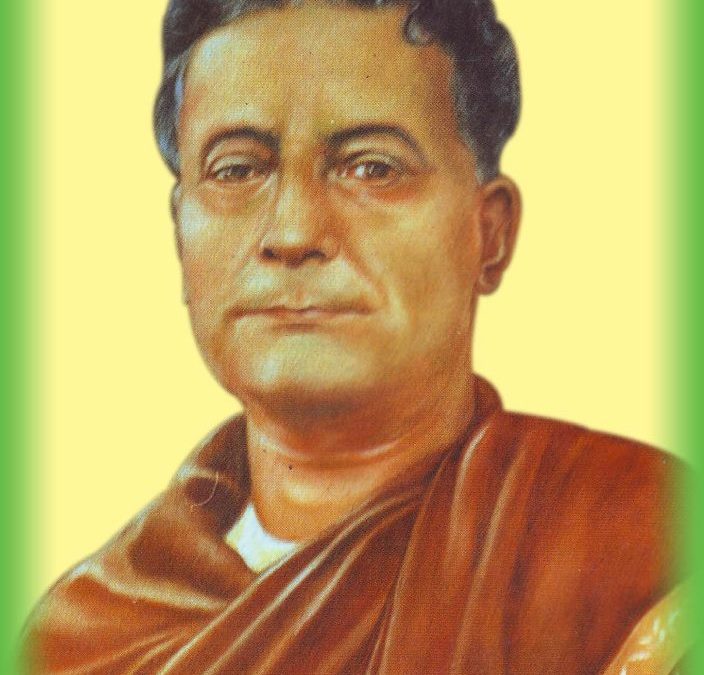
Featured image: A portrait of Lakshminath Bezbaroa. Photo by Homen Biswas, licensed under CC BY-SA 3.0, via Wikimedia Commons.