Fakir Mohan Senapati (13 January 1843 – 14 June 1918) was an Indian novelist, short-story writer, poet and administrator who wrote in Odia. He led the fight to save the Odia language when officials proposed to replace it in schools, wrote its first modern short story and its greatest novel, and is revered as the father of modern Odia literature. He is known as Vyasakabi.
Quick Facts
| Full name | Fakir Mohan Senapati (born Braja Mohan) |
| Born | 13 January 1843, Mallikashpur, Balasore, Bengal Presidency (now in Odisha) |
| Died | 14 June 1918, Balasore (aged 75) |
| Language | Odia |
| Occupation | Novelist, short-story writer, poet, teacher, administrator |
| Notable works | Rebati, Chha Mana Atha Guntha, Mamu, Prayaschitta, Lachhama, Atma Jibana Charita |
| Titles | Vyasakabi, Katha Samrat |
Early Life
He was born at Mallikashpur, a quarter of the port town of Balasore, into a family that had once held military rank under the Marathas. His father died when he was a year and a half old and his mother a few months later. He was brought up by his grandmother. A sickly child, he recovered after she vowed to dedicate him to a Muslim saint; he was renamed Fakir, and for some years begged alms as a fakir during Muharram.
There was no money for schooling. As a boy he worked as a labourer in the sail-making sheds of the port and kept accounts for a salt merchant. He taught himself, attended school only briefly, and at about twenty-one became a teacher and then headmaster of the mission school at Balasore. He learnt Sanskrit, Bengali, Persian and English largely on his own. The British collector John Beames, a scholar of Indian languages, befriended him and learnt Odia from him.
Saving the Language
In the 1860s Odisha was administered partly from Bengal, and Bengali officials and teachers argued that Odia was only a dialect of Bengali and should be replaced by it in schools. One pamphlet was titled “Odia is not a separate language”.
Senapati answered in the most practical way. Odia had almost no school textbooks, so he wrote them: books of history, arithmetic and grammar. In 1868 he and his friends, raising money share by share, set up a printing press at Balasore, the first in north Odisha, and brought out journals. With the support of Beames and other officials, Odia was confirmed as the language of the region’s schools and courts.
Administrator
From 1871 he served for about twenty-five years as dewan, or manager, of a succession of small princely states of Odisha, including Nilgiri, Dhenkanal, Daspalla and Keonjhar. In Keonjhar in 1891 he was captured by tribal rebels during an uprising and escaped by a trick. The work gave him an intimate knowledge of landlords, moneylenders, clerks and peasants.
Writer
He translated the Ramayana, the Mahabharata and other Sanskrit classics into Odia verse, which earned him the title Vyasakabi. His original fiction came late, after he retired to Cuttack and Balasore in his fifties.
- **”Rebati” (1898):** a village girl’s wish to study is blamed for the disasters that fall on her family. It is regarded as the first modern Odia short story.
- **Chha Mana Atha Guntha (“Six Acres and a Third”, serialised 1897–99):** a cunning landlord, Ramachandra Mangaraj, cheats a weaver couple out of their small plot. Told by a sly, mocking narrator in the everyday speech of villagers, it exposed the land system of colonial India years before other Indian novelists took up the theme.
- **Mamu** and **Prayaschitta:** novels of the new English-educated class
- **Lachhama:** a historical novel of the Maratha raids
- **Atma Jibana Charita:** his autobiography, the first in Odia
Personal Life
He married twice; his first wife, Lilavati, died young, and his second, Krushna Kumari, whom he loved deeply, died in 1894. He had a son, Mohini Mohan, and a daughter. His last years in Balasore, in a house with a garden he named Shanti Kanan, were lonely. He died there in 1918.
Legacy
Fakir Mohan University at Balasore is named after him. Chha Mana Atha Guntha has been translated into English several times and is taught as a founding text of Indian realism.
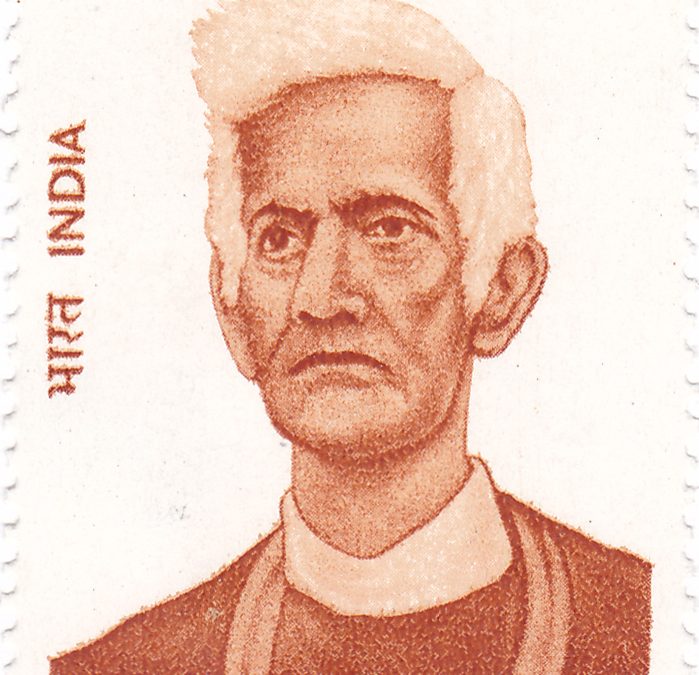
Featured image: Fakir Mohan Senapati on a 1993 postage stamp of India. Photo by India Post, Government of India, licensed under Government Open Data License – India, via Wikimedia Commons.