Bhai Vir Singh (5 December 1872 – 10 June 1957) was an Indian poet, novelist, scholar and reformer who wrote in Punjabi. He wrote the first novel in the language, gave it a modern poetry and prose, and devoted his life to the revival of Sikh learning. He is regarded as the father of modern Punjabi literature and is sometimes called the sixth river of Punjab.
Quick Facts
| Full name | Bhai Vir Singh |
| Born | 5 December 1872, Amritsar, Punjab |
| Died | 10 June 1957, Amritsar (aged 84) |
| Language | Punjabi |
| Occupation | Poet, novelist, scholar, editor, reformer |
| Notable works | Sundari, Bijay Singh, Satwant Kaur, Rana Surat Singh, Lehran de Haar, Matak Hulare, Mere Saiyan Jio, Kalgidhar Chamatkar |
| Awards | Sahitya Akademi Award (1955), Padma Bhushan (1956) |
| Spouse | Chatar Kaur |
| Children | 2 |
Early Life
He was born in Amritsar into a family of scholars. His father, Dr Charan Singh, was a physician who wrote poetry and prose in Braj and Punjabi, and his maternal grandfather, Giani Hazara Singh, was a noted commentator on Sikh scripture, with whom the boy spent much of his childhood. He learnt Sanskrit, Persian, Urdu and the Sikh texts in the traditional way, and then went to the Church Mission School in Amritsar, where he passed the matriculation examination in 1891, standing first in the district.
The Choice
Government service was open to him. He chose to become a printer and writer. Punjab at the time was the scene of vigorous preaching by Christian missionaries and by Hindu and Muslim reform groups, and the Sikhs, their kingdom lost within living memory, feared for their identity. The Singh Sabha movement had arisen to restore Sikh faith and education, and he became its most influential voice.
- **1892:** He set up the Wazir-i-Hind Press in Amritsar with a friend, Wazir Singh.
- **1894:** He founded the Khalsa Tract Society, which issued hundreds of cheap booklets on religion and social reform.
- **1899:** He started the weekly newspaper Khalsa Samachar, which is still published.
Works
Novels
Sundari (1898), the story of a brave Sikh woman in the troubled eighteenth century, is the first novel in Punjabi. It was followed by Bijay Singh (1899), Satwant Kaur and Baba Naudh Singh. They were written to give readers pride and courage, and they were read in almost every literate Sikh home.
Poetry
- Rana Surat Singh (1905): an epic of more than twelve thousand lines, in blank verse, on a widow’s spiritual search
- Short lyrics, in which he is at his best, collected in Trel Tupke, Lehran de Haar, Matak Hulare and Bijlian de Haar. Their subjects are nature, especially the landscape of Kashmir, and the longing of the soul for God.
- Mere Saiyan Jio (1953), for which he received the Sahitya Akademi Award in 1955, the first given for Punjabi
Scholarship
He wrote lives of the Sikh Gurus, Kalgidhar Chamatkar on Guru Gobind Singh and Guru Nanak Chamatkar, edited and annotated the great historical poem Gur Pratap Suraj Granth in fourteen volumes, revised his grandfather’s dictionary of the Guru Granth Sahib, and worked until his death on a commentary on the scripture itself.
Institutions
He helped found the Chief Khalsa Diwan in 1902, the Central Khalsa Orphanage in 1904, the Punjab and Sind Bank in 1908, and a home for the blind and a hospital in Amritsar.
Character
He avoided public platforms, seldom allowed his name to appear on his books in his early years, and gave no speeches. Visitors remembered his silence and gentleness.
Honours
- Honorary doctorate from the Panjab University, 1949
- Nominated to the Punjab Legislative Council, 1952
- Sahitya Akademi Award, 1955
- Padma Bhushan, 1956
Personal Life
He was married at seventeen to Chatar Kaur, and they had two daughters. He lived all his life in Amritsar and died there on 10 June 1957.
Legacy
His house in Amritsar is a museum, and the Bhai Vir Singh Sahitya Sadan in New Delhi promotes Punjabi studies. Later Punjabi writers, among them Amrita Pritam, built on the language he had made fit for modern literature.
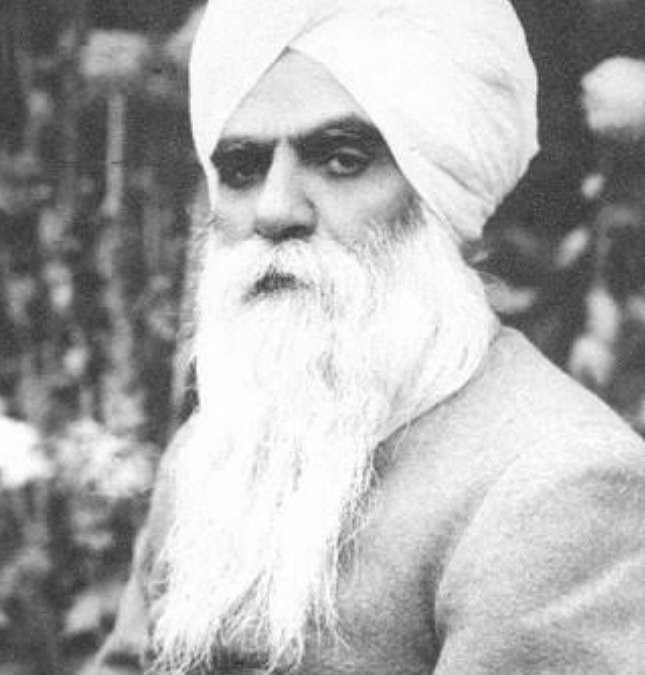
Featured image: Bhai Vir Singh in 1943. Photo by an unknown photographer, in the public domain, via Wikimedia Commons.