
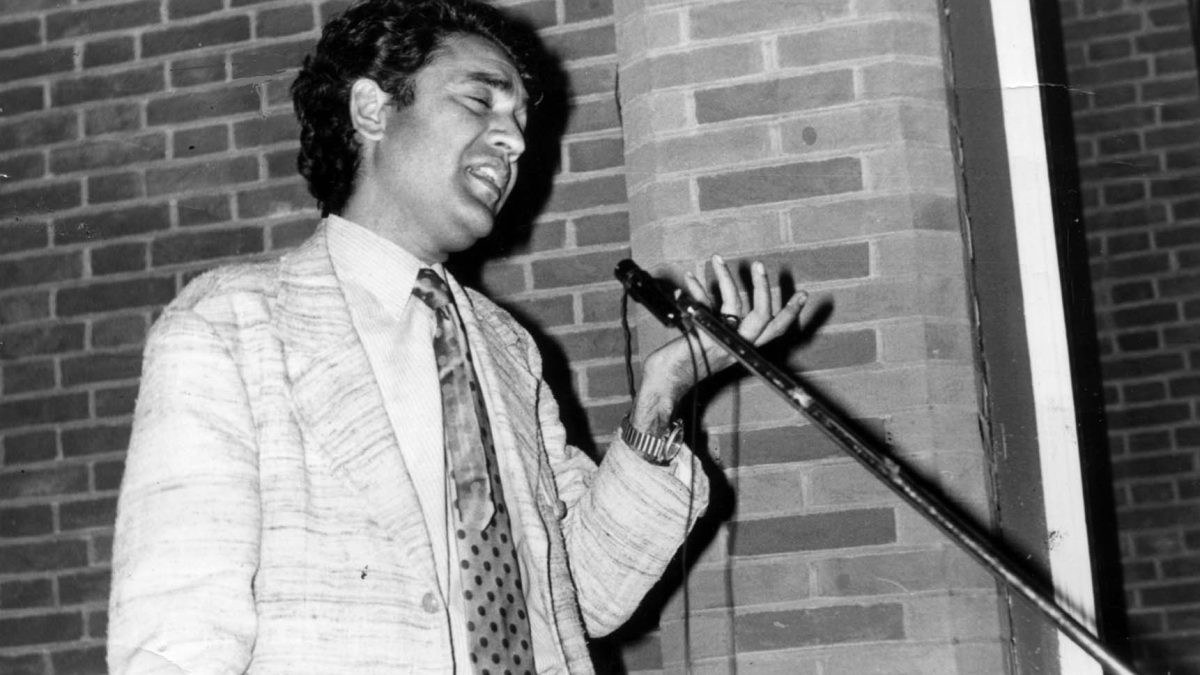
Shiv Kumar Batalvi (23 July 1936 – 6 May 1973) was an Indian poet who wrote in Punjabi. In a writing life of little more than a decade he produced lyrics of love, separation and death that are sung to this day, and a verse play, Loona, for which he became the youngest writer to receive the Sahitya Akademi Award. He died at thirty-six. Amrita Pritam called him Birha da Sultan, the king of the sorrow of parting.
Quick Facts
| Full name | Shiv Kumar Batalvi |
| Born | 23 July 1936, Bara Pind Lohtian, Shakargarh, Punjab, British India (now in Pakistan) |
| Died | 6 May 1973, Kiri Mangyal, near Pathankot, Punjab (aged 36) |
| Language | Punjabi |
| Occupation | Poet, lyricist |
| Notable works | Peeran da Paraga, Lajwanti, Aate Dian Chirian, Mainu Vida Karo, Birha Tu Sultan, Loona |
| Awards | Sahitya Akademi Award (1967) |
| Spouse | Aruna Batalvi (m. 1967) |
| Children | 2 |
Early Life
He was born in a village in the Shakargarh tehsil, in a Brahmin family. His father, Pandit Krishan Gopal, was a village revenue official. As a boy he would disappear for the day and be found lying under a tree by the stream or listening to the wandering singers and snake-charmers; the village, its seasons and its songs are the landscape of his poetry.
At Partition in 1947 Shakargarh went to Pakistan. The family crossed to the Indian side and settled at Batala in Gurdaspur district, where his father was posted. He was eleven, and he never ceased to feel the loss of the village.
Youth
He matriculated in 1953 and enrolled in one course after another, in science, in arts and at a school of civil engineering, without finishing any. His father found him work as a patwari, which he gave up. He spent his time writing and reciting.
His poems of this time grew from two griefs. A girl he loved, Maina, whom he had met at a fair, died young of illness. Later he loved the daughter of a writer; she went abroad and married there. Out of the first came the elegy “Maina”; out of the second the song “Ajj Din Chadheya Tere Rang Varga” and, when he heard that she had borne a child, “Main Ik Shikra Yaar Banaya”, in which the beloved is a hawk that takes the food offered and flies away.
Poetry
His first collection, Peeran da Paraga (“A Handful of Pains”), came out in 1960 and made him famous. Others followed quickly: Lajwanti (1961), Aate Dian Chirian (1962), Mainu Vida Karo (1963), Dardmandan Dian Aahin and Birha Tu Sultan (1964).
He drew on the forms of Punjabi folk song, and he recited, or rather sang, his poems in a voice that held large audiences still. Among the best known:
- “Maye Ni Maye”, a daughter telling her mother of her pain
- “Ik Kudi Jihda Naam Mohabbat”, a notice for a lost girl whose name is love
- “Ki Puchde O Haal Fakiran Da”
- “Bhatti Waliye” and “Lajwanti”
They have been recorded by Jagjit Singh, Nusrat Fateh Ali Khan, Surinder Kaur, Mahendra Kapoor and many others, and several have been used in films.
Loona
Loona (1965) retells the legend of Puran Bhagat. In the old story the young queen Loona, who desires her stepson and has him mutilated when he refuses her, is a villain. Batalvi made her the centre: a girl of low caste married against her will to an old king, and wronged before she does wrong. The verse play won the Sahitya Akademi Award in 1967. He was thirty-one.
Later Years
He joined the State Bank of India at Batala in 1966 and moved to Chandigarh in 1968. In February 1967 he married Aruna, a girl from his own community chosen with the family’s approval, and the marriage was a happy one. They had a son, Meharban, and a daughter, Puja.
He had been drinking heavily for years. In 1972 he was invited to England, where he was feted by the Punjabi community and interviewed by the BBC, and where the drinking and late nights ruined what was left of his health. He came home with cirrhosis of the liver. Unable to pay for treatment, he was taken to his wife’s family village of Kiri Mangyal, and died there on 6 May 1973.
Legacy
An auditorium in Batala is named after him. Critics who had dismissed him in his lifetime as a poet of mere sorrow have since recognised the range of his language, and he remains the most popular modern poet in Punjabi on both sides of the border.
Featured image: Shiv Kumar Batalvi reciting at Southall, England, in the early 1970s. Photo by Amarjit Chandan, licensed under CC BY 4.0, via Wikimedia Commons.



