
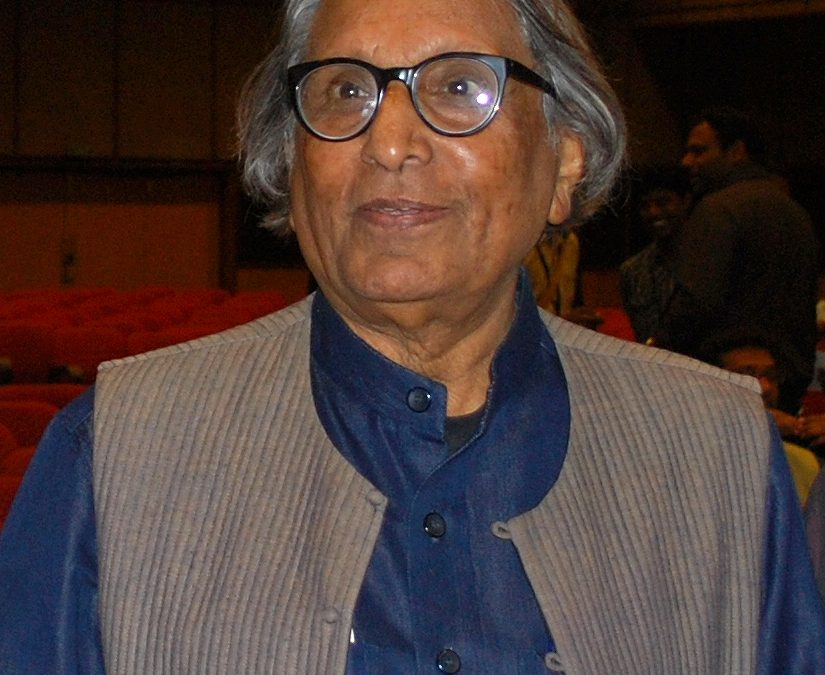
Balkrishna Vithaldas Doshi (26 August 1927 – 24 January 2023) was an Indian architect, teacher and institution builder. He learnt his craft under Le Corbusier and worked beside Louis Kahn, then spent sixty years in Ahmedabad creating an architecture rooted in Indian life: campuses, housing for the poor and buildings that breathe with the climate. In 2018 he became the first Indian to receive the Pritzker Architecture Prize, the highest honour of the profession.
Quick Facts
| Full name | Balkrishna Vithaldas Doshi |
| Born | 26 August 1927, Pune, Maharashtra |
| Died | 24 January 2023, Ahmedabad (aged 95) |
| Education | Sir J. J. School of Architecture, Bombay |
| Occupation | Architect, urban planner, educator |
| Notable works | Sangath, CEPT University and Amdavad ni Gufa, Ahmedabad; Indian Institute of Management, Bangalore; Aranya Low Cost Housing, Indore |
| Awards | Padma Shri (1976), Aga Khan Award (1995), Pritzker Prize (2018), Padma Bhushan (2020), RIBA Royal Gold Medal (2022), Padma Vibhushan (2023, posthumous) |
| Spouse | Kamala Parikh |
Early Life
He was born in Pune into a family of furniture makers. His mother died when he was a baby, and he grew up in a large joint household that kept adding rooms as it grew, an experience he said taught him that a house is never finished. A teacher encouraged his drawing, and he entered the Sir J. J. School of Architecture in Bombay in 1947.
Le Corbusier
In 1950 he left for London and from there, hearing that Le Corbusier was looking for help with his Indian work, went to Paris. He spoke no French and worked for the first eight months without pay. He stayed four years, drawing for the new city of Chandigarh and the master’s buildings in Ahmedabad.
He came back in 1954 to supervise those buildings, among them the Mill Owners’ Association building and the Sarabhai house, and settled in Ahmedabad for life. See the Capitol Complex at Chandigarh.
His Own Practice
He founded his firm, Vastu Shilpa, in 1956. In 1962 he persuaded the American architect Louis Kahn to design the Indian Institute of Management at Ahmedabad and worked with him on it for more than a decade.
Buildings
- **School of Architecture, Ahmedabad (1966):** an open brick-and-concrete building without barriers, the beginning of the institution now called CEPT University, which he founded and led
- **Tagore Memorial Hall and the Institute of Indology, Ahmedabad**
- **Sangath (1980):** his own studio, a group of low vaults covered in broken white china tiles, half sunk in the ground among gardens and water channels
- **Indian Institute of Management, Bangalore (from 1977):** stone buildings linked by long shaded corridors and courts open to the sky, modelled on the temple towns of the south
- **Amdavad ni Gufa (1994):** an underground gallery of bulging domes made with the painter M. F. Husain
Housing
He held that architecture must serve those who cannot pay architects. For the Life Insurance Corporation in Ahmedabad he designed stepped houses that families could extend. At Aranya, in Indore, begun in the 1980s, he laid out a township for some eighty thousand people, most of them poor. Each family received a small plot with a plinth, a water tap and a toilet, on a pattern of lanes and small squares, and built upward as its means allowed. It won the Aga Khan Award for Architecture in 1995.
Teacher
He founded or helped to found the school of architecture and the school of planning that became CEPT University, the Visual Arts Centre and the Kanoria Centre for Arts in Ahmedabad, and a research foundation for the study of housing. Generations of Indian architects were his students.
Recognition
- Aga Khan Award for Architecture (1995)
- Pritzker Architecture Prize (2018)
- Royal Gold Medal of the Royal Institute of British Architects (2022)
- Padma Shri, Padma Bhushan and, after his death, Padma Vibhushan
Personal Life
He married Kamala Parikh in 1955; they had three daughters. He rose early, sketched constantly and compared designing to telling a story.
He died at his home in Ahmedabad on 24 January 2023, aged ninety-five. With Charles Correa he gave Indian architecture a modern language of its own.
Featured image: B. V. Doshi at an architects’ convention in Chennai, December 2013. Photo by Sanyam Bahga, licensed under CC BY-SA 3.0, via Wikimedia Commons.



