Charles Mark Correa (1 September 1930 – 16 June 2015) was an Indian architect and urban planner, the most influential architect of independent India. He adapted modern architecture to the Indian climate and way of life, with courtyards, terraces and what he called spaces open to the sky. He designed museums, housing and public buildings across the country and was the chief architect of Navi Mumbai. He argued throughout his life for cities planned around the needs of the poor.
Quick Facts
| Full name | Charles Mark Correa |
| Born | 1 September 1930, Secunderabad |
| Died | 16 June 2015, Mumbai (aged 84) |
| Education | St Xavier’s College, Bombay; University of Michigan; Massachusetts Institute of Technology (M.Arch., 1955) |
| Occupation | Architect, urban planner |
| Notable works | Gandhi Smarak Sangrahalaya, Ahmedabad; Kanchanjunga Apartments, Mumbai; Bharat Bhavan, Bhopal; Jawahar Kala Kendra, Jaipur; Champalimaud Centre, Lisbon |
| Awards | Padma Shri (1972), RIBA Royal Gold Medal (1984), Praemium Imperiale (1994), Aga Khan Award (1998), Padma Vibhushan (2006) |
| Spouse | Monika Correa |
Early Life
He was born at Secunderabad into a Roman Catholic family of Goan origin and grew up in Bombay. As a boy he played with model trains and drew layouts for them, which he later called his first lessons in planning. He studied at St Xavier’s College, then at the University of Michigan and the Massachusetts Institute of Technology, where Buckminster Fuller was among his teachers.
He returned in 1955 and opened his own office in Bombay in 1958.
Sabarmati
His first major building, completed in 1963, was the museum and memorial to Gandhi at the Sabarmati Ashram in Ahmedabad. It is a grid of small tiled-roof pavilions, some enclosed and some open, around a water court: modest, cool and made of brick, stone and wood, in keeping with the man it honours.
Ideas
In a hot country, he held, the best room is often no room at all but a shaded courtyard or a terrace. Buildings should use the movement of air and the path of the sun, not machines, to stay cool, and should be journeys, with a sequence of spaces to walk through.
Major Works
- **Kanchanjunga Apartments, Mumbai (1983):** a tower of interlocking flats, each with a two-storey garden terrace cut into the corner to catch the sea breeze
- **Bharat Bhavan, Bhopal (1982):** an arts centre stepping down a hillside to a lake in a series of terraces and sunken courts
- **Jawahar Kala Kendra, Jaipur (1992):** an arts centre planned as nine squares, after the diagram on which the old city of Jaipur was laid out
- **Vidhan Bhavan, Bhopal:** the Madhya Pradesh assembly, which won the Aga Khan Award for Architecture
- **National Crafts Museum and the British Council building, New Delhi**
- **Abroad:** the neuroscience centre at the Massachusetts Institute of Technology, the Ismaili Centre in Toronto and the Champalimaud Centre for the Unknown in Lisbon (2010), a cancer research institute on the waterfront which he considered among his best
Housing
At Belapur in Navi Mumbai in the 1980s he built low-rise housing for people of different incomes, in clusters of small houses around shared courtyards, each on its own plot so that families could extend it as they prospered. He maintained that such housing could reach high densities without towers and gave the poor what towers could not: a piece of ground and a place to work.
Navi Mumbai
In 1964, with two colleagues, he proposed that Bombay, crowded on to a narrow island, should grow not northward but eastward, across the harbour, as a twin city. The government accepted the idea. From 1970 to 1975 he was chief architect of the agency that planned New Bombay, now Navi Mumbai, a city of more than a million people.
He chaired the National Commission on Urbanisation in the 1980s, founded the Urban Design Research Institute in Mumbai, and fought, without success, to have the land of the city’s closed textile mills used for parks and public housing.
Honours
- Padma Shri (1972) and Padma Vibhushan (2006)
- Royal Gold Medal of the Royal Institute of British Architects (1984), which later described him as India’s greatest architect
- Gold Medal of the International Union of Architects (1990)
- Praemium Imperiale of Japan (1994)
Personal Life
He was married to Monika, a weaver, who collaborated on some of his projects; they had a son and a daughter. He taught at universities abroad, wrote essays collected as The New Landscape and A Place in the Shade, and gave his archive to the Royal Institute of British Architects. He died in Mumbai on 16 June 2015.
With B. V. Doshi he defined what a modern Indian architecture could be.
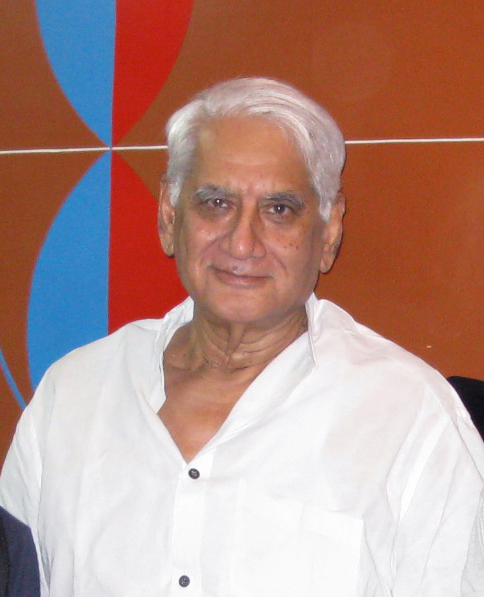
Featured image: Charles Correa in December 2011. Photo by Dipz99, licensed under CC BY-SA 3.0, via Wikimedia Commons.