Yusuf Khwaja Hamied (born 25 July 1936) is an Indian scientist and businessman, the non-executive chairman of the pharmaceutical company Cipla, which his father founded. A chemist trained at Cambridge, he was a leading voice for the patent law that allowed India to build a generic drug industry. In 2001 he offered a combination of AIDS medicines to poor countries for less than a dollar a day, a small fraction of the prevailing price, and so made mass treatment of the disease possible.
Quick Facts
| Full name | Yusuf Khwaja Hamied |
| Born | 25 July 1936, Vilnius (then in Poland; now Lithuania) |
| Age | 90 |
| Education | Cathedral and John Connon School and St Xavier’s College, Bombay; Christ’s College, Cambridge (Ph.D. in chemistry, 1960) |
| Occupation | Chemist, industrialist |
| Company | Cipla (non-executive chairman) |
| Known for | Low-cost generic medicines for HIV/AIDS |
| Awards | Padma Bhushan (2005); Honorary Fellow of the Royal Society (2019) |
| Spouse | Farida Hamied |
Early Life
His father, Khwaja Abdul Hamied, an Indian chemist and nationalist from Aligarh, had gone to Berlin to take a doctorate, and there met and married Luba Derczanska, a Jewish student from Lithuania. Yusuf was born at Vilnius while his parents were visiting her family, and brought up in Bombay. Most of his mother’s relatives were killed in the Holocaust.
In 1935 his father had founded the Chemical, Industrial and Pharmaceutical Laboratories, Cipla, to make medicines in India. Mahatma Gandhi visited the factory in 1939.
Cambridge
He went to Christ’s College, Cambridge, at eighteen, and took a doctorate in organic chemistry in 1960 under Lord Todd, a Nobel laureate. He returned to join Cipla as a research officer, at first, because of a government rule on salaries, on a nominal wage.
The Patent Law
Under the patent law that India had inherited from British rule, foreign companies held most drug patents and Indian prices were among the highest in the world. With others in the industry he formed an association of Indian drug manufacturers in 1961 and campaigned for change.
The Patents Act of 1970, passed under Indira Gandhi, recognised patents only on the process by which a medicine was made and not on the substance itself. An Indian firm that found another route could make any drug. Hamied, a gifted process chemist, did exactly that. Over the next three decades India became the largest supplier of low-cost generic medicines in the world, and prices at home fell to among the lowest.
He became managing director of Cipla in 1976 and chairman in 1989.
The AIDS Drugs
By 2000 the combination of three antiretroviral drugs that keeps people with HIV alive had been in use in rich countries for several years. It cost between ten and fifteen thousand dollars a patient a year. In Africa, where tens of millions were infected, almost no one received it.
Cipla had been making one of the drugs since the early 1990s. In September 2000 Hamied told a European Commission meeting that he could supply the combination far more cheaply. On 6 February 2001 he offered it to the medical charity Médecins Sans Frontières at 350 dollars a patient a year, less than a dollar a day, and to governments at 600.
The offer made headlines round the world. The large pharmaceutical companies, which were then suing the government of South Africa over its medicines law, dropped the case and cut their own prices. International funds were created to buy the drugs. Cipla put all three medicines into a single pill, taken twice a day. Within some years millions of Africans were on treatment, a large share of them with Indian generics.
He was called a pirate by parts of the industry. He replied that he was not against patents but against monopoly, and that in a matter of life and death no company should have the right to deny a medicine to those who cannot pay.
Other Work
- low-cost versions of medicines for cancer, asthma, malaria and influenza, including a generic of the antiviral used against bird flu
- drugs for children with HIV and for preventing transmission from mother to child
- a palliative care centre for cancer patients at Pune
After India adopted product patents in 2005 to comply with world trade rules, he argued for the use of compulsory licences for essential drugs.
Recognition
- Padma Bhushan (2005)
- Honorary Fellow of the Royal Society (2019)
- The chemistry department of the University of Cambridge was named the Yusuf Hamied Department of Chemistry in 2020 after a benefaction from him
Personal Life
He married Farida; they have no children. He handed the executive leadership of Cipla to professional managers and members of his brother’s family and remains its non-executive chairman. He divides his time between Mumbai and London.
Others who built India’s pharmaceutical industry include K. Anji Reddy and Cyrus Poonawalla.
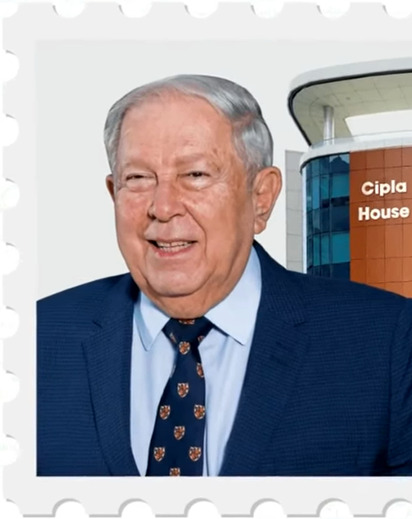
Featured image: Yusuf Hamied, from a 2025 postage stamp of India marking 90 years of Cipla. Photo by India Post, Government of India, licensed under Government Open Data License – India, via Wikimedia Commons.