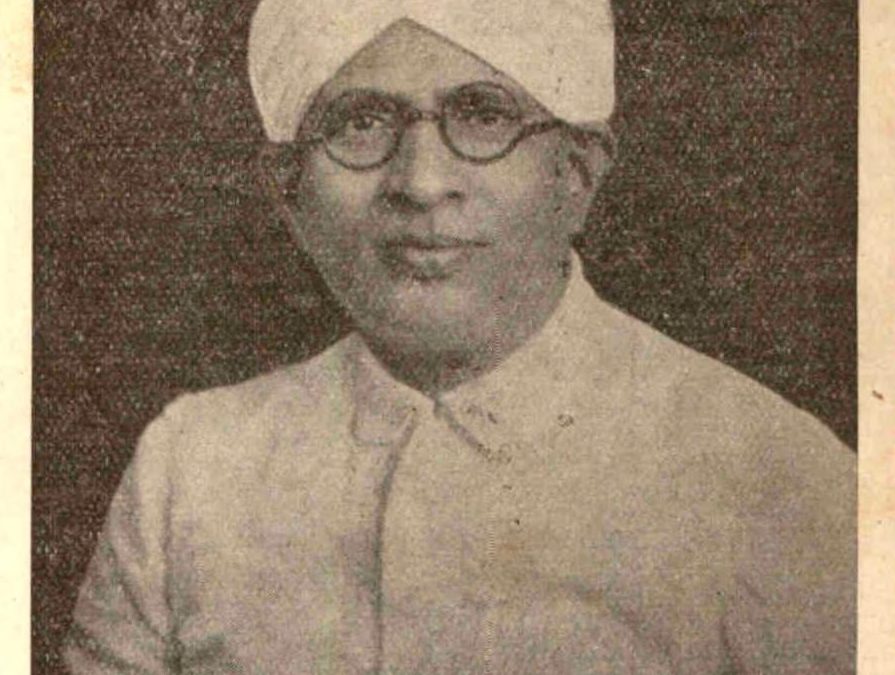
Walchand Hirachand Doshi (23 November 1882 – 8 April 1953) was an Indian industrialist who pioneered the transport industries of India. He built up the first large Indian-owned shipping line, and in the 1940s founded the country’s first modern shipyard, its first aircraft factory and its first car factory, each in the face of official discouragement. The day his company’s first ship sailed for England, 5 April 1919, is observed as National Maritime Day.
Quick Facts
| Full name | Walchand Hirachand Doshi |
| Born | 23 November 1882, Solapur, Maharashtra |
| Died | 8 April 1953, Siddhpur, Gujarat (aged 70) |
| Community | Gujarati Jain |
| Occupation | Industrialist |
| Founded | Scindia Steam Navigation Company (1919); Hindustan Construction Company (1926); Hindustan Aircraft (1940); Hindustan Shipyard, Visakhapatnam (1941); Premier Automobiles (1944) |
| Spouse | Kasturbai |
Early Life
He was born at Solapur into a Jain family from Gujarat that dealt in cotton and moneylending. He studied at colleges in Bombay and Pune but left to join the family business, which did not interest him.
Contractor
In 1903, with a former railway clerk as partner, he began taking contracts for railway construction. He proved to be a contractor of drive and daring. His firm built stretches of line, river bridges, the tunnels through the Bhor Ghat for the railway between Bombay and Pune, and the pipeline that brought water to Bombay from Tansa. It later merged with a Tata company and became, in time, the Hindustan Construction Company.
Shipping
Coastal and overseas shipping from India was a British preserve. After the First World War, with Narottam Morarjee and others, he bought a steamer from the Scindia family of Gwalior, and on 5 April 1919 the SS Loyalty left Bombay for London, the first voyage of an Indian-owned ship on that route.
British lines answered with a rate war, cutting fares to a fraction to drive the newcomer out. The Scindia Steam Navigation Company survived, was allowed a share of the coastal trade, and became the leading Indian shipping line. Walchand campaigned for years for a national merchant navy and for the coastal trade to be reserved for Indian ships.
Aircraft
On a voyage in 1939 he met an American aircraft entrepreneur, and decided that India should build aeroplanes. The Government of India was not interested until the war in Europe changed its mind. With the support of the Maharaja of Mysore, who gave land and capital, Hindustan Aircraft was founded at Bangalore in December 1940, and its first aircraft flew the next year. The government took a share in 1941 and took over the management in 1942. The factory is now Hindustan Aeronautics.
Shipyard
He chose Visakhapatnam, on the east coast, for a shipyard, and the foundation stone was laid in June 1941. Work was held up by the war. The first ship, the Jala Usha, was launched in March 1948 by Jawaharlal Nehru. The yard was later nationalised as Hindustan Shipyard.
Cars
He had tried since the 1930s to start a car factory, and been refused. Premier Automobiles was set up at Bombay in 1944, with an agreement with the Chrysler company, and began assembling cars and trucks in 1947. It later made the Fiat-based cars sold as the Premier Padmini, for decades one of the two cars most Indians could buy.
Other Ventures
He started a sugar estate and factory at Ravalgaon and another at the town now called Walchandnagar, which grew into an engineering works, and companies making pipes and confectionery. He was a president of the federation of Indian chambers of commerce, and gave financial help to the Congress.
Character
He was impatient, an optimist and a gambler by temperament, who began enterprises before he had the money to finish them. More than once the state took over what he had started. He said that he would rather begin something and lose it to the nation than not begin it at all.
Death
A stroke in 1949 ended his working life. He died at Siddhpur in Gujarat on 8 April 1953. His brothers and their descendants carried on the group.
Legacy
Almost alone among the businessmen of his time he chose the heavy, risky industries that a modern country needs and that colonial policy withheld. His contemporaries in other fields included G. D. Birla and J. R. D. Tata.
Featured image: Walchand Hirachand in 1939. Photo by an unknown photographer, in the public domain, via Wikimedia Commons.