
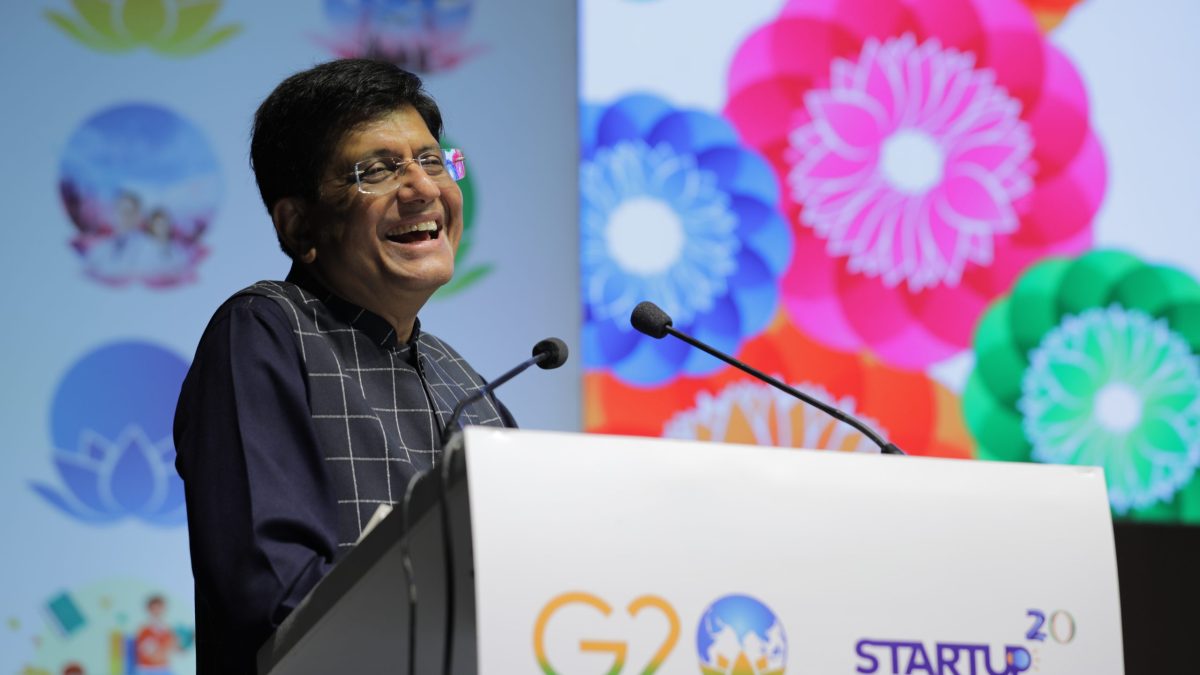
Commerce Minister Piyush Goyal said on 26 October, speaking at the India-Netherlands Business Forum in The Hague, that India and the United States have "concluded most of the discussions" on their trade deal and are now "fine-tuning the agreement." Trump has also said the two countries were "pretty close" to a deal. No agreement has been signed. The only document agreed so far is a framework for an interim deal announced in a joint statement on 6 February, in which Washington set a reciprocal tariff of 18 percent on Indian goods. With US tariff law in flux and the oil trade under scrutiny, exporters want to know how close the deal really is.
The case for the deal is based on trade that is already large and growing. India's merchandise exports to the United States rose 11.1 percent to $50.81 billion in April-September 2026, from $45.73 billion a year earlier, according to Commerce Ministry data presented on 15 October, and the United States remained India's largest export destination. Commerce Secretary Rajesh Agrawal said the negotiations were "in the right direction" and that India wants the preferential market access a deal would give. Under the February framework, the US would remove its reciprocal tariff on goods such as generic medicines, gems and diamonds and aircraft parts, while India would cut tariffs on US industrial goods and many farm products. India also said it intends to buy $500 billion of American goods over five years.
The case against moving fast is that the terms are still moving. Agrawal said signing depends on Washington finalising its wider tariff structure, which is being rebuilt under Section 301 after the US Supreme Court ruled on 20 February that the emergency-powers law could not be used to impose tariffs. According to a legal analysis by ATB Legal, a 10 percent Section 301 duty has applied to most Indian goods since 24 July, and the US trade representative said on 1 October that the deal was in its "short strokes" but "not imminent." Exports are also rising without a deal: imports from the US grew faster, by 26 percent to $32.33 billion, and India's surplus fell to $18.48 billion from $20.07 billion. A $500 billion pledge over five years implies about $100 billion a year of purchases, about 55 percent more than the April-September import figure of $32.33 billion would give over a full year, by simple arithmetic.
The outcome matters for exporters of textiles, electronics, engineering goods and chemicals, who sell most heavily to the American market and need clarity on duties before they commit to orders. A signed agreement would give them a lower, more predictable tariff than rivals face, which is the competitive edge Goyal has said India needs. A prolonged delay would leave firms facing uncertainty at a time when higher energy costs and a weaker rupee are already raising their expenses. It would also affect how India balances its energy imports and its ties with Washington.
Goyal's comments suggest the deal is close, but the signature is still missing. Until the text is signed and the US sets out its tariff rate in law, exporters will have to plan around promises, not rules.
Featured image: Commerce Minister Piyush Goyal speaking at a G20 event in Gurugram in 2023 (file photo). Photo: Shariquejamalworld, CC BY-SA 4.0, via Wikimedia Commons.


Leave a Reply