
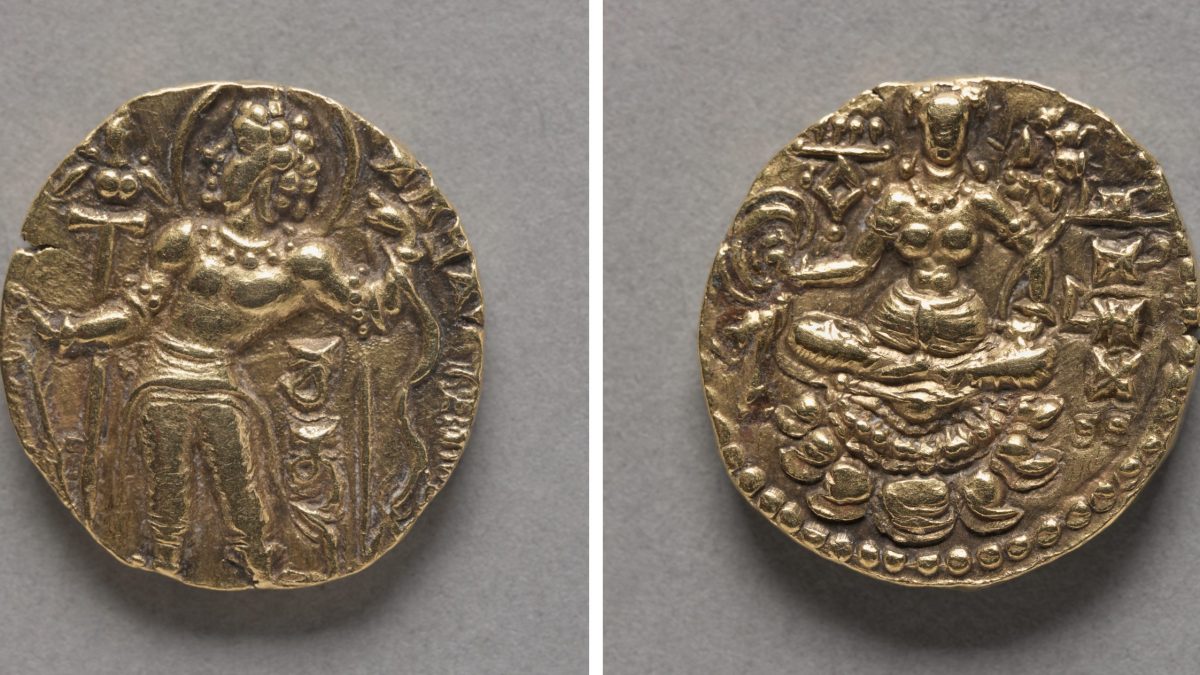
The Gupta Empire ruled much of northern India from the middle of the third century to the middle of the sixth century CE. Many historians have called its time a golden age, for its achievements in literature, mathematics, astronomy, art and architecture, though others dispute the label. It was founded by a ruler named Gupta, and reached its height under Samudragupta, Chandragupta II and Kumaragupta I.
Quick Facts
| Period | Mid 3rd century to mid 6th century CE |
| Capital | Pataliputra (and later Ayodhya, in some accounts) |
| Great rulers | Samudragupta, Chandragupta II (Vikramaditya), Kumaragupta I, Skandagupta |
| Known for | Kalidasa, Aryabhata, Gupta temples, Ajanta paintings, Nalanda |
| Decline | Hun invasions and loss of territory to former feudatories |
The Rulers
- **Chandragupta I:** the first major ruler of the line, who married into the Licchavi family
- **Samudragupta (c. 335–375):** a great conqueror, celebrated in the Allahabad Pillar inscription composed by his courtier Harishena; later writers have called him the Napoleon of India, though that is an interpretation
- **Chandragupta II, Vikramaditya (c. 375–415):** defeated the Western Kshatrapas of Gujarat and Malwa, extended the empire to the Arabian Sea, and presided over a flourishing court
- **Kumaragupta I:** ruled in peace for decades, and is traditionally linked with the founding of the Nalanda monastery
- **Skandagupta:** held off the Hun invasions in the mid-fifth century
Culture and Science
Epics such as the Mahabharata and Ramayana, and the Puranas, were put into written form in this period. The poet and dramatist Kalidasa wrote at a Gupta court, though exactly which one is not settled. The mathematician and astronomer Aryabhata wrote the Aryabhatiya in 499 CE, setting out an approximation of pi and the idea that the Earth rotates on its axis, and Varahamihira and Vatsyayana also worked in this age. The iron pillar at Delhi, which has resisted rust for about 1,600 years, is usually dated to this time. The rock-cut caves and wall paintings of Ajanta belong largely to the Gupta and Vakataka era, and temples in brick and stone set the form of later Hindu architecture.
An Account by a Visitor
The Chinese Buddhist monk Fa-Hien (Faxian) travelled in India around 399 to 414 CE. He described a prosperous and mild administration, with few harsh punishments and a free population. His account, like all such sources, reflects a pilgrim’s view and not the whole country.
The ‘Golden Age’ Debate
Historians who accept the term point to the cultural achievements and to the political order. Others argue that the empire controlled less territory than the Mauryas, that much of its authority rested on feudatories, and that the period of the Gupta Empire was not uniformly prosperous, and that regional kingdoms in the south, such as the Pallavas, were also creative.
Decline
In the later fifth century the Hunas, nomads from Central Asia, invaded the north-west. The empire lost territory to the Huns and to its own feudatories, and the main line ended in the middle of the sixth century. For the earlier empire, see Chandragupta Maurya and Ashoka; for Nalanda, the Nalanda Mahavihara.
Featured image: A gold coin of the Gupta emperor Chandragupta II showing the king as an archer. Photo by anonymous, licensed under CC0, via Wikimedia Commons.

Leave a Reply