Anna Modayil Mani (23 August 1918 – 16 August 2001) was an Indian physicist and meteorologist who made India self-reliant in weather instruments. She standardised the designs of about a hundred instruments, built the country’s networks for measuring solar radiation and ozone, and mapped its potential for solar and wind power long before renewable energy was fashionable.
Quick Facts
| Full name | Anna Modayil Mani |
| Born | 23 August 1918, Peermade, Travancore (now in Kerala) |
| Died | 16 August 2001, Thiruvananthapuram (aged 82) |
| Field | Physics, meteorology |
| Education | Presidency College, Madras (B.Sc. Honours, 1939); Indian Institute of Science; Imperial College London |
| Known for | Indian-made weather instruments; solar radiation and ozone measurement; wind energy surveys |
| Position | Deputy Director-General, India Meteorological Department (retired 1976) |
| Honours | K. R. Ramanathan Medal of the Indian National Science Academy (1987) |
Early Life
She was born at Peermade in the hills of Travancore, the seventh of eight children of a prosperous Syrian Christian family. Her father was a civil engineer who owned cardamom estates. She was a voracious reader; by twelve she is said to have read nearly every book in the local public library. On her eighth birthday she declined the customary gift of diamond earrings and asked for a set of the Encyclopaedia Britannica.
As a child she was moved by Mahatma Gandhi‘s visit to Travancore during the Vaikom satyagraha, and she wore khadi for the rest of her life.
Education
She wanted to study medicine but chose physics, graduating with honours from Presidency College, Madras, in 1939. The following year she won a scholarship to the Indian Institute of Science in Bangalore, where she worked in the laboratory of C. V. Raman on the spectroscopy of diamonds and rubies. She recorded the light they gave off at different temperatures, often working through the night, and published five papers.
She submitted her dissertation to Madras University in 1945. The university refused her the doctorate because she did not hold a master’s degree. The dissertation is preserved at the Raman Research Institute. She never received a Ph.D.
Career
Instruments
A government scholarship took her to Imperial College London in 1945, where she specialised in meteorological instruments. She joined the India Meteorological Department at Pune in 1948. India then imported even simple instruments such as rain gauges and barometers. Leading a division of more than a hundred people, she had the instruments designed, standardised and manufactured in India.
Sun and ozone
For the International Geophysical Year of 1957–58 she set up a network of stations to measure solar radiation across India. She developed an Indian ozonesonde, a balloon-borne instrument for measuring ozone, which made India one of the few countries with its own; it was later used at India’s Antarctic station. She also set up the meteorological tower and instruments at the Thumba rocket launching station for Vikram Sarabhai.
After retirement
She retired as Deputy Director-General in 1976 and worked for some years as a visiting professor at the Raman Research Institute. Her two reference works, the Handbook of Solar Radiation Data for India (1980) and Solar Radiation over India (1981), are still used by engineers. She then organised surveys of wind speeds at hundreds of sites, which guided the placing of India’s first wind farms, and ran a small company in Bangalore making instruments for wind and solar measurement.
Views
She disliked being singled out as a woman scientist, saying that her being a woman had no bearing on what she chose to do with her life.
Personal Life
She never married. Her pastimes were trekking and birdwatching. A stroke in 1994 left her immobile, and she died in Thiruvananthapuram in 2001.
Legacy
The World Meteorological Organization published a profile of her on her centenary, and she is widely called the Weather Woman of India.
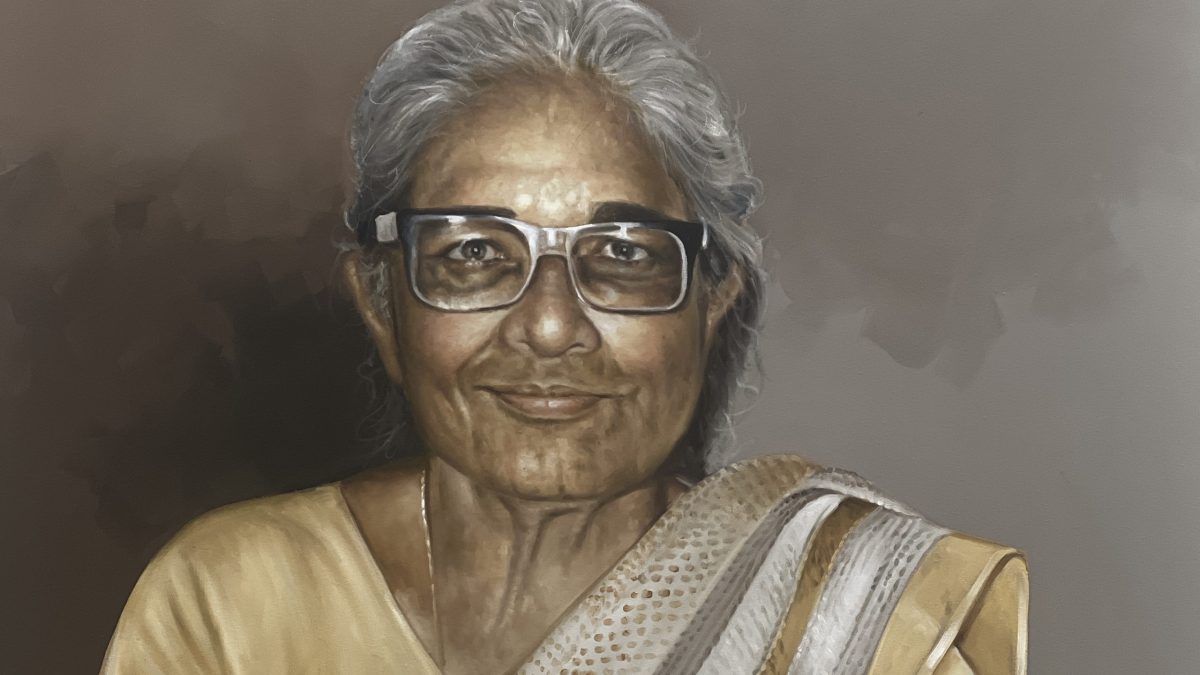
Featured image: Anna Mani in an oil portrait by Rajasekharan Parameswaran. Photo by Rajasekharan Parameswaran, licensed under CC BY-SA 4.0, via Wikimedia Commons.