
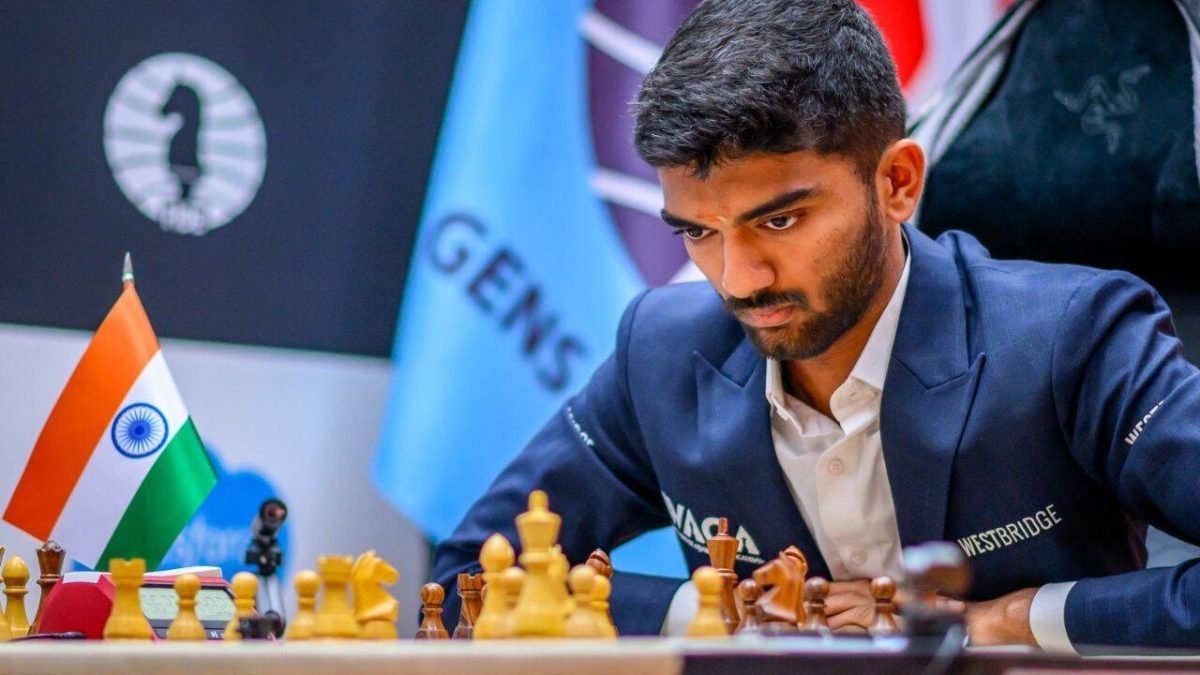
Nothing has separated D. Gukesh and Javokhir Sindarov after three games of the World Chess Championship in Geneva. The scores are tied at 1.5-1.5, with three consecutive draws, as the 14-game match enters its first rest day on Friday, 27 November 2026. The twist from Game 3, played on 26 November, is that the defending champion, Gukesh, came out of it with the better of the psychological exchange: Sindarov, the challenger from Uzbekistan, admitted at the post-game press conference that he had been out-prepared. "Today my opponent was really well prepared," he said. "We checked this move 5…Be7, but not that deep. I was surprised." The match resumes on Saturday, 28 November, with Game 4.
The context makes the quiet start more interesting than it might look. This is the youngest world title match in history: both players are 20 years old. Gukesh, from Chennai, is defending the crown, while Sindarov is the challenger. The Hindu's coverage describes the match as a battle of preparation, seconds and futures, and the decision of the winner will stand as the world champion for the next two years, according to the paper's report on the second game. After three games, neither player has had a decisive advantage, which matches Gukesh's own assessment of the first two games: "In the first two games, neither of us really got them," he said of chances. "That is pretty expected because, obviously, we spent a lot of months preparing."
Game 1, played on 24 November, was the most dramatic of the three. Gukesh, with Black, chose the Berlin Defence, a solid option that The Hindu recalls Viswanathan Anand playing against a computer before he had won any of his world titles, and the game, featuring a same-coloured-bishop ending, ended in a draw by threefold repetition after 38 moves. It had intense phases, and Gukesh battled the clock for much of it before holding the draw. The first game also had a procedural moment: the arbiter had to point out to Sindarov that his claim of a draw was slightly premature.
Game 2, on 25 November, was a quieter affair. Gukesh, with White for the first time, began with the London System, an opening used in the previous title match by his predecessor, Ding Liren of China, who played it twice in Singapore, with both games drawn. Sindarov again moved ahead on the clock, and Gukesh spent a long time on his 16th move, an f-pawn push, falling behind by more than half an hour. But once he brought his dark-squared bishop into play the position was balanced, and both players repeated moves. The game was drawn after just 20 moves, with Sindarov this time claiming the draw correctly. As The Hindu put it, "when the peace treaty was signed in Geneva — how appropriate! — much of the ammunition still remained on the board."
Game 3 was different in character. Gukesh, with Black, played in a way that surprised his opponent in the opening: for the first time in the match he was seen blitzing out his moves, while Sindarov, with White, stayed in his chair for long stretches trying to work out the position. Sindarov said Gukesh seemed to know his preparation "until around the 15th move" and that he spent a lot of time in the opening. "I think it was most stressful for him, because I always had enough time on the clock," Gukesh said, though he acknowledged it was "a little stressful when he had about 7 seconds for the last move". He credited his team for the line: "A lot of credit to my team, who prepared this line." The Indian also admitted that his position had awkward moments: "My bishop is kind of offside, and my rook is on a4… if kingside action starts, my pieces are not perfectly placed for the action." In the endgame, Sindarov said, he began to understand the position was "completely equal", and that in the time trouble he was "really very close to missing something", though he was "happy that I defended very well."
What do the draws tell us? The case that they are a good sign for Gukesh rests on preparation and the clock. He has not been outplayed in any of the three games, he spent less time than his opponent in Game 3, and the champion's team seems to have brought a line that his challenger had not analysed deeply. Sindarov's frank admission that he was surprised is the sort of remark that suggests the pressure sits with the player who has to find new ideas. The Hindu's reporting also shows that Gukesh has twice been behind on the clock early in games, so the same factor that helped him in Game 3 has hurt him in Games 1 and 2.
The case for caution is that three draws in a 14-game match decide very little. Gukesh himself made the point: "Three draws sound like a big thing, but it's in the context of 14 games, so we're not even anywhere close to halfway. It's a long match." Sindarov echoed him, saying he was not thinking much about the scores and that there is "always pressure in every game of the match". Both players said the quality of play was high. "We try to create chances and make the most out of them, but so far none of us really got too many big chances," Gukesh said. "It usually means that we are playing good chess."
There is another storyline off the board. Both players have spoken about the new "fast classical" time control, which gives 45 minutes plus a 30-second increment. Gukesh said he finds it "weird to call it classical, and especially to have it rated as classical", pointing to a blunder by R. Praggnanandhaa that counted for his classical rating. Sindarov agreed that "45 plus 30 is neither rapid nor classical: it is something in the middle", saying it makes players nervous because "from the start, you feel that you have a lot of time, but then the time goes very fast". These comments are about other events and not about the title match, but they show how the players view the sport's evolving formats while they compete for its biggest prize.
What should readers watch for? Game 4 on Saturday will be the first test after the rest day, and the choice of opening by each side will show whether Sindarov has changed his preparation after being caught on 5…Be7. The clock will remain a key factor, since the younger challenger has moved ahead on time in each of the first two games. And the first decisive result, when it comes, will change the psychology of a match that has so far been defined by caution. For India, whose fans are watching a home-grown champion defend his title against a rival of the same age, the picture is encouraging but far from settled: the champion looks well-prepared, the challenger looks resilient, and 11 games remain.


Leave a Reply