Kumar Shri Ranjitsinhji (10 September 1872 – 2 April 1933), known to the cricketing world as Ranji, was an Indian prince who played Test cricket for England and is counted among the greatest batsmen in the history of the game. He brought to batting new strokes, the leg glance above all, and a wristy, back-foot style that astonished Victorian England. From 1907 he was the ruler of the state of Nawanagar in Kathiawar. India’s first-class championship, the Ranji Trophy, bears his name.
Quick Facts
| Full name | Ranjitsinhji Vibhaji Jadeja |
| Title | Maharaja Jam Sahib of Nawanagar (1907–1933) |
| Born | 10 September 1872, Sadodar, Kathiawar (now Gujarat) |
| Died | 2 April 1933, Jamnagar (aged 60) |
| Education | Rajkumar College, Rajkot; Trinity College, Cambridge |
| Sport | Cricket |
| Tests | 15 for England (1896–1902); 989 runs, average 44.95 |
| First-class | 24,692 runs, average 56.37; 72 centuries |
| Teams | Cambridge University, Sussex, London County |
| Honours | Wisden Cricketer of the Year (1897) |
Early Life
He was born in the village of Sadodar into a branch of the ruling Jadeja Rajput family of Nawanagar. The ruler, who had disinherited his own son, selected the boy as his heir, though the adoption was never completed, and when a son was later born to one of the ruler’s wives Ranjitsinhji was set aside. He was educated at the college for princes at Rajkot, where the English headmaster taught him cricket.
Cambridge and Sussex
He went to England in 1888 and to Trinity College, Cambridge. He was slow to win recognition; it was said that the university captain was reluctant to pick an Indian. He practised for hours each day against hired professional bowlers, and won his Blue in his last year, 1893.
He joined Sussex in 1895 and made 77 and 150 on his debut, at Lord’s. In partnership with C. B. Fry he made the county’s batting the wonder of the age.
Test Cricket
In 1896 the question of whether he should play for England against Australia was openly argued; he was left out of the first Test. Chosen for the second, at Manchester, he made 62 and 154 not out, the second innings including a hundred runs before lunch on the third morning. On the tour of Australia in 1897–98 he made 175 in his first Test there.
In 1899 he became the first batsman to score three thousand runs in an English season, and he did it again in 1900. He played fifteen Tests in all.
The Batsman
English batsmen of the time played forward and hit the ball in front of the wicket on the off side. Ranjitsinhji played back, watched the ball on to the bat and, with a turn of the wrists at the last instant, deflected fast bowling fine on the leg side. The leg glance was his invention. He cut late and square with the same ease. A contemporary wrote that he never made a Christian stroke in his life.
He was slight, wore his silk shirt buttoned at the wrist and fluttering in the breeze, and became one of the most famous men in England. The Jubilee Book of Cricket, published under his name in 1897, was the standard book on the game for a generation.
Jam Sahib
The young ruler of Nawanagar died in 1906, and after a disputed succession the British recognised Ranjitsinhji. He was installed in March 1907. He had lived extravagantly in England and was deep in debt, and the state was poor and plague-ridden.
In time he proved a capable ruler. He rebuilt the capital, Jamnagar, with wide streets, developed the port of Bedi, built a railway, roads and irrigation works, and improved the state’s finances. He served in the First World War on the staff in France, lost his right eye in a shooting accident in Yorkshire in 1915, represented India at the League of Nations, and was Chancellor of the Chamber of Princes.
He remained attached to the British connection and was criticised by nationalists for it.
India
He did nothing for Indian cricket. He did not play in India beyond a few minor matches, took no part in founding its board, and discouraged his nephew Duleepsinhji, also a great batsman, from playing for India, remarking that they were English cricketers. Yet his example, an Indian who had beaten the English at their own game, meant a great deal to Indians of his time.
Death
He died at Jamnagar on 2 April 1933. He never married. The following year the Indian board founded a national championship, and the Maharaja of Patiala gave a trophy in his memory.
India’s own first Test captain was C. K. Nayudu.
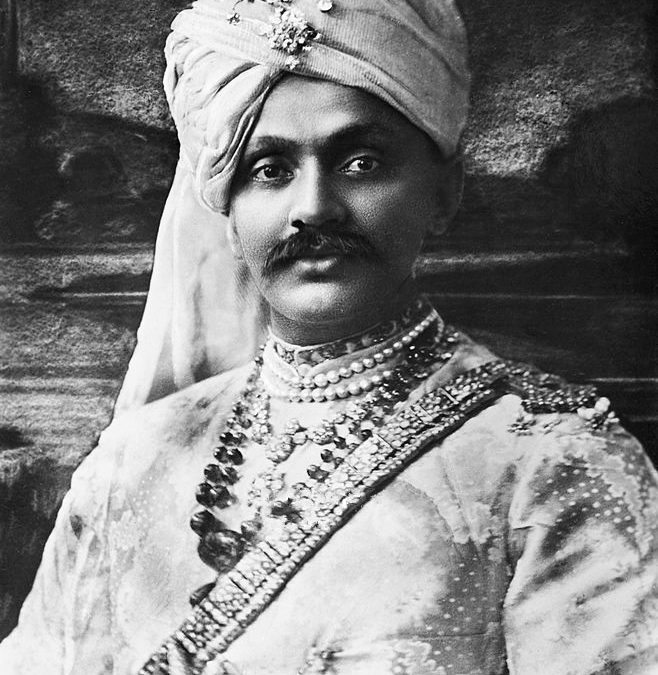
Featured image: Ranjitsinhji as Jam Sahib of Nawanagar, about 1908. Photo by an unknown photographer, in the public domain, via Wikimedia Commons.